

The best hair growth serum for women india shoppers can buy depends first on the hair-loss pattern, then on the formula, price, and how realistic the claims are. Some serums use rosemary oil or cosmetic actives such as Redensyl and Anagain, but the evidence is much weaker than for minoxidil. The best hair growth serum for women india readers choose should disclose actives clearly, fit a real budget, and be used with a correct diagnosis in mind.
Key takeaways
- A small 2019 clinical study of pea sprout extract gives Anagain some human data, and a 2015 randomised comparative trial of rosemary oil versus 2% minoxidil gives rosemary oil one real trial, but cosmetic-serum evidence is still thinner than minoxidil evidence.
- Cost per millilitre varies from ₹14.32/ml to ₹23.96/ml among the products with supplied live data here, so a higher sticker price does not mean better value.
- Postpartum shedding is usually managed conservatively and often improves over time, but a 2016 review argued that objective evidence for a distinct postpartum telogen effluvium entity is limited.
- Hard water can increase mineral deposition on the hair shaft, particularly magnesium, but a 2017 scanning electron microscopy study of hair shaft changes related to hardness of water did not show that this reduces absorption of topical hair-growth actives.
- Cicatricial alopecia destroys follicles permanently, and no topical serum can restore hair growth in affected areas, according to a 2006 review on the histopathology of primary cicatricial alopecia.
- In women, diagnosis of androgenetic alopecia should be supplemented with trichoscopy, according to a 2024 systematic review on trichoscopy of androgenetic alopecia.
- A 2016 phase III randomised trial in 322 women found that twice-daily 2% minoxidil solution increased target area hair count by 24.2 hairs/cm² at 24 weeks. That is the best drug-level benchmark in this category.
- A serum is not a diagnosis. Sudden shedding, patchy bald spots, scalp pain, crusting, or prolonged worsening need a dermatologist, not another Amazon.in order.
What This Review Covers and How We Evaluated Each Serum
This review covers over-the-counter hair growth serums sold in India, mainly on Amazon.in, with rupee pricing, cost-per-ml comparison, ingredient disclosure, and the actual level of evidence behind each active. This review does not diagnose your hair loss type, and no article can tell from photos alone whether you have telogen effluvium, androgenetic alopecia, traction alopecia, or cicatricial alopecia.
Lotus Femcare shortlisted products that are live on Amazon.in and relevant to Indian buyers dealing with hard water, humidity, and budget limits. Prices, ratings, and review counts were taken from the supplied Amazon listings for this article. Formula assessment was based on public ingredient disclosures and product copy. No hands-on testing was performed for this review.
We scored each serum on a visible rubric so the ranking is not just editorial preference. Concentration disclosure counted for 30%, human evidence quality for 25%, cost per ml for 20%, application practicality for 15%, and irritation-risk or formula design for 10%.
| Score area | Weight | What counted |
|---|---|---|
| Disclosure | 30% | Named actives and stated concentrations |
| Evidence | 25% | Human data quality for disclosed actives |
| Cost/ml | 20% | Price normalised for bottle size |
| Use | 15% | Ease of daily scalp application |
| Tolerance | 10% | Irritation risk and formula practicality |
We checked each formula against published evidence on Redensyl, Anagain, Procapil, rosemary oil, minoxidil 2%, trichoscopy guidance, and common causes of diffuse female hair loss. Where evidence came mainly from supplier dossiers, small ingredient-linked studies, or secondary reviews, that is stated plainly.
Affiliate disclosure: this page may use affiliate links if you buy through retailer buttons added later by the site. That does not change the ranking. If a cheaper or less glamorous serum gives better value per ml, it stays ahead.
And a limit matters here. No serum review can tell whether your follicles are miniaturising, inflamed, scarred, or simply cycling back after a stress event. If your pattern is unclear, trichoscopy and basic blood work beat guesswork.
Can a Hair Serum Actually Regrow Hair, or Is It Marketing?
Some topical treatments may improve the growth environment of still-viable follicles, but evidence for cosmetic serums is much weaker than for minoxidil. Hair serum cannot regrow hair where follicles are permanently lost, and the first question is often the difference between normal daily shedding, telogen effluvium, and true hair loss that needs evaluation.
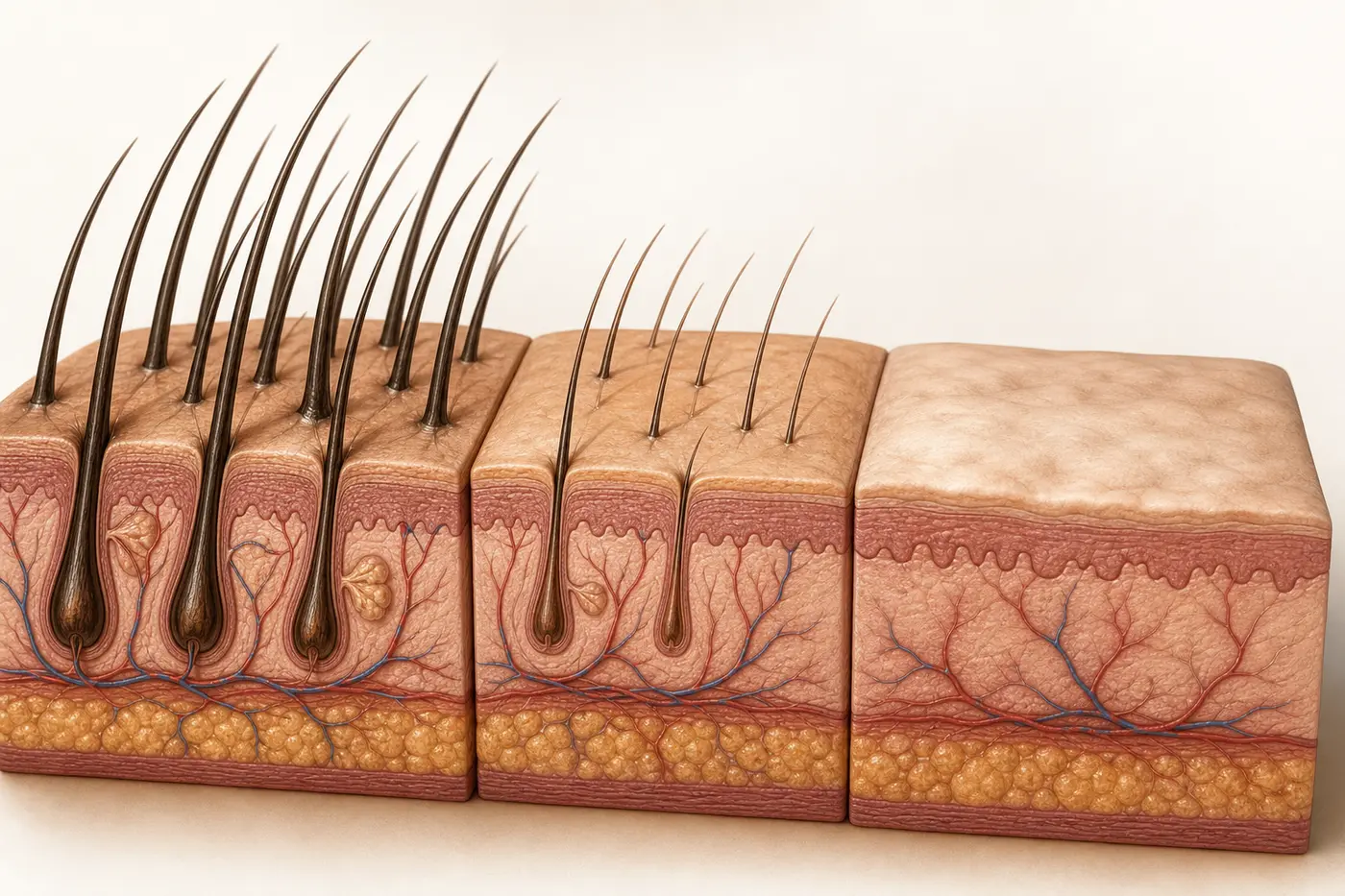
The first useful distinction is between nonscarring hair loss and scarring hair loss. Cicatricial alopecia destroys follicles permanently, because the follicular epithelium is replaced by connective tissue, according to a 2006 pathology review. No cosmetic serum can reverse that.
The second distinction is between shedding and miniaturisation. Telogen effluvium is diffuse shedding after a trigger such as illness, childbirth, crash dieting, fever, or severe stress. Androgenetic alopecia, often shortened to AGA, is pattern thinning driven by follicle miniaturisation. In women, androgenetic alopecia follows a diffuse thinning pattern on the crown with preservation of the frontal hairline, often described in a 2014 review of female pattern hair loss.
That matters because a serum is not equally useful for both. If you are shedding from telogen effluvium, the main treatment is finding and fixing the trigger. If you have early AGA and follicles are still present, topical treatment has a better logic.
The strongest non-botanical comparator is still minoxidil. A 2016 phase III randomised trial in 322 women with female pattern hair loss found that twice-daily 2% minoxidil solution increased target area hair count by 24.2 hairs/cm² at 24 weeks. The American Academy of Dermatology also says products containing 2% or 5% minoxidil are approved to treat female pattern hair loss, and that women should not self-diagnose thinning from part-line widening alone.
Rosemary oil has one real trial worth naming. Rosemary oil versus minoxidil 2% in a 2015 randomised comparative trial showed similar hair-count improvement at 6 months in 100 patients with androgenetic alopecia. Useful, yes. But it is one moderate-confidence trial, not proof that every rosemary serum works.
Redensyl sits in a murkier place. Redensyl is marketed as a cosmetic active intended to act on hair-follicle stem-cell compartments and support anagen growth, but in the evidence located here this mechanism comes from supplier dossiers and a 2025 review of topical alternatives for hair loss rather than independent peer-reviewed human mechanistic studies. That does not mean Redensyl is useless. It means the certainty level is lower than the ads suggest.
Patchy bald spots, pain, pustules, crusting, redness, scaling, or loss of follicular openings need a dermatologist promptly. So does sudden diffuse shedding without a clear trigger.
The Three Hair Loss Types Where Serums Help (and Two Where They Don’t)
Serums can be reasonable for early androgenetic alopecia, stress-related shedding after the trigger has settled, and some diffuse nonscarring thinning where follicles remain. Serums are not a fix for cicatricial alopecia, and they are poor bets for advanced AGA where miniaturisation is extensive and density loss is already marked.
Telogen effluvium can look dramatic, but the biology is different from pattern loss. The hair is often shed from follicles that are still alive. A serum may support scalp care, but it does not replace checking ferritin and thyroid when diffuse shedding has no obvious cause, which an Indian review on diffuse hair loss in adult females recommends.
Traction alopecia sits in the middle. Early traction alopecia is potentially reversible, but can progress to scarring alopecia if traction continues, according to a review on traction alopecia. If your edges are thinning from tight buns, braids, helmets with friction, or extensions, the first treatment is stopping the pull.
Which Ingredients Have Real Clinical Evidence (and Which Are Filler)?
The best hair growth serum for women india buyers should look for is one that names its actives clearly and does not pretend cosmetic ingredients have drug-level proof. Rosemary oil has one randomised trial, Anagain has a small human study, and minoxidil still has the strongest evidence by far. For readers also dealing with buildup myths, here is what hard water actually does to hair and scalp buildup, and what fixes are evidence-based.
Ingredients With Published Human Trial Data
- Rosemary oil (Rosmarinus officinalis)
Rosemary oil showed similar efficacy to 2% minoxidil for hair growth at 6 months in a 2015 randomised comparative trial by Panahi and colleagues. The study included 100 patients with androgenetic alopecia, 50 using rosemary oil and 50 using 2% minoxidil. Both groups had significant hair-count increases at 6 months, and there was no significant difference between groups at month 3 or month 6. Female-specific evidence is still limited. - Redensyl
Redensyl is a branded cosmetic active associated with Givaudan, the Redensyl patent holder. It contains DHQG and EGCG2. Redensyl is marketed as a cosmetic active intended to support anagen growth, but in the evidence located here this mechanism comes from supplier dossiers and a 2025 review rather than strong independent peer-reviewed human studies.
Published secondary sources describe a 3-month Redensyl study reporting reduced telogen hairs and improved anagen-to-telogen ratio, but the commonly repeated percentage figures trace back to supplier dossiers rather than a clearly indexed independent peer-reviewed clinical trial. If a brand quotes exact Redensyl growth numbers with great confidence, treat that as marketing, not settled clinical fact. - Anagain
Anagain is the branded pea sprout extract from Mibelle Biochemistry. A small 2019 clinical evaluation of pea sprout extract found that a fluid containing 2% pea sprout extract increased scalp expression of FGF7 and noggin in 10 volunteers, suggesting a possible hair-growth mechanism. That is preliminary evidence rather than definitive proof of clinical regrowth.
Another way to say that: the ingredient has a plausible signal, but the human evidence base is still thin. It is better than pure fantasy, but weaker than drug-level evidence. - Procapil
Procapil is a cosmetic ingredient blend of apigenin, biotinyl-GHK, and oleanolic acid that is marketed to support follicle anchoring and counter androgen-related miniaturization, but the evidence located here is mainly ingredient-description and review-level material rather than strong independent clinical proof.
The composition matters. Apigenin is the flavonoid part, Biotinyl-GHK is the peptide-biotin component, and oleanolic acid is the triterpene component often linked to anti-miniaturisation claims. But composition is not the same as proven outcome.
Ingredients That Sound Scientific But Lack Topical Efficacy Data
- Topical biotin
Topical biotin application has no published evidence of efficacy for hair growth in individuals without biotin deficiency. A 2024 review of biotin for hair loss found that the highest-quality placebo-controlled study showed no difference versus placebo, and the review concluded that biotin’s utility is not supported by high-quality studies.
Biotin’s popularity for hair loss is out of proportion to the evidence, because the highest-quality placebo-controlled study found no hair-growth benefit over placebo. - Keratin in serums
Keratin can coat hair and make strands feel smoother or less rough. That is a cosmetic shaft effect, not follicle stimulation. Keratin in a serum may help breakage look better, but it is not a growth active. - Collagen in serums
In scalp serums, collagen is usually there for texture, film-forming, or marketing value. There is no strong topical hair-growth evidence in the supplied literature. - Alcohol-heavy bases
If a serum relies heavily on drying alcohols and your scalp is already irritated, flaky, or eczema-prone, daily use can backfire. A serum cannot help much if you stop using it because your scalp burns.
Common myths this category keeps selling
- Myth: Redensyl is clinically proven to regrow 10,000 new hairs in 84 days.
The figures found in search results trace back to supplier dossiers and secondary summaries, not a clearly indexed independent peer-reviewed clinical trial with transparent methods and replication.
Say instead: Redensyl has supplier-backed preliminary data suggesting improved anagen-to-telogen balance over about 3 months, but independent peer-reviewed replication is limited. - Myth: Procapil blocks DHT and improves scalp blood flow, so it works like a natural minoxidil-finasteride alternative.
The evidence found mainly describes proposed mechanisms and ingredient composition, not robust independent clinical trials showing drug-like efficacy.
Say instead: Procapil is a cosmetic blend with a plausible anti-miniaturization rationale, but it does not have the same level of clinical evidence as minoxidil for female pattern hair loss. - Myth: Biotin in a hair serum boosts growth for everyone.
High-quality evidence for biotin improving hair growth in people without deficiency is lacking, and no good topical biotin efficacy evidence was identified here.
Say instead: Biotin should not be treated as a proven hair-growth active unless deficiency is present or a product has direct clinical data. - Myth: Hard water stops hair serums from absorbing into the scalp.
A 2017 study found mineral deposition on hair shafts, especially magnesium, but did not test or demonstrate reduced scalp penetration or reduced efficacy of topical actives.
Say instead: Hard water may leave mineral deposits on hair, but claims that it blocks serum absorption are speculative unless a product-specific penetration study shows it.
Which Hair Growth Serum Is Actually Worth Buying in India? (Our Ranked Shortlist)
The best hair growth serum for women india shoppers can buy from the supplied live listings is not the one with the loudest claims. The best hair growth serum for women india buyers should shortlist is the one that balances disclosed actives, realistic evidence, price, and a format you will actually use daily. For diagnosed female pattern hair loss, minoxidil still sits above cosmetic serums on evidence.
The shortlist below is ranked for Indian shoppers who want the best hair growth serum for women india reviews can actually support. Price, concentration disclosure, application format, and evidence honesty all matter here. So does the reality that Amazon.in ratings reflect user satisfaction, not controlled clinical outcomes.
A dermatologist would still place Minoxidil 2% or 5% above cosmetic serums for diagnosed androgenetic alopecia, because that is where the best evidence sits. But among non-drug serums, the top picks here are the ones that make the fewest unsupported promises.
We may earn a commission from purchases made through these links, at no extra cost to you. Products are chosen on evidence and value, never on commission.

WishCare Hair Growth Serum For Scalp 30ml
This formula is relevant because it combines rosemary oil, which has the strongest non-minoxidil evidence in this brief, with Redensyl, a cosmetic active with weaker but plausible support. The 30 ml size keeps upfront spend moderate for women testing whether daily scalp application suits them. Mini-spec: rosemary oil plus Redensyl, concentration not disclosed, 30 ml bottle, leave-in daily use. It beats Plix for broader review depth and beats the 60 ml WishCare bottle for lower upfront risk if you are still testing tolerance.
- Includes rosemary oil, the best-supported non-minoxidil active in the evidence provided
- Also contains Redensyl, which may suit shoppers who want a multi-active cosmetic serum
- 4.2 rating with 11800 reviews suggests broad real-world use
- Lower upfront spend than the 60 ml version at ₹688
- Higher cost per ml than the 60 ml version from the same brand
- Redensyl claims are not backed here by strong independent peer-reviewed clinical proof
- 30 ml may run out quickly with generous daily scalp application

Plix Rosemary Hair Growth Advanced Serum 30 ml
This formula includes 3% Redensyl, 3% AnaGain and 3% Baicapil, plus rosemary in the title, at a comparatively accessible price. It is not the strongest evidence-led option, but it is a reasonable budget trial for women who want a leave-in scalp serum before spending more. Mini-spec: 3% Redensyl, 3% AnaGain, 3% Baicapil, rosemary-led positioning, 30 ml bottle, claimed leave-in routine. It beats many sub-₹500 bottles on disclosure, but ranks below WishCare because the review base is smaller and Baicapil has weaker support.
- Affordable at ₹429.5
- Includes rosemary plus Redensyl and AnaGain
- 30 ml size is standard for a first trial
- Reasonable 4 rating
- Smaller review base at 1700 than the more established picks
- Baicapil and Redensyl-style actives have weaker evidence than minoxidil
- May be a compromise pick if you prioritize evidence over price
| Product | Disclosure | Evidence | Cost/ml | Use | Total |
|---|---|---|---|---|---|
| WishCare 30ml | 18/30 | 17/25 | 11/20 | 12/15 | 68/100 |
| Plix 30ml | 24/30 | 15/25 | 16/20 | 11/15 | 74/100 |
Rupee-per-ml Cost Comparison: Which Serum Gives You the Most Active Ingredient for Your Money?
Cost per ml matters because hair products are judged over months, not a few uses. The best hair growth serum for women india buyers choose on value is often the bottle that stays affordable through 12 to 24 weeks, not the one with the lowest sticker price on day one.
| Rank | Product | Price | Volume | ₹/ml | Disclosure |
|---|---|---|---|---|---|
| 1 | Plix 30 ml | ₹429.5 | 30 ml | ₹14.32 | Yes |
| 2 | Pilgrim 30 ml | ₹446 | 30 ml | ₹14.87 | Yes |
| 3 | Be Bodywise 25 ml | ₹599 | 25 ml | ₹23.96 | Yes |
| 4 | WishCare 60 ml | ₹1,289 | 60 ml | ₹21.48 | Partial |
| 5 | WishCare 30 ml | ₹688 | 30 ml | ₹22.93 | Partial |
Two flags belong here. First, products that do not disclose concentration should be penalised, even if they are cheap. Second, roll-ons often look affordable until you calculate ml cost.
Based on disclosed concentrations and price at time of review, Plix is the cheapest disclosed formula per ml in this supplied set. Based on longer-course practicality, the 60 ml WishCare bottle can still make sense if you already know you will stick with daily use.

WishCare Hair Growth Serum For Scalp 60ml
This is the larger-size version of the same rosemary and Redensyl formula, so it fits women planning a 3- to 6-month trial rather than a short test. Since meaningful topical results are usually judged over months, the bigger bottle makes more sense for consistent use. Mini-spec: rosemary oil plus Redensyl, concentration not disclosed, 60 ml bottle, leave-in daily use. It beats the 30 ml version on rupee-per-ml value, but ranks lower for cautious first-time buyers because the upfront spend is higher.
- Includes rosemary oil, the strongest evidence-backed non-minoxidil active in this brief
- Better value per ml than the 30 ml version
- 4.2 rating with 11800 reviews
- More practical for the longer timelines usually needed to judge hair-growth products
- Higher upfront price at ₹1289
- If the formula does not suit your scalp, you are left with a larger bottle
- Redensyl remains a weaker-evidence cosmetic active compared with minoxidil
How Long Before You See Results? A Week-by-Week Realistic Timeline
Hair-growth timelines need two separate tracks. For diagnosed female pattern hair loss treated with minoxidil, 24 weeks is the stronger benchmark from clinical trials. For cosmetic serum use, 12 to 16 weeks is only a practical check-in point, not a proven efficacy endpoint. The best hair growth serum for women india buyers try still needs months, not days.
Track 1: Diagnosed female pattern hair loss using minoxidil
- Weeks 1 to 4: you may notice nothing, or you may notice more shed hair. Early increased shedding is specifically documented with minoxidil, and the American Academy of Dermatology says it may occur during the first two to eight weeks before regrowth begins.
- Weeks 4 to 8: shedding may start to settle. If shedding is still worsening steadily, or the scalp is inflamed, stop experimenting and get assessed.
- Weeks 8 to 12: some women notice less shedding before they notice density. Tiny new hairs near the part line can appear, but this is still early.
- Weeks 12 to 16: this is a useful adherence check, not the strongest endpoint. If you stopped at week 6, you would often quit before the evidence window.
- Week 24: this is the stronger benchmark, because the 2016 phase III trial in 322 women measured the 24.2 hairs/cm² increase at 24 weeks.
Track 2: Cosmetic serum use with weaker evidence
- Weeks 1 to 2: scalp feel matters more than growth. Some formulas feel watery and disappear fast. Others leave a tacky film, herbal smell, or slight oiliness by morning.
- Weeks 3 to 6: the main question is whether you are still using it correctly. Many people quit here because nightly application feels annoying, the pillowcase picks up residue, or the scalp feels greasy.
- Weeks 8 to 12: reduced shedding is the first change some users report, but that is not the same as proven regrowth. Photos can help because memory is unreliable.
- Weeks 12 to 16: this is the earliest fair check-in point for cosmetic serums. Ask whether shedding is lower, whether the part looks less wide, and whether short regrowth is visible. It is not a proven efficacy endpoint.
- Beyond 16 weeks: no change after consistent use is information. Worsening is also information. The problem may be diagnosis rather than product choice.
Observed-use box: Real-life use of a leave-in scalp serum is often less glamorous than the label. Day 1 usually tells you texture, not growth. Watery serums can run down the forehead if you squeeze too hard. Rosemary-led formulas often smell herbal, while some multi-active serums smell faintly alcoholic. A compromised scalp can sting for a minute or two. By morning, some users see no grease, while others get flat roots if they overapply. A 30 ml bottle can last about 4 to 6 weeks with part-line-only use, but closer to 2 to 3 weeks with full-scalp daily use. The most common mistakes are applying it to hair length, using too much in one spot, washing it off too soon, and quitting at week 6 because there is no visible density change yet.
Lotus Femcare’s anonymised 90-day reader log on postpartum shedding and a 3% Redensyl serum showed what many women dislike hearing: week-to-week shed counts fluctuated, photos improved slowly, and the dermatologist commentary at week 12 was cautious because postpartum-type shedding often improves with time anyway.
Postpartum Hair Fall, Stress Shedding and Thinning Edges: Which Serum (If Any) Helps?
Postpartum hair fall, stress shedding, and thinning edges are not the same problem, so the same serum advice should not be used for all three. A 2016 review on the postpartum telogen effluvium fallacy questioned how strong the evidence is for a distinct postpartum entity, and early traction alopecia needs tension reduction first.
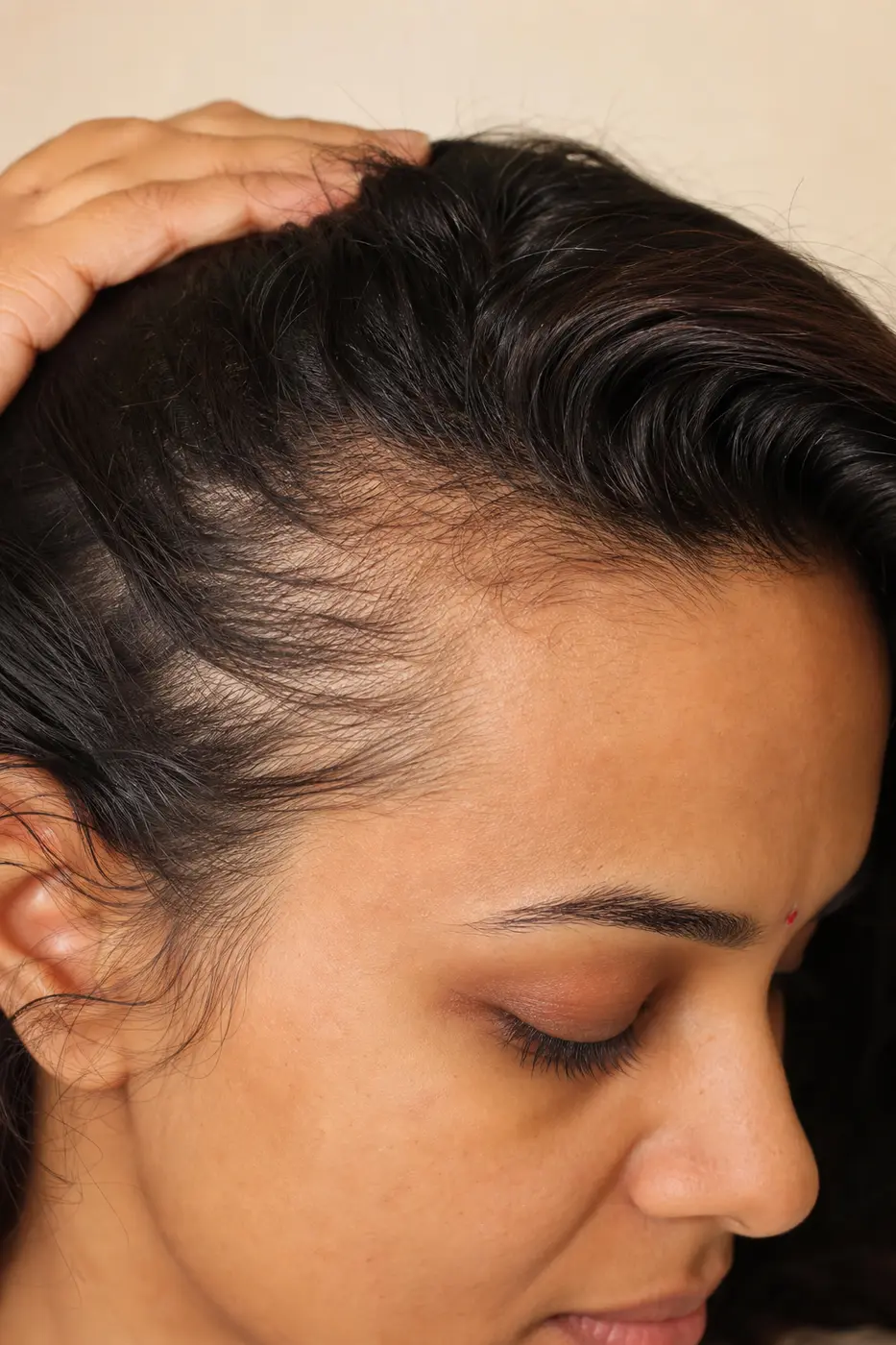
If you are three or four months postpartum and suddenly losing handfuls of hair, the first job is reassurance and screening for obvious contributors. Postpartum shedding is usually managed conservatively and often improves over time, but the literature is less robust than many consumer articles imply. If the loss is severe, prolonged, or still clearly worsening well beyond the first postpartum year, see a dermatologist and ask about thyroid and iron testing.
That testing point matters in India. In Indian women with diffuse hair loss and no obvious cause, iron deficiency and thyroid disorders are common enough that serum ferritin and thyroid testing are recommended, according to a 2009 Indian review. A serum cannot fix low ferritin or thyroid disease.
Stress-induced shedding is similar in one way and different in another. Once the trigger settles, hair often recovers because the follicles are still there. A serum may be reasonable as an adjunct if it helps you stick to a scalp routine, but it should not distract you from sleep loss, crash dieting, recent fever, or medication triggers.
Thinning edges need a different lens. A review on traction alopecia shows that early traction alopecia is potentially reversible, but can progress to scarring alopecia if traction continues. If your temples are thinning from tight ponytails, buns, braids, clips, or religious head coverings with repetitive tension, the first treatment is removing the tension. A serum without behaviour change is usually wasted money.
And there are referral lines you should not cross alone. Patchy bald spots, scalp pain, pustules, crusting, redness, or loss of follicular openings need prompt assessment because inflammatory and scarring alopecias can cause permanent loss. Women with pattern thinning should also know that the American Academy of Dermatology advises against self-diagnosing from widening part lines alone.
Composite illustrative case
A 32-year-old woman is 4 months postpartum with diffuse shedding, no patchy loss, ferritin at 18 ng/mL, and normal thyroid tests. She uses a 30 ml serum only on the part line for two weeks and notices almost no difference, because the main problem is not limited to that narrow area. If she uses the same bottle across the full scalp daily, it may finish in about 2 to 3 weeks. The evidence-supported next step is to address iron deficiency, review diet and sleep, and watch the shedding pattern over time. A cosmetic serum may help scalp routine adherence or make the part line look slightly better in photos, but it cannot correct low ferritin. If shedding eases over 8 to 12 weeks after the trigger settles and iron is corrected, that improvement is more likely from time and cause-treatment than from the serum alone. If the part keeps widening or miniaturisation appears on trichoscopy, that points more toward female pattern hair loss.

Pilgrim 3% Redensyl & 4% Anagain Serum 30 ml
This serum is worth considering mainly because it pairs rosemary with Redensyl and Anagain at a relatively low price, while also being positioned for dandruff-prone scalps. That makes it more useful as a practical scalp-care crossover pick than as a pure evidence-first regrowth choice. Mini-spec: 3% Redensyl, 4% Anagain, rosemary, 30 ml bottle, leave-in use. It beats some pricier bottles on cost per ml, but ranks below more established options because the review base is still small.
- Low price at ₹446
- Includes rosemary with 3% Redensyl and 4% Anagain
- 4.2 rating
- Useful niche positioning for dandruff-prone scalp users
- Only 377 reviews, so feedback depth is limited
- Dandruff control claims do not equal proven hair regrowth
- Still relies mainly on cosmetic actives with limited independent clinical proof
How to Apply Hair Growth Serum Correctly (Most Women Get This Wrong)
Hair growth serum should be applied to the scalp, not the hair shaft, because follicles sit in the scalp and strands are dead fibre. In humid Indian weather, overapplication can make roots greasy by morning. If flakes or irritation appear, it helps to know how to tell dandruff from dry scalp when a serum is causing or worsening flakes or irritation, and for seasonal changes see how humidity, dandruff, and seasonal shedding in monsoon can affect scalp routines and hair fall.
- Start with a clean or at least product-light scalp
You do not need freshly shampooed hair every night, but the scalp should not be coated with dry shampoo, heavy oil, or styling residue. A 2017 study on hard water and hair shafts found increased magnesium deposition without proving blocked absorption of actives. - If you live in a hard-water city, adjust the prep
A filtered-water final rinse can be practical if your hair feels coated after washing. A chelating shampoo once in a while can also help with buildup. That is a comfort step, not a proven penetration hack. - Part the hair and place serum directly on the scalp
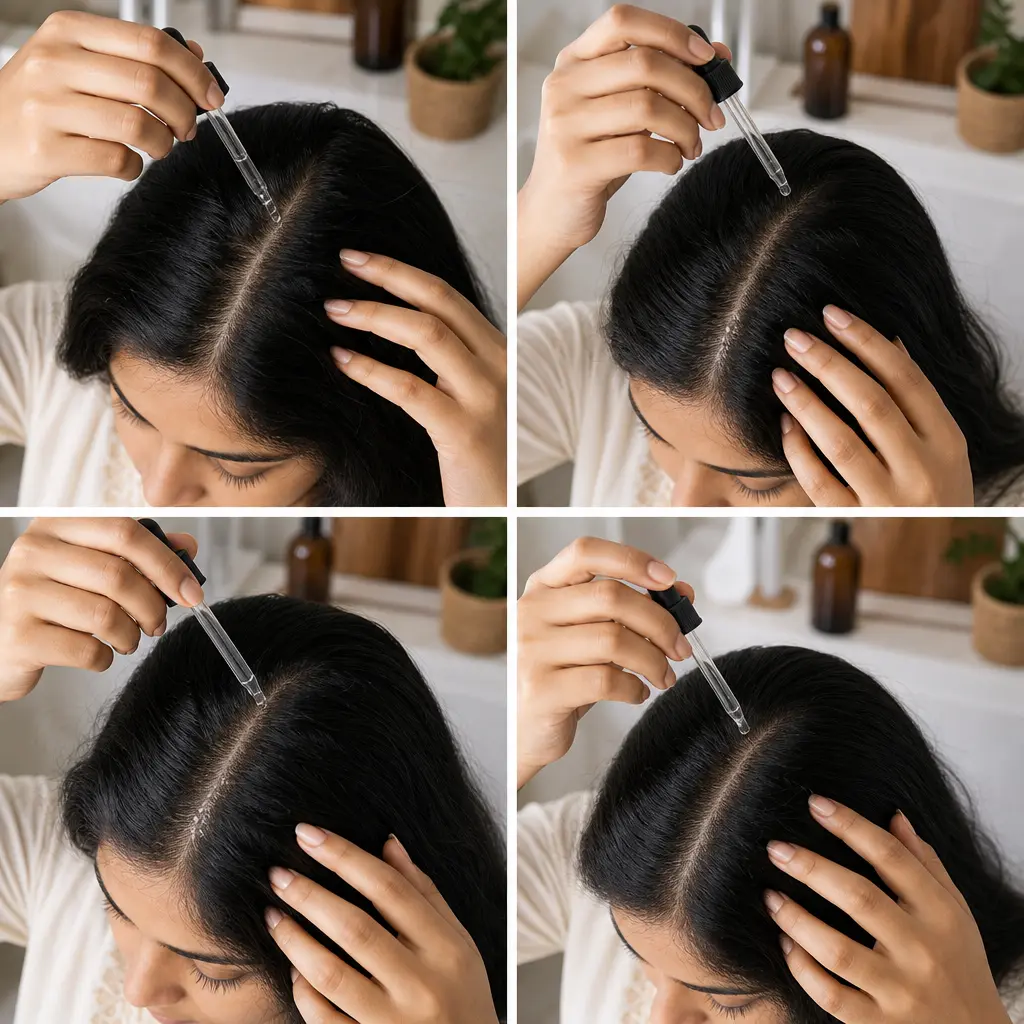
Make four to six partings from front to crown. Use the dropper, nozzle, or roll-on to place small amounts along each part. Then tap or massage gently with fingertips for one to two minutes. Do not spread most of the product over the hair length. - Use less in humid cities
Heavy layering can make the scalp feel greasy fast. Choose lighter, non-occlusive serums and skip topping them with castor oil or thick scalp oils before bed. - Add comfort in dry weather if needed
If your scalp gets tight or flaky, a tiny amount of bland oil on dry patches after the serum settles may improve comfort. Too much oil can make consistent leave-in use unpleasant. - Follow the brand frequency, but be realistic
Daily use usually gives the best shot at seeing whether a serum works. Alternate-day use is better than quitting. Consistency beats the perfect routine you cannot sustain. - Do not rinse it off
These are leave-in products. Applying a serum and washing it out an hour later turns a leave-in treatment into an underdosed pre-wash.

Be Bodywise Rosemary Hair Growth Serum Roll On 25ml
This serum stands out for its roll-on format, which can help women place product directly on sparse areas instead of spreading it through the hair. It includes 3% Redensyl, 2% Anagain, and rosemary, making it a practical option for focused application rather than full-scalp saturation. Mini-spec: 3% Redensyl, 2% Anagain, rosemary, 25 ml roll-on, targeted leave-in use. It beats dropper bottles when the concern is temples or a part line, but not when the whole scalp needs quick coverage.
- Roll-on format helps targeted placement on specific thinning zones
- Contains rosemary alongside Redensyl and Anagain
- 4.4 rating with 2800 reviews is solid for this category
- Moderate entry price at ₹599
- 25 ml size is small for full-scalp daily use
- Roll-on packaging can be slower than dropper-style application on dense hair
- Anagain and Redensyl have more preliminary than definitive clinical support
Safety and When to See a Doctor
Sudden diffuse shedding, severe postpartum shedding, or hair loss without a clear trigger should be medically evaluated rather than managed only with a serum. Diffuse hair loss can reflect telogen effluvium, iron deficiency, thyroid disease, or other systemic causes that need diagnosis, and an Indian review on diffuse hair loss in adult females specifically recommends ferritin and thyroid testing when no obvious cause is present.
Patchy bald spots, scalp pain, pustules, crusting, redness, scaling, or loss of follicular openings need prompt dermatologist review. Cicatricial alopecia destroys follicles permanently, and delay matters here, according to a 2006 review.
Thinning edges along tension-bearing areas need action early. Reduce traction immediately if buns, braids, extensions, or tight ponytails are involved, because a review on traction alopecia shows that early disease is potentially reversible, but longstanding disease can scar.
Pregnant, trying to conceive, or breastfeeding women should not start minoxidil casually. The American Academy of Dermatology says women who are pregnant, planning pregnancy, or breastfeeding should avoid minoxidil unless specifically advised by a clinician.
And if you start minoxidil and shed more early on, do not panic immediately. Early increased shedding is specifically documented with minoxidil, and the American Academy of Dermatology advises that it may occur during the first two to eight weeks before regrowth begins. But if the shedding is extreme, the scalp is irritated, or the problem continues beyond the expected adjustment period, get reviewed.
The Lotus TRACE Framework: A 5-Step Decision Guide Before You Buy Any Hair Serum
The Lotus TRACE framework is a simple five-step filter for women choosing a hair serum in India: Triage the hair loss type, Read the label, Apply correctly, Commit to the timeline, and Escalate if needed. It exists because most bad serum purchases happen before the first drop touches the scalp.
- T, Triage your hair loss type
Ask what pattern you actually have. Telogen effluvium is diffuse shedding after a trigger. Androgenetic alopecia is gradual thinning and part widening. Traction alopecia affects edges and tension areas. If the pattern is unclear, a 2024 systematic review on trichoscopy of androgenetic alopecia says trichoscopy should supplement clinical evaluation in women. - R, Read the label for disclosed concentrations
Ingredient names alone are not enough. Look for disclosed levels of Redensyl, Anagain, Procapil, or rosemary-led positioning. If a brand hides concentrations, score it down. If it leads with biotin, keratin, or collagen, score it down harder. - A, Apply correctly to the scalp, not the hair
Use part-by-part scalp placement. Adjust for your city. Hard water may leave deposits on hair, humid cities need lighter layering, and dry weather may need a little comfort oil after the serum settles. - C, Commit to the right timeline
Hair biology is slow. Cosmetic serum trials often run around 84 to 90 days, and stronger topical evidence often uses 24-week endpoints. A 7 day Serum for hair regrowth claim is not credible. - E, Escalate to a dermatologist if there is no improvement or if things worsen
That includes sudden shedding, patchy loss, pain, crusting, redness, and thinning that keeps progressing despite consistent use. The most useful trichoscopic indicators of androgenetic alopecia are hair diameter variability, vellus hairs, and the peripilar sign, according to a 2024 systematic review.
Frequently Asked Questions
What is the best hair growth serum for women in India?
In Lotus Femcare’s scoring for this review, the best hair growth serum for women india buyers can choose from the supplied live listings depends on the use case. WishCare 30 ml is a balanced rosemary-led pick for first-time users, while Plix is cheaper per ml among disclosed formulas. For diagnosed female pattern hair loss, the stronger evidence still supports minoxidil, not cosmetic serums.
Can a hair serum actually regrow hair?
Some topical treatments may improve the growth environment of still-viable follicles, but cosmetic-serum evidence is much weaker than minoxidil evidence. Hair serum cannot regrow hair where follicles are permanently scarred, and a 2006 pathology review explains why scarring alopecia is different.
What are the top hair growth serums available in India on Amazon?
Based on disclosed concentrations and price at time of review, the strongest supplied shortlist here includes WishCare 30 ml, Plix Rosemary, Be Bodywise Roll On, WishCare 60 ml, and Pilgrim 3% Redensyl & 4% Anagain. The best hair growth serum for women india amazon shoppers pick should still match the hair-loss pattern and the area being treated.
What is the best serum for female hair growth?
For over-the-counter cosmetic serums, the best serum for hair growth and thickness is usually the one you can apply correctly for months without quitting. For diagnosed female pattern hair loss, dermatologists still lean toward minoxidil because a 2016 phase III trial in 322 women gives a much stronger benchmark than cosmetic actives do.
What is the highest rated hair regrowth serum?
In the supplied Amazon.in data used for this review, Be Bodywise has a 4.4 rating from 2800 reviews, while WishCare products sit at 4.2 from 11800 reviews. A high rating does not prove regrowth. It can also reflect texture, fragrance, ease of use, or lower irritation.
What are the Top 10 hair growth Serum in India?
This article does not force a Top 10 hair growth Serum in India list beyond the supplied products, because unsupported padding helps nobody. Based on the products reviewed here, the practical names are WishCare 30 ml, WishCare 60 ml, Be Bodywise Roll On, Plix Rosemary, and Pilgrim 3% Redensyl & 4% Anagain.
What do Indian women use for hair growth?
Indian buyers often combine traditional oiling with newer leave-in serums, but discussion volume is not proof of efficacy. Oils can condition hair without treating pattern loss. If the issue is androgenetic alopecia, diagnosis matters more than tradition, according to American Academy of Dermatology guidance.
Is a 7-day hair regrowth serum claim real?
No credible clinical trial in the supplied evidence supports visible hair regrowth in 7 days. Human scalp-hair cycles are slow, and stronger treatment outcomes are usually assessed over at least 12 to 24 weeks. A 7 day Serum for hair regrowth claim is usually marketing, not a clinical endpoint.
Which hair growth serum do dermatologists recommend in India?
The best hair growth serum recommended by doctors is usually not a cosmetic serum at all when female pattern hair loss is confirmed. The American Academy of Dermatology says minoxidil is the most-recommended treatment, and products containing 2% or 5% minoxidil are approved for women. Among cosmetic options, the best hair growth serum recommended by doctors in India is more likely to be one that discloses actives clearly than one that hides behind vague “hair fall control” language.
Should I use a hair growth serum for postpartum hair fall?
Postpartum shedding is usually managed conservatively and often improves over time, but a 2016 review says the literature is less robust than many consumer articles imply. A serum is not the main treatment. If shedding is severe, prolonged, or accompanied by fatigue or other symptoms, ask for ferritin and thyroid testing.
How do I apply hair growth serum correctly for best results?
Apply serum directly to the scalp in sections, not to the hair shaft. Use the dropper or applicator to place product at the root, then massage gently. Do not rinse it off. In Lotus Femcare’s scoring for this review, application practicality counted for 15% because many women stop not from lack of hope, but because the formula feels messy or greasy.
Where the Evidence Is Missing
Independent peer-reviewed human trials for Redensyl, Procapil, DHQG, EGCG2, and similar cosmetic actives are sparse compared with minoxidil. Much of the evidence base appears to come from supplier dossiers, small exploratory studies, or secondary reviews rather than large independent randomised trials.
Evidence specific to Indian women is also limited. That matters because Indian washing habits, oiling practices, climate exposure, and scalp conditions differ from the populations used in many ingredient studies.
Topical biotin evidence is especially thin. The available review literature focuses mainly on oral biotin and finds weak support overall, and no strong published topical biotin efficacy evidence was identified here.
Hard-water claims also outrun the proof. There is some evidence of mineral deposition on hair shafts, but no direct evidence from the located study that hard water reduces penetration or efficacy of topical hair-growth actives.
And postpartum timelines are often stated too confidently. A 2016 review challenged the strength of evidence for a distinct postpartum telogen effluvium entity, so precise recovery promises should be treated carefully.
Final verdict
If you want the best hair growth serum for women india shoppers can buy without walking blind into marketing, start with a disclosed formula you can afford to use for months and apply correctly. Among the supplied products, WishCare 30 ml is a balanced first try, Plix is the cheaper disclosed formula per ml, and Be Bodywise is the neatest for targeted areas. If you want the treatment with the strongest evidence for female pattern hair loss, that answer is still minoxidil, not a cosmetic serum.
If your shedding pattern is unclear, painful, patchy, inflamed, or simply not improving, book the dermatologist first and the serum second.