

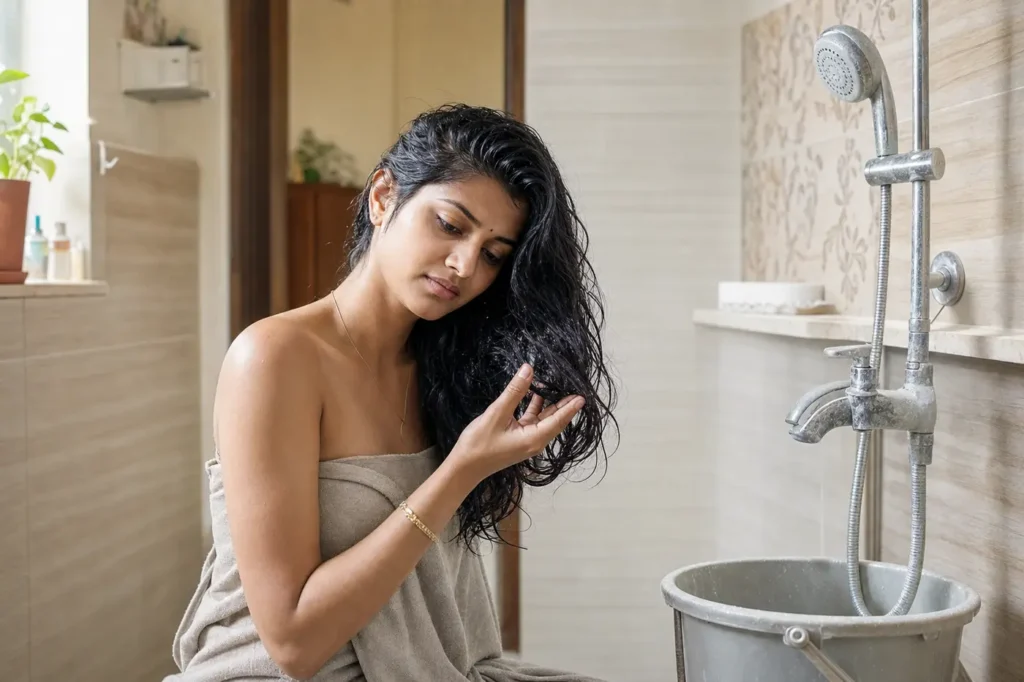
Hard water does not pull hair out from the follicle. Calcium and magnesium deposits coat the hair shaft, increase surface residue, rough feel, and combing friction, and make strands brittle, so they snap during washing and combing. Switching to a chelating shampoo weekly and adding an acidic rinse may improve visible roughness and the hard water hair damage pattern within 4 to 8 weeks, but ongoing shedding from the root needs a medical check.
Key takeaways
- Hard water causes hair breakage by depositing calcium and magnesium on the shaft, not hair loss from the follicle. That distinction changes which treatments actually work for hard water hair damage.
- The Bureau of Indian Standards IS 10500:2012 sets a desirable drinking water hardness limit of 200 mg/L as calcium carbonate (CaCO3) and a permissible maximum of 600 mg/L.
- A chelating shampoo containing EDTA (ethylenediaminetetraacetic acid), phytic acid, or citric acid, used once a week rather than daily, is the most evidence-supported way to address hard water hair damage by removing mineral deposits from the hair shaft. A 2015 dermatology review notes that shampoos often include EDTA specifically to sequester calcium and magnesium ions.
- Boiling water removes only temporary hardness caused by bicarbonate salts. It does not remove permanent hardness caused by sulphate salts, which is common in Indian borewell supply, according to the background section of PMC3927171, the Srinivasan et al. Journal of Trichology paper.
- Shower filters reduce chlorine better than hardness minerals. Peer-reviewed evidence that they remove calcium and magnesium at the hardness levels common in Indian cities is limited. A 2021 review of centralized water softening technologies supports softening systems for hardness reduction.
Does Hard Water Actually Cause Hair Fall, or Is It Something Else?
Hard water does not cause hair to fall from the follicle. Calcium and magnesium deposits coat the hair shaft, increase surface roughness, and make strands brittle enough to snap during brushing or washing. This breakage is often mistaken for hair loss, but the follicle itself remains unaffected, which is the first step in sorting out hard water hair damage from true shedding.
That distinction matters. If your issue is hard water hair damage, the fix is to remove mineral buildup from the hair shaft and reduce friction. If your issue is true shedding from the root, a chelating shampoo will not solve it.
The best-known paper in this area is small and weak, and you should know that before anyone quotes it at you. PMC3927171, the Srinivasan et al. Journal of Trichology study was an in vitro experiment on 15 hair samples. Hair exposed for 30 days to hard water at 212.5 ppm CaCO3 did not show a statistically significant drop in tensile strength or elasticity compared with distilled water at 10 ppm CaCO3, with P values of 0.858 and 0.874.
But that study did not measure the thing most readers actually notice first. It did not directly measure surface friction, tangling, cuticle roughness during combing, or the coated feel that makes hair seem dry and stiff. So the paper is useful for ruling out one simple claim, not for proving that hard water is harmless.
And the literature is not fully settled. A second small 2018 in vitro study of 50 samples found the opposite mechanical result, reporting a significant reduction in baseline hair strength after repeated hard-water treatment, with no such reduction after deionized-water treatment.
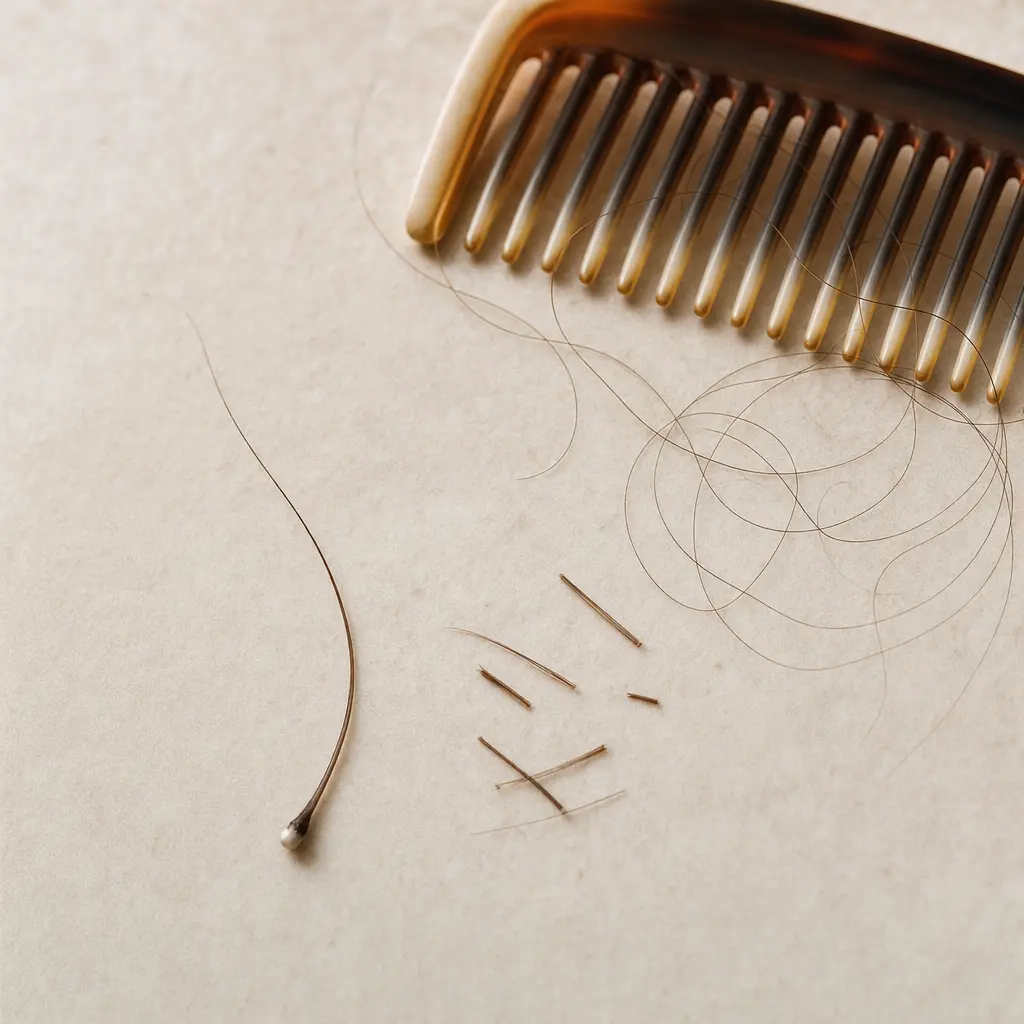
A practical way to separate hard water hair damage from shedding is to look closely at what comes out in the comb or sink. Snapped strands are usually shorter, uneven, and have no white bulb at one end. Root-shed hairs are longer and often have a small white club bulb. In week 1 after switching to a weekly chelating wash and gentler detangling, hard water hair damage usually shows up as less snagging while wet before you see less breakage on the floor. By weeks 3 to 6, the comb often collects fewer short fragments if water-related breakage was the main problem. Stop self-treating and book dermatology review if shedding still looks root-based, if the part is widening, or if the loss keeps going despite routine changes. For a fuller guide on how to tell normal daily shedding from breakage and when hair loss is more than the usual range, use that pattern check before blaming hard water alone.
See a dermatologist if shedding keeps going after you change the water source or routine, or if shedding started 2 to 4 months after childbirth, illness, surgery, crash dieting, or major stress. DermNet says telogen effluvium, the diffuse shedding that follows a body shock, is a different condition. The American Academy of Dermatology also notes that excessive shedding often appears a few months after a trigger. DermNet says androgenetic alopecia, patterned follicular miniaturisation, is also different and needs proper diagnosis.
How Hard Water Damages Hair: The Mechanism Behind the Breakage
Calcium and magnesium ions in hard water increase mineral deposition on the hair surface after repeated exposure. One 2016 microscopy study found more calcium and magnesium deposition and a ruffled cuticle appearance after hard-water exposure, but the exact in-use mechanism is better described as surface mineral buildup, rough feel, and higher combing friction than as a proven keratin-binding film.
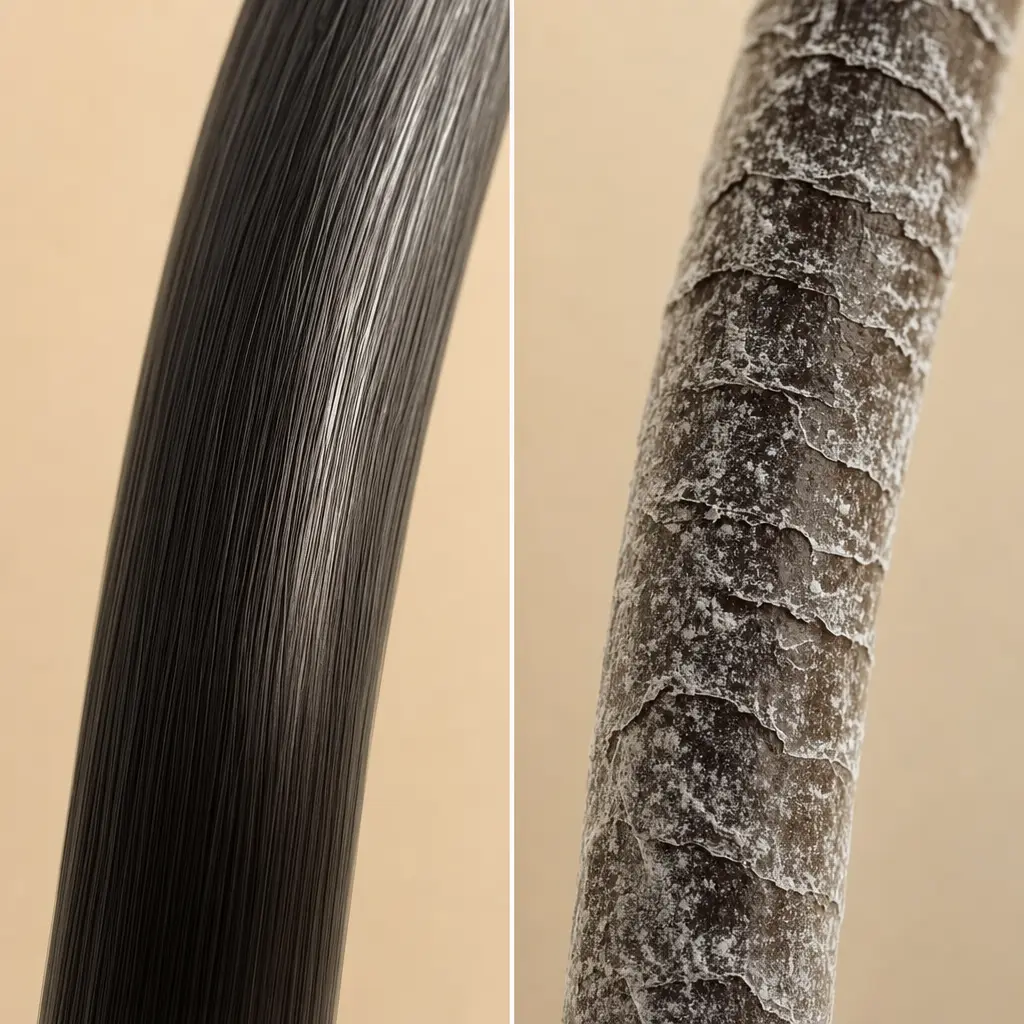
Hair feels coated, rough, and less slippery right after washing. The strand catches against nearby strands, so detangling takes more force and breakage goes up. That is the everyday texture of hard water hair damage.
A second useful point is residue. Mineral and product residues can accumulate on the hair surface and alter surface properties, which may make hair feel rougher or less conditioned. A 2019 in vitro study on hair surface quality supports the idea that deposits change surface condition. So the fair claim is simpler: coated hair often feels less responsive to conditioner.
Chemically treated hair may have a harder time here. A 2023 in vitro study found that dyed and bleached hair exchanges calcium and magnesium with tap water more readily than untreated hair, suggesting that coloured or bleached hair may be more vulnerable to hard-water buildup and hard water hair damage.
Scalp symptoms can also confuse the picture. Mineral residue can leave a flaky, dusty layer that looks like dandruff. But true dandruff and seborrhoeic dermatitis are most often driven by Malassezia, not by water hardness, according to DermNet. If flakes are greasy, itchy, or inflamed, read more about the difference between mineral residue that looks like dandruff and true dandruff or seborrhoeic dermatitis linked to Malassezia.
Why Your Shampoo Stops Lathering in Hard Water
Hard water reduces lather because calcium and magnesium ions react with soap fatty acids to form insoluble salts commonly called soap scum, but this mechanism applies to true soap more directly than to all modern shampoos, which often use synthetic detergents and chelators. The classic residue here is calcium stearate.
That is why some people feel they need two or three rounds of shampoo in hard water. Less foam makes you think the scalp is still dirty, so you use more product and wash longer. Then the lengths dry out faster.
And that dryness is partly routine-driven. Repeated washing strips sebum, your scalp’s natural oil, from the mid-lengths and ends. So hard water hair damage often becomes a mix of mineral residue plus over-cleansing.
Temporary vs Permanent Hardness: Why Boiling Only Solves Half the Problem
Temporary hardness is caused by calcium bicarbonate and can be reduced by boiling. Permanent hardness is caused by calcium and magnesium sulphates, including magnesium sulphate (MgSO4), and cannot be removed by boiling, according to the background explanation in PMC3927171.
That is why the old advice to boil water for hair washing is such a weak fix in India. Borewell water hair damage is often linked to groundwater with permanent hardness, not just temporary bicarbonate hardness. You can boil a bucket and still end up washing with mineral-heavy water.
How to Tell If Your Water Is Hard: The Lotus 5-Step Home Test
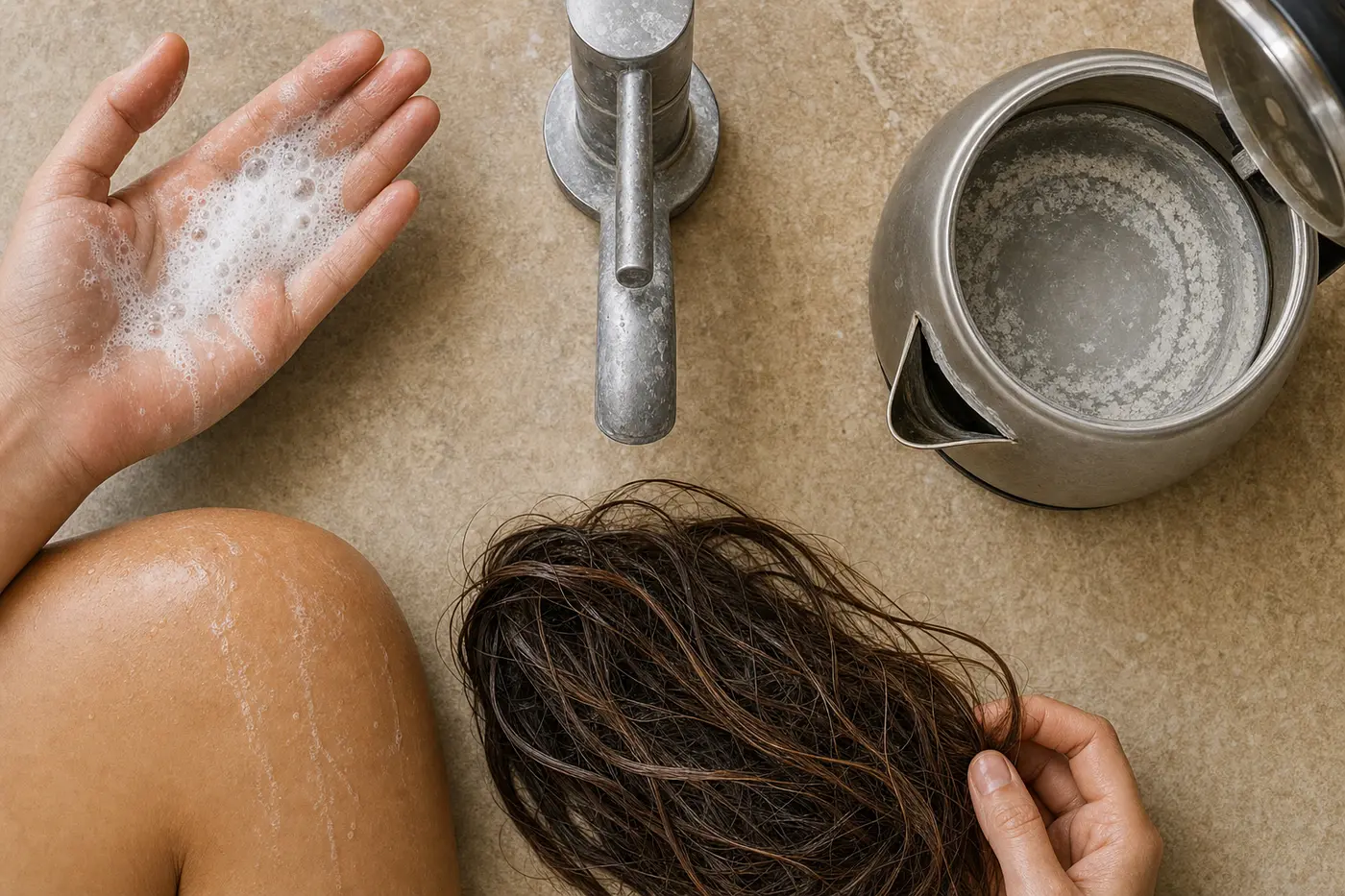
Use the Lotus Hard Water Hair Test as an informal checklist, not a diagnosis. Lather a small amount of shampoo in your palm with tap water, poor foam suggests hardness. Check taps and utensils for white chalky residue, notice if soap leaves a film on skin, and look for white scale inside your kettle. The only reliable confirmation is a water test report or hardness strip result in mg/L CaCO3.
The Bureau of Indian Standards IS 10500:2012 sets a desirable hardness limit of 200 mg/L as calcium carbonate (CaCO3) and a permissible maximum of 600 mg/L when no alternate source is available. You do not need a lab report to suspect hard water hair damage, but the home signs help you decide whether the problem is worth testing properly.
- Lather test
Wet your palm and use a small amount of shampoo. If foam is poor and the product seems to disappear without much lather, hard water is possible. This sign is stronger if the same shampoo lathers normally elsewhere. - Tap and utensil residue
Look around taps, showerheads, bucket rims, and steel utensils. White chalky deposits are a classic sign of mineral-heavy water. A crusty showerhead is a clue your hair is seeing the same minerals. - Soap film on skin
Hard water often leaves skin feeling sticky or not fully rinsed. If soap feels like it sits on the skin instead of washing clean, mineral content may be high. - Hair texture comparison
Focus on the first 10 minutes after washing. Hard water hair damage often feels rough, squeaky, or straw-like while still wet, not only after it dries. - Kettle scale
Check the inside of an electric kettle or water heater. White mineral crust strongly suggests hard water in the household supply.
Then verify with your local report if possible. Delhi readers can check Delhi Jal Board updates. If your building uses tanker or borewell supply, society testing matters more than city averages.
Hard Water in India: Which Cities Are Worst Affected?
Delhi NCR, Jaipur, Ahmedabad, and borewell-dependent parts of Bangalore and Chennai are often more likely to have hard water above the Bureau of Indian Standards IS 10500:2012 desirable limit of 200 mg/L CaCO3, while Mumbai and Kolkata are usually softer because they depend more on surface reservoir or river supply. But city averages are only context, because your building’s source matters more than the city name when judging hard water hair damage.
Bureau of Indian Standards IS 10500:2012 sets a desirable total hardness limit of 200 mg/L as CaCO3 and a permissible maximum of 600 mg/L as CaCO3 when no alternate source exists.
The Central Ground Water Board gives the clearest broad warning for groundwater. A CGWB shallow-aquifer report found samples above 600 mg/L total hardness in Delhi, Gujarat, and Rajasthan, with state-level shares of 8.4 percent, 20.2 percent, and 25.0 percent respectively. That supports caution, especially for borewell users, but not lazy claims that every home in those states has extreme hardness.
This comparison is strongest for groundwater and state reports, not for perfectly matched municipal data across all metros. I did not retrieve a clean, directly comparable primary dataset that ranks Delhi, Bengaluru, Chennai, and Mumbai using the same method and period. So treat the table below as practical context, not a league table.
| City | Source | Range | BIS status | Check |
|---|---|---|---|---|
| Delhi NCR | Mixed municipal plus groundwater | 200 to 600+ | Often above desirable | DJB or society test |
| Jaipur | Groundwater dominant | 200 to 600+ | Often above desirable | Local lab reports |
| Ahmedabad | Groundwater and mixed supply | 200 to 600+ | Often above desirable | Municipal and local test |
| Bangalore | Mixed source, many borewells | Variable | Building-specific | BWSSB and apartment test |
| Chennai | Mixed municipal and borewell | Variable | Building-specific | CMWSSB and local test |
| Mumbai | Reservoir supply | Often below 200 | Usually within desirable | MCGM reports |
| Kolkata | River surface supply | Often below 200 | Usually within desirable | Municipal report |
It is plausible and widely reported in practice that Cauvery-supplied water is softer than peripheral borewell water, but I did not retrieve a BWSSB primary report with directly comparable hardness values for that exact claim. So the honest version is simple: check your own apartment’s source before blaming the whole city for hard water hair damage.
CMWSSB supply and private borewell water are not interchangeable. And in any city, borewell users face higher risk than municipal surface-water users.
Signs Your Hair Is Damaged by Hard Water (Not Something Else)
Hard water hair damage signs cluster around wash day. The hair feels rough immediately after rinsing, lathers poorly, tangles more during combing, and breaks from the mid-length rather than shedding with a full white bulb from the root. If symptoms improve when you wash with bottled or filtered water for a few weeks, hard water becomes a much stronger suspect.
- Straw-like texture right after washing
Not just dry ends by evening. The rough feel starts while the hair is still wet. - Poor lather and more shampoo use
You keep adding product because the first wash feels flat or unfoamy. - More tangling and snapping during combing
Breakage shows up as shorter snapped strands, especially near the front and crown where friction is high. - Dullness and less shine
Hair looks coated rather than glossy. - Flaking that is not true dandruff
Mineral residue can mimic dandruff. True dandruff is more closely linked to Malassezia. - Colour-treated hair feeling worse faster
Repeated washing causes oxidative dye to leach from the shaft, and a 2023 in vitro study found that dyed or bleached hair exchanges calcium and magnesium with tap water more readily than untreated hair. But I did not verify a primary study proving that hard water specifically makes artificial colour fade faster than soft water. - Improvement with bottled or filtered water
If one or two weeks of washing with low-mineral water makes hair softer and less tangly, water is probably part of the problem.
What hard water hair damage is not: pattern thinning at the part line, a shrinking ponytail, postpartum shedding, thyroid-related diffuse loss, or patchy bald spots. Those point toward androgenetic alopecia, telogen effluvium, or other medical causes and need a doctor. If flakes, itch, or scalp irritation keep going, read more about why persistent scalp flaking and irritation may need anti-dandruff treatment instead of only changing water or shampoo.
What Actually Helps: Ranked by Cost and Evidence
A chelating shampoo containing EDTA, phytic acid, or citric acid is the most effective first step for hard water hair damage in India. Use it once a week, not daily, because the goal is to remove mineral deposits without stripping natural oils. Products marketed as hard water shampoos without a real chelating agent on the ingredient list are usually just clarifying shampoos.
If the problem is mineral buildup on the hair shaft, remove the buildup first. Then restore slip and moisture. If the water source itself is very hard, no hair product will fully replace a true softening system.
Chelating Shampoo: The Most Evidence-Supported First Step
EDTA (ethylenediaminetetraacetic acid) chelates divalent metal ions including calcium and magnesium, enabling their removal during washing, according to a 2015 dermatology review. The same review notes that shampoo formulas often include chelating agents such as EDTA specifically to sequester calcium and magnesium ions.
Use a chelating shampoo once weekly. Daily use is usually too stripping, especially on Indian hair that is already dry, coloured, heat-styled, or washed in low humidity winters. On the label, look for EDTA, disodium EDTA, tetrasodium EDTA, phytic acid, sodium phytate, or citric acid.
Be strict about marketing language. Products labelled hard water shampoo, detox shampoo, or anti-hard water without EDTA, phytic acid, or citric acid on the ingredient list are clarifying shampoos, not true chelating shampoos. They may remove oil and product buildup. They may not remove mineral deposits well enough for hard water hair damage.
Acidic Rinses: Cheap, Effective, and Backed by Chemistry
A 2014 review on shampoo pH found that alkaline cleansing increases negative charge, friction, and cuticle damage risk in the hair shaft. That supports the idea of using a low-pH follow-up step after washing when hard water hair damage leaves hair rough and snag-prone.
A practical home option is apple cider vinegar (ACV), 1 tablespoon in 500 ml water, used as a final rinse and then lightly rinsed out if the smell bothers you. Citric acid powder in water is another option. But the evidence line matters here: low-pH hair products may help the cuticle lie flatter, but I did not verify a primary source showing that home acidic rinses at pH 3 to 4 dissolve hard-water mineral deposits from hair in real-world use.
So use acidic rinses as a support step, not as a replacement for chelation. They can improve feel. They are not proven to remove buildup as effectively as EDTA-based cleansing.
Shower Filters: What They Can and Cannot Do
KDF shower filters reduce chlorine and chloramine through a redox reaction, but the source for this claim is a manufacturer technical bulletin, not an independent hair study. Vitamin C shower filters neutralise chlorine and chloramine by straightforward chemistry, and a 2015 point-of-use study supports chlorine removal chemistry, though it is not a hair study and not specific to shower cartridges.
But the bigger claim is the one you should distrust. Peer-reviewed evidence that KDF or Vitamin C shower filters meaningfully remove hardness minerals such as calcium and magnesium from very hard water is limited, and a 2021 review of centralized drinking water softening technologies supports hardness reduction more clearly for softening systems than for shower filters marketed mainly for chlorine or chloramine.
If your municipal supply is chlorinated and only moderately hard, a filter may improve feel and reduce scalp irritation from chlorine exposure. But if your main issue is borewell water hair damage, a ₹800 to ₹4,000 shower filter is not the same thing as a water softener.
Cost and ingredient comparison
Prices change, and marketplace discounts move daily. The table below uses the current listed prices supplied for products available on Amazon.in. No hands-on testing was performed for this article. Product selection was based on public listings, stated purpose, price, and fit with the evidence on hard water hair damage.
| Product | Chelator named | Size | Price | Use | Limit |
|---|---|---|---|---|---|
| Detoxie Hard Water Shampoo | Not clearly disclosed | 200 ml | ₹399 | Weekly clarifying step | Listing does not clearly name EDTA |
| TRESemme Hydra Matrix | Not clearly disclosed | 185 ml | ₹189 | Maintenance wash | Not a proven chelating fix |
Because live retail data changes and some ingredient lists are incomplete on marketplaces, use this buying rule instead of trusting front-label claims: if EDTA, phytic acid, sodium phytate, or citric acid does not appear anywhere in the ingredient list, do not assume the shampoo can remove hard-water mineral deposits.
For the water itself, a whole-home water softener is the most complete household fix for hardness reduction supported by water-treatment evidence. Established hardness-removal technologies reviewed in 2021 include ion exchange, membrane separation, and pellet or lime softening. An ion exchange resin water softener swaps hardness ions for softer ions and is the closest thing to a real solution for very hard household water. In India, installed systems often start around ₹15,000 and can go to ₹40,000 or more depending on size and plumbing, but that price range varies by brand, capacity, and installation complexity.
We may earn a commission from purchases made through these links, at no extra cost to you. Products are chosen on evidence and value, never on commission.
This article includes affiliate product links. Product selection was based on public ingredient listings, price, and fit with the evidence summary. No named medical reviewer had any role in product selection, and no hands-on testing was performed.
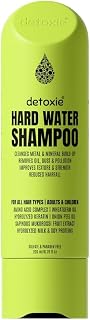
Detoxie Hard Water Shampoo 200 ml
This is the closest direct fit to the article’s main fix: a shampoo explicitly positioned for metal and mineral buildup. That matches the evidence better than generic repair shampoos, because hard-water trouble is better described as surface deposition and roughness than true root-level hair loss.
- Directly aligned with the article’s evidence-backed approach of removing surface mineral buildup
- Moderate price at 399 rupees
- Suitable article fit for readers who need a first-step troubleshooting product
- The listing does not clearly state a chelating active like EDTA in the title
- At 200 ml, regular use can get expensive for long hair
- Its ‘reduces hairfall’ claim is not something the article should rely on

TRESemme Hydra Matrix Hydrating Shampoo 185ml
This is not a proven hardness remover from the title alone, but it is a low-cost shampoo aimed at dry hair with a hard-water-detox positioning. In this article, it works better as an affordable maintenance shampoo than as a stand-alone fix for severe mineral buildup.
- Low entry price at 189 rupees
- Useful for readers whose hard-water issue shows up more as dryness than heavy residue
- Better article fit than unsupported vinegar or water-softener claims
- Small 185 ml bottle
- The title does not name a chelating ingredient, so it may be weaker for stubborn mineral deposits
- May not cleanse enough for oily scalp with visible buildup
What Does Not Help, and Why
Boiling removes only temporary hardness, caused by calcium bicarbonate, which converts to insoluble calcium carbonate and settles out. It does nothing for permanent hardness caused by calcium and magnesium sulphates, the dominant type in much Indian borewell water. For most Indian households relying on groundwater, boiling is a partial fix at best and impractical for daily hair washing.
- Shampoos labelled hard water shampoo without EDTA, phytic acid, or citric acid
These are usually clarifying shampoos. They remove oil and styling residue better than mineral deposits. - Oil treatments such as coconut oil or castor oil
Oils can reduce dryness and friction after washing. They do not remove calcium or magnesium buildup. Use them after chelation, not instead of it. - Protein treatments
Protein can help some chemically damaged hair, but protein does not target mineral coating. On already stiff, coated hair, heavy protein can make the feel worse. - Cold water rinse
Cool water may make hair feel smoother for a short time. It does not remove mineral deposits from the shaft. - A shower filter alone as a softener
If hardness is the main problem, use a true softening method such as ion exchange or another validated hardness-reduction system. Shower filters marketed for chlorine are not proven substitutes for softeners. - Apple cider vinegar instead of a chelating shampoo
An acidic rinse may improve feel or reduce alkalinity-related roughness, but evidence is stronger for shampoos formulated with chelators such as EDTA when mineral buildup is the target.
Can Hard Water Hair Damage Be Reversed?
Mineral deposits on the hair shaft can be reduced with a chelating shampoo, and surface roughness may improve over several weeks of weekly use, but the exact 4 to 8 week timeline for hard water hair damage has limited direct trial evidence. Hair that has already snapped cannot regrow from the mid-shaft, but new growth emerging from an unaffected follicle will be healthy once the water source or washing routine changes.
You can reverse the coated feel, roughness, tangling, and some of the breakage pattern from hard water hair damage. You cannot glue broken ends back together. Those need trimming.
Lotus Femcare reader anecdote, not evidence of efficacy: One Delhi reader with shoulder-length, fine, colour-treated hair, washed three times a week in borewell-linked water estimated above 300 mg/L CaCO3, switched to a weekly chelating wash plus an apple cider vinegar rinse. The routine was one clarifying wash on Sundays, a regular gentle shampoo midweek, and conditioner only from ears down. The ACV rinse was 1 tablespoon in about 500 ml water. The reader described the smell as sharp for a few minutes, then faint after a light rinse-out. In the first two weeks, the main change was softer wet texture and less drag while finger-detangling. By day 30, the scalp looked less dusty, but old split ends still caught on the comb. By day 60, comb clean-out showed fewer short snapped pieces and detangling time was shorter. By day 90, the ends still needed trimming, but new growth and upper lengths felt smoother. That pattern fits hard water hair damage improving at the surface first, not instant repair of old breakage.
See a dermatologist if shedding continues after 8 weeks of changing the water source or routine, or if the loss is diffuse and linked to childbirth, fever, surgery, thyroid symptoms, weight loss, or low ferritin risk. The American Academy of Dermatology says female pattern hair loss is progressive and hereditary, and treatment works best when started early rather than after months of self-diagnosing water as the cause.

L’Oréal Professionnel Absolut Repair Mask 250ml
The evidence does not show hard water directly causes root hair loss, but mineral deposition and rougher surface feel can make hair seem drier and more breakable. A repair mask fits that problem well by improving manageability after cleansing, even though it does not remove hardness from water.
- Good support product for the article’s ‘repair the feel and breakage’ part
- 250 ml size is practical for medium to long hair
- Price is more accessible than premium salon leave-ins at 877 rupees
- Does not address hardness minerals directly
- Can feel too rich for fine hair or oily scalps if used near roots
- Jar packaging is less convenient and less hygienic than a pump

Redken Acidic Bonding Concentrate Leave-in 150 ml
Low-pH hair care is a reasonable support strategy because alkaline swelling and friction can worsen cuticle roughness, even though the evidence does not prove home acidic products dissolve mineral deposits. In this article, this works as a finish-step product for smoother, less snag-prone lengths.
- Fits the article’s evidence-supported idea of reducing roughness and improving manageability rather than claiming to stop root hair loss
- Useful for lengths that break from friction and tangling
- Includes heat-protectant positioning for readers who style often
- Expensive at 1980 rupees for 150 ml
- Not a clarifying or chelating wash product
- Can be overkill if your only issue is mild dryness without styling damage

BBLUNT 7 in 1 Repair & Revive Hair Mask 120 g
For this article, this is the budget repair-mask pick rather than a mineral-removal treatment. It helps address the practical result of hard-water buildup, rougher, less manageable hair, after you use a clarifying shampoo, without making unsupported claims about softening water or stopping true hair loss.
- Affordable at 251 rupees
- Useful companion product after a buildup-removal shampoo
- Better value entry point for readers testing whether conditioning improves hard-water roughness
- Small 120 g size
- Does not remove hardness minerals or water contaminants
- May be too rich for fine low-volume hair
Safety and when to see a doctor
Diffuse shedding lasting more than a few months, or shedding that began 2 to 4 months after childbirth, illness, surgery, crash dieting, or major stress, needs a dermatologist or physician. DermNet says telogen effluvium often starts a few months after the trigger, and the American Academy of Dermatology says sudden shedding should not automatically be blamed on water. Iron deficiency, thyroid disease, or nutritional problems may be involved. For more detail on what ongoing diffuse shedding after childbirth illness stress dieting or thyroid issues usually points to, use that guide instead of treating hard water hair damage as the only explanation.
A widening part, a thinner ponytail, temple recession, or gradual patterned thinning needs early dermatology review for female pattern hair loss or androgenetic alopecia. The American Academy of Dermatology notes that female pattern hair loss is hereditary and progressive, and earlier treatment gives a better chance of preserving density.
An itchy, inflamed, greasy, or scaly scalp that does not settle with routine care should not be blamed on hard water forever. The American Academy of Dermatology referral guidance supports assessment for scalp conditions when symptoms persist. Seborrhoeic dermatitis, psoriasis, eczema, and fungal scalp disease need proper diagnosis. The same goes for patchy hair loss, sudden bald spots, scalp burning, or signs of scarring. AAD guidance on hair loss evaluation supports prompt review for these patterns.
If you are pregnant, planning pregnancy, or breastfeeding, do not start minoxidil on your own for suspected patterned thinning. Topical minoxidil is used for female pattern hair loss, not for hard-water buildup itself, and the American Academy of Dermatology advises avoiding it in pregnancy and breastfeeding unless a clinician specifically recommends it.
Where the evidence is missing
Most hard-water hair studies I found were small, in vitro, and not designed around real Indian routines such as frequent oiling, heat styling, mixed municipal-plus-borewell exposure, or long hair washed in buckets. That limits how confidently anyone should talk about hard water hair damage.
I did not find good head-to-head human trials comparing chelating shampoos, acidic rinses, shower filters, and softeners for reader-relevant outcomes like breakage, roughness, combability, or scalp comfort. The evidence for shower-filter removal of calcium and magnesium at household hardness levels relevant to Indian borewell water is especially thin.
And while dyed or bleached hair appears to exchange minerals with tap water more readily than untreated hair, I did not find a primary study proving that hard water specifically fades hair colour faster than soft water in real use. This article keeps separating what is likely, what is proven, and what is just marketing.
Frequently Asked Questions
Does hard water cause hair fall?
Hard water does not cause hair to fall from the follicle. A 2016 microscopy study found more calcium and magnesium deposition and a ruffled cuticle appearance after hard-water exposure, which fits breakage from a rougher hair surface rather than root-level shedding. Persistent shedding unrelated to water change should be assessed by a dermatologist.
How do I know if my water is hard?
Test at home: lather a small amount of shampoo in your palm with tap water, poor foam suggests hardness. Check taps and utensils for white chalky deposits. Notice if soap leaves a sticky film on skin. White scale inside your kettle supports the suspicion. The only reliable confirmation is a water test report or hardness strip result in mg/L CaCO3, and BIS IS 10500:2012 uses 200 mg/L CaCO3 as the desirable limit.
Which Indian cities have the hardest water?
Delhi NCR, Jaipur, Ahmedabad, and borewell-dependent areas of Bangalore and Chennai are often more likely to exceed the BIS IS 10500:2012 desirable limit of 200 mg/L CaCO3, while Mumbai and Kolkata are usually softer because they rely more on surface-water supply. A CGWB shallow-aquifer report found samples above 600 mg/L total hardness in Delhi, Gujarat, and Rajasthan, but building supply still matters more than city averages.
Do shower filters actually work for hair in India?
KDF shower filters reduce chlorine and chloramine according to a manufacturer technical bulletin, and a 2015 point-of-use study supports chlorine-removal chemistry more broadly. Published evidence for removing calcium and magnesium at Indian borewell hardness levels is limited. Expect modest help in chlorinated city water, not a full fix for hard water hair damage.
Does hard water make hair dry and rough?
Yes. Repeated hard-water exposure increases mineral deposition on the hair surface, and a 2016 microscopy study found more calcium and magnesium deposition with a ruffled cuticle appearance. The result is hard water hair damage that feels rough and straw-like after washing, tangles more easily, and loses shine.
Can hard water cause dandruff?
Hard water does not cause true dandruff, which is usually linked to Malassezia according to DermNet. However, mineral residue and soap scum can leave flaking and irritation that look similar. If the scalp improves after washing with filtered or bottled water, residue is more likely than dandruff fungus. Persistent itching or greasy scale needs medical treatment.
Will a chelating shampoo reverse hard water damage?
A chelating shampoo containing EDTA, phytic acid, or citric acid can help remove mineral deposits from the hair shaft and improve the feel of hard water hair damage over several weeks of weekly use, but the exact 4 to 8 week timeline is not tightly proven by direct clinical trials. It cannot regrow hair that has already broken. Snapped lengths need trimming, while new growth should improve once buildup is controlled.
Does boiling water reduce hardness for hair washing?
Boiling removes only temporary hardness, caused by calcium bicarbonate, which settles out as calcium carbonate. It does nothing for permanent hardness caused by calcium and magnesium sulphates, which are common in Indian borewell water, according to the background explanation in PMC3927171. For most households using groundwater, boiling is therefore an incomplete and impractical fix.
Can hair recover from hard water damage?
Hair can recover from the mineral coating and rough feel, but not from already broken ends. Weekly chelating shampoo, a good conditioner, and less friction usually improve softness and combability over time. If the shaft has snapped repeatedly, trims are still needed. New growth can come in normally because the follicle is not damaged.
How do I remove hard water from my hair?
Use a chelating shampoo once a week and check the ingredient list for EDTA, phytic acid, sodium phytate, or citric acid. Follow with a conditioner or mask on lengths. An acidic rinse such as diluted apple cider vinegar can be a support step, but it is not a proven replacement for chelation if hard water hair damage is the main issue.
How do I stop hard water from ruining my hair?
Reduce exposure first. If possible, wash with softer water, install a true softener, or at least identify whether your home uses borewell supply. Then use a weekly chelating shampoo, avoid over-washing, and add slip back with conditioner or a leave-in. If the water is very hard, product changes alone will only partly help hard water hair damage.
How do you know if your hair is damaged from hard water?
The clearest hard water hair damage signs are rough, squeaky hair immediately after washing, poor lather, more tangling, and mid-length breakage rather than root shedding. White deposits on taps and kettle scale strengthen the suspicion. The best home test is improvement after one to two weeks of washing with lower-mineral water.