

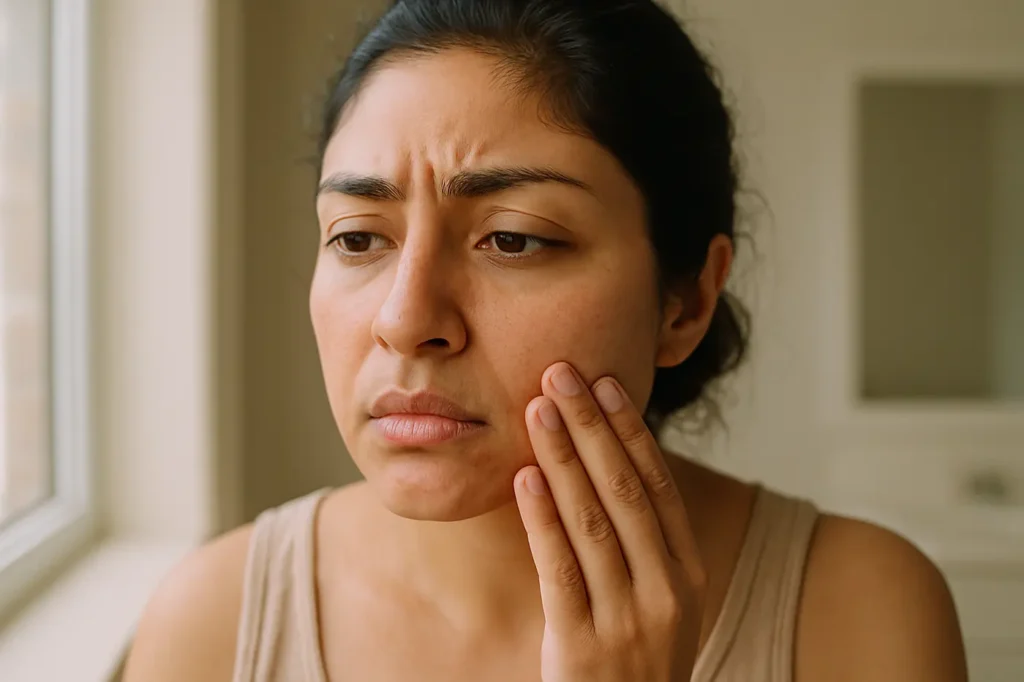
A damaged skin barrier can show up as stinging after skincare, tightness soon after washing, flaking with oiliness, and new reactive breakouts. This guide to damaged skin barrier signs and repair explains what those patterns suggest, how to repair skin barrier problems with a stripped-back routine, and when similar skin barrier damage symptoms may actually be eczema, rosacea, seborrhoeic dermatitis or contact dermatitis.
Key takeaways
- A damaged skin barrier often stings, flakes, feels tight after washing and breaks out at the same time. If three or more of these patterns appear together, that strongly suggests barrier damage, but eczema, rosacea, seborrhoeic dermatitis and contact dermatitis can look similar.
- The main repair step is stopping active ingredients for a period, not adding more products. That usually means pausing AHAs, BHAs, retinol, vitamin C and other products that clearly sting or worsen skin burning after applying products.
- Ceramides, cholesterol and fatty acids are the three lipid classes that make up the barrier’s mortar layer. A moisturiser with all three is more physiologically complete than one with ceramides alone.
- Indian-specific triggers can matter. A 2022 UK Biobank cohort study of 306,531 adults linked harder domestic water with higher eczema prevalence, and a 2011 cohort study found repeated suberythemal UV exposure increased TEWL and reduced major stratum corneum lipids.
- If symptoms persist beyond four weeks of simplified care, or if you see weeping, crusting or symmetrical redness across the face, see a dermatologist. Those patterns fit eczema, rosacea or contact dermatitis more than routine barrier damage.
Does Your Skin Have a Damaged Barrier? The Six-Sign Checklist
Damaged skin barrier signs and repair start with pattern recognition. Common skin barrier damage symptoms include sharp prickling after skincare, tightness within minutes of washing, flakes sitting over an oily surface, new scattered bumps, and redness that lingers after the trigger is removed. These signs suggest barrier damage, but similar patterns can also happen with eczema, rosacea, seborrhoeic dermatitis and contact dermatitis.
Observed patterns matter here. Sunscreen that used to disappear can suddenly prickle for 30 to 60 seconds. The corners of the nose and mouth often go first. Some people describe the skin as both greasy and papery, then keep adding hydrating serums because the surface looks shiny. Others mistake tiny red bumps for purging, even though the bumps are tender, scattered and show up in places they do not usually break out.
Stinging happens because a weaker barrier lets ingredients reach living skin more easily. Even water, glycerin and gentle cleansers can sting when the stratum corneum lipid layer is depleted. A 2023 review on acne and barrier care, which should be read cautiously because of its skincare context, supports a real link between barrier dysfunction and reactivity, but stinging alone does not diagnose barrier damage.
A compromised barrier is also linked to acne and follicular barrier dysfunction, although the specific claim that Cutibacterium acnes penetrates damaged skin more easily than intact skin was not directly verified in the primary sources reviewed. A 2023 expert-panel style review, which should be read cautiously, supports a real relationship between acne and barrier dysfunction. In practice, small inflamed breakouts appearing with stinging and flaking often point to irritation rather than routine acne.
If three or more signs are happening together, barrier damage is a strong possibility, not a certainty. Keep the caveat in mind, because eczema, rosacea, seborrhoeic dermatitis and contact dermatitis can overlap with the same checklist.
-
Products suddenly sting or burn
A cleanser, moisturiser or sunscreen that felt normal last month now gives a hot, needly or prickly feeling on contact. The sensation often peaks fast, then settles over 30 seconds to a few minutes. If even bland products sting, the barrier may be compromised, but allergic or irritant dermatitis can also present this way.
-
Skin feels tight within minutes of washing
Healthy skin can feel clean after washing. Damaged skin often feels stretched, squeaky or oddly dry before you even towel-dry. Some people notice smiling feels uncomfortable, especially around the cheeks and mouth.
-
Flaking and oiliness show up together
Dry skin alone is not enough to call barrier damage. A more suggestive pattern is loose flakes on top with a shiny forehead, nose or cheeks underneath. People often respond by using stronger cleansers, which can make too many actives skin damage worse.
-
New breakouts appear without a clear reason
You did not change your diet, cycle or makeup, but small red bumps start showing up. Barrier-related breakouts often feel sore, rough and stingy rather than deep and clogged. They are usually more scattered than your usual acne pattern.
-
Redness stays past 24 hours
Temporary pinkness after a strong active can happen. Redness that is still there the next day, even after stopping the product, suggests the skin has moved beyond brief irritation into ongoing barrier stress. Persistent central redness and flushing should also raise the question of rosacea.
-
Moisturiser does not seem to help
A normal moisturiser should make skin feel more comfortable fairly quickly. If moisturiser sits on top, pills, or gives only a few minutes of relief before the skin feels hot or tight again, the barrier may be too disrupted for a basic routine to compensate.
Why Oily Skin Can Have a Damaged Barrier Too
Oily skin can still show damaged skin barrier signs and repair needs because sebum and water are not the same thing. When transepidermal water loss rises, skin may produce more oil while still feeling dehydrated underneath. That can leave the face shiny by noon but uncomfortable after cleansing.
In humid weather, that shiny-dehydrated pattern is easy to misread as “I need stronger cleansing.” Many people then add salicylic acid, clay masks or extra face washing. If your face gets greasy fast but also feels stingy after washing, think about skin barrier damage symptoms before assuming you only have oily skin.
What the Skin Barrier Actually Is (Plain Language)
The skin barrier is the outermost part of skin, called the stratum corneum. It is made of flattened skin cells called corneocytes, held together by a lipid matrix often described as bricks and mortar. A 2007 review described that lipid matrix as being made mainly of ceramides, cholesterol and fatty acids.
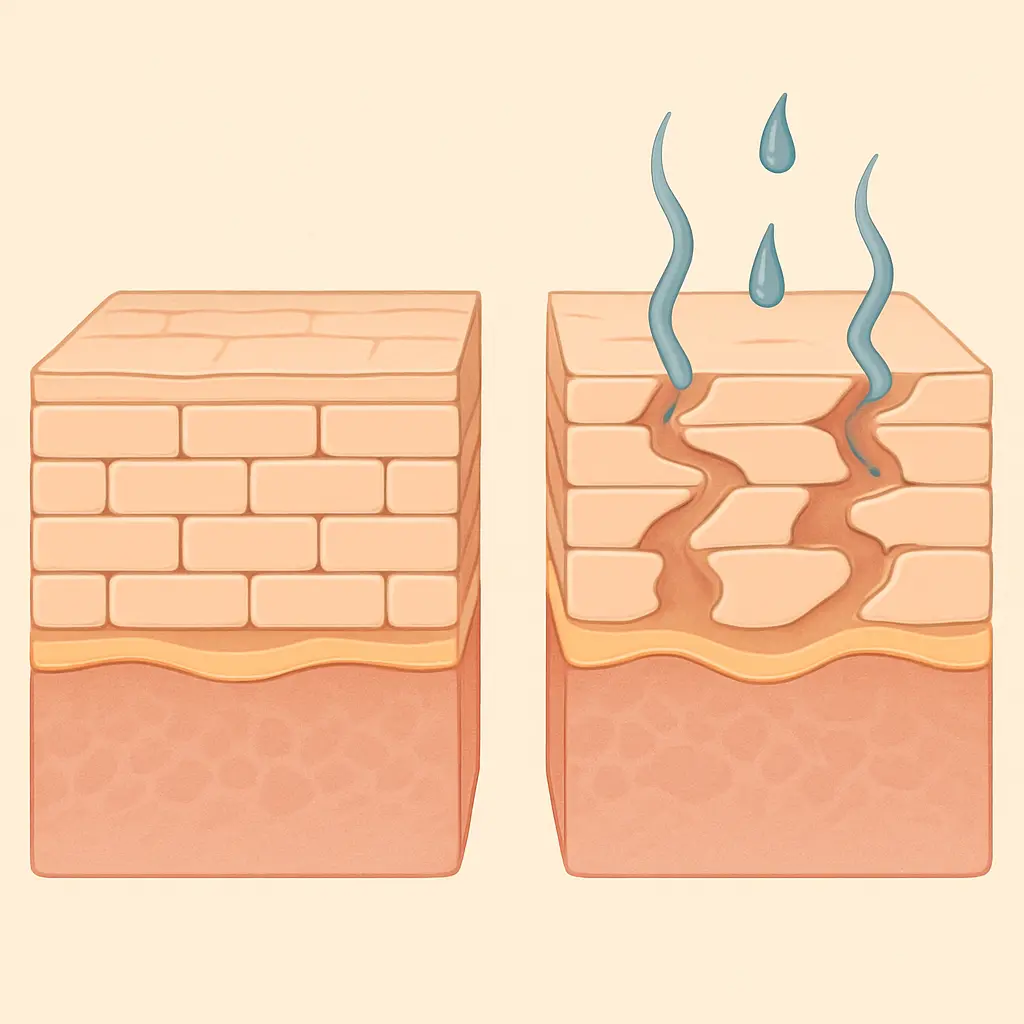
That structure explains many damaged skin barrier signs and repair basics. When the mortar is intact, water stays in and irritants stay out. When the mortar is depleted, water escapes, skin feels tight, and even basic products can sting.
When that lipid mortar is disrupted, transepidermal water loss, or TEWL, rises. TEWL simply means water evaporating out through the skin. A 2022 randomised trial of 34 adults with dry, eczema-prone skin found that a barrier-focused cream reduced resting TEWL by 15.3 g m−2 h−1 versus a reference emollient after four weeks, and also reduced sodium lauryl sulfate sensitivity, but the trial was small and industry-linked.
The skin surface also has an acid mantle, a mildly acidic film that helps normal barrier function. A 2008 multicentre cohort study of 330 participants found average forearm skin pH was below 5 and that washing with tap water around pH 8 raised skin pH for up to six hours. So the usual “skin pH is exactly 4.5 to 5.5” line is too neat.
Cleanser choice matters here. A 2021 randomised forearm in-use study of 50 people found that alkaline soaps increased skin pH, increased TEWL and caused more erythema than syndet cleansers. A 2018 review also found syndet cleansers are less barrier-damaging than traditional soaps because they cause less protein denaturation, dryness and irritation.
Why Ceramides Alone Are Not Enough
Ceramides matter, but they are only one part of the structure. The stratum corneum needs ceramides, cholesterol and fatty acids in a workable balance for repair. A product that advertises ceramides but leaves out cholesterol and meaningful fatty-acid support is less complete for barrier support.
That does not prove every triple-lipid cream is better than every ceramide-only cream in humans. The safer wording is that a ceramide, cholesterol and fatty-acid formula is more physiologically complete, based on how the barrier is built. A 2022 mechanistic study gives one reason, showing that linoleate-containing omega-O-acylceramides are required for healthy lamellar phase architecture of skin barrier lipids.
How the Barrier Gets Damaged: Causes Specific to Indian Skin Routines
Most damaged skin barrier signs and repair stories start with repeated irritation, not one dramatic mistake. Common triggers are too many actives, too much cleansing, too much sun, and too little recovery time between changes. In India, hard water, humidity, sweat, heat and indoor AC can add stress even before you open a serum.
Start with the obvious skincare causes. Retinol, glycolic acid, salicylic acid, vitamin C, scrubs and strong cleansers all have a place. But they do not belong in the same week for a beginner with no margin for error.
Over-exfoliation is real, but the evidence needs careful wording. Exfoliating acids can irritate skin and contribute to skin barrier damage symptoms, but a human study of 4% glycolic acid used twice daily for three weeks did not show disruption of stratum corneum lipid lamellae or an increase in TEWL. So the blanket claim that AHAs and BHAs always destroy the barrier is wrong. Formula, strength, frequency and your own tolerance decide the outcome.
Retinoids are another common trigger. A 2024 acne review supports that topical retinoids commonly cause early irritation, dryness, scaling and burning, so they should be introduced gradually on barrier-compromised skin. If retinol burns, scales and keeps worsening, stop.
Layering too many actives is where routines usually go wrong. A glycolic toner in the morning, niacinamide 10% serum, vitamin C, and retinol at night can look normal on social media. On real skin, especially beginner skin, that mix often leads to over exfoliation signs, stinging and flaking.
Harsh foaming cleansers are another repeat offender. If a wash contains sodium lauryl sulfate, has a high-pH soap base, or leaves your face squeaky, it may be doing too much. A 2021 randomised cleanser study found alkaline soaps caused more TEWL, more erythema and higher pH shifts than syndets. Hot water can make that worse.
Hard water matters too. A 2022 UK Biobank cohort study of 306,531 adults found a dose-response association between higher domestic hard-water exposure and higher eczema prevalence, measured as calcium carbonate hardness, not TDS. That study did not test Indian municipal water or direct lipid-barrier damage, so the fairest reading is that hard water may worsen irritation-prone skin rather than proving a direct barrier effect in every city.
UV matters as well. A 2011 cohort study found repeated suberythemal ultraviolet exposure increased TEWL over 12 weeks and was associated with a gradual decrease in major stratum corneum lipids, with a notable decrease in ceramide. “Suberythemal” means below the level that causes obvious redness. So skin can lose barrier lipids from repeated sun exposure even without visible sunburn. During recovery, the correct amount of sunscreen to apply and reapply during barrier recovery in Indian heat and UV conditions matters as much as the SPF number on the tube.
The D2C Active Overload Problem
Access to strong actives is easier now, and that is not always good for beginner skin. You can build a cart with glycolic acid, retinol, salicylic acid and niacinamide 10% at low cost across Indian D2C brands, but the exact under-₹2,000 claim was not supported by a stable source and changes with pricing. The real problem is not price alone. The real problem is stacking too many irritating steps without knowing what each one does.
Beginners are most at risk because they cannot yet tell purging from irritation, dehydration from oiliness, or a normal retinoid adjustment from a failing barrier. Affordable formulas are not the problem. Unsupervised stacking is.
Niacinamide needs one correction here. A safety assessment of niacinamide and niacin reported niacinamide as generally well tolerated in cosmetic use, and it did not verify a clear evidence-based irritation threshold above 5%. If higher-strength niacinamide stings your skin, pause it during repair. If you want a deeper look at whether niacinamide above 5% is actually more irritating and how niacinamide compares with vitamin C in a routine, that guide covers the concentration and layering question in more detail.
Indian City Environmental Trigger Guide
Delhi: Hard water can be a practical problem in many homes. The evidence reviewed links higher hardness, measured as CaCO3, with more adult eczema, though not directly with Indian TDS cutoffs. If your skin feels tighter after tap-water washing, shorten contact time and keep the rest of the routine plain.
Mumbai: Monsoon humidity can trap sweat under rich occlusive creams. That can make damaged skin feel greasy, itchy and congested at the same time. In humid months, lighter daytime textures often feel easier to tolerate than thick balms all over the face.
Chennai: Repeated UV exposure can worsen barrier stress even without obvious sunburn, based on the 2011 cohort study on suberythemal ultraviolet exposure and barrier lipids. SPF 50 is not optional here if the barrier is already reactive.
Bengaluru: Office AC can dry skin more than the outdoor weather suggests. Indoor air can leave skin normal outdoors but tight at your desk. Applying moisturiser soon after washing matters more on those days.
The Repair Protocol: Why the Answer Is Subtraction, Not Addition
Damaged skin barrier signs and repair usually call for fewer variables, not more. The evidence-backed part is simple: stop the products that are clearly irritating, use a gentle cleanser, use a plain moisturiser, wear sunscreen, and give the skin time. The exact day-by-day framework below is an editorial protocol built from the evidence reviewed here, not a formal clinical guideline.
Stop exfoliating acids, retinol, vitamin C, scrubs, peel pads and any product that clearly burns or worsens redness. Niacinamide does not need a blanket cutoff, but if you already know a higher-strength niacinamide serum stings you, pausing it is sensible. Continue only a gentle cleanser, a moisturiser and SPF 50. Reintroduce one active at a time after a symptom-free stretch.
The timeline also needs careful wording. A 2025 review of skin barrier physiology says barrier recovery begins within hours to days after acute disruption and does not simply wait for a 28-day turnover cycle. That does not support exact house rules like “all mild cases heal in two weeks.” A fairer summary is that mild cases often start settling within about two weeks, moderate cases may take several weeks, and severe or long-standing cases can take six to eight weeks or longer.
No supplied source proves that no topical product can speed recovery in every case. The safer claim is that no topical product has strong evidence for dramatically shortening the repair window once irritation is established. Products mainly help by reducing ongoing damage and supporting hydration.
Phase 1: STOP, Days 1 to 14
Remove every active that can keep irritation going.
- glycolic acid
- lactic acid
- mandelic acid
- salicylic acid
- retinol and prescription retinoids
- vitamin C
- physical scrubs
- peel pads
- strong clay masks
- spot treatments
- any serum or cream that clearly stings
Use only:
- a fragrance-free, non-foaming cleanser
- a barrier moisturiser
- SPF 50 every morning
Do not just “use less” of the product that is clearly causing skin burning after applying products. If the skin burns, scales, feels hot, or breaks out in new zones, stop the product.
Cleansing should be boring. Use lukewarm water, not hot water. Wash once at night if you stayed indoors, twice only if you need it. The American Academy of Dermatology recommends fragrance-free cleansers made for sensitive skin and applying moisturiser while the skin is still damp.
Phase 2: WAIT, Days 15 to 21
Do not rush because the stinging dropped by day 5. Early comfort is not full recovery.
- Does moisturiser still sting?
- Does skin still feel tight 10 minutes after washing?
- Are flakes still visible by evening?
- Is redness lingering into the next day?
- Are new red bumps still appearing?
If the answer to any of these is yes, stay in this phase longer. The 2022 randomised trial of 34 adults with dry, eczema-prone skin found that a cream containing ceramides, triglycerides and cholesterol reduced resting TEWL and irritant sensitivity after four weeks, not overnight.
Phase 3: REINTRODUCE, Day 22 onward
Bring back one active at a time, at the lowest available concentration, with a 10-day gap before adding another.
- niacinamide, if you tolerate it
- one acne or pigment active you actually need
- retinol last
Do not restart three products because your skin looked fine for two days. If irritation returns, you need to know exactly which product caused it.
If you are pregnant or planning pregnancy, avoid topical retinoids such as adapalene, tretinoin and tazarotene. The European Medicines Agency states topical retinoids are contraindicated in pregnant women and women planning a pregnancy as a precaution, even though systemic absorption is negligible.
Printable day-by-day checklist
Days 1 to 3
- Stop all actives
- Switch to gentle cleanser
- Apply moisturiser morning and night
- Apply SPF 50 every morning
- No scrubs, masks, peels or facials
Days 4 to 7
- Check whether stinging is less intense
- Keep showers and face washing lukewarm
- Avoid trying “soothing” new serums
- Use petrolatum only on very dry patches if needed
Days 8 to 14
- Check whether tightness after washing is improving
- Keep routine unchanged
- Do not restart acids because skin looks calmer
- Patch test any product you plan to use later
Days 15 to 21
- Assess redness, flakes, breakouts and product sting
- Continue cleanser, moisturiser and SPF only
- If symptoms remain active, extend this phase
Day 22 onward
- Reintroduce one active only
- Use it two times a week first
- Wait 10 days before adding anything else
- Stop immediately if stinging or scaling returns
What “Gentle Cleanser” Actually Means (and What to Avoid)
A gentle cleanser is usually a syndet or low-foaming cleanser with no sodium lauryl sulfate, no added fragrance, and no strong stripped feeling after rinsing. A 2021 randomised study found alkaline soaps increased TEWL and irritation more than syndets. A 2018 cleanser review reached a similar conclusion.
Avoid anything that gives a squeaky-clean feel. Avoid strong foam as a goal. Avoid “detan” or “deep pore” face washes while the barrier is healing.
The 60-Second Moisturiser Rule
Apply moisturiser soon after washing while skin is still damp. The American Academy of Dermatology says applying moisturiser within three minutes after bathing and through the day can reduce dryness and symptoms in atopic dermatitis. The exact 60-second rule is a practical shorthand, not a named trial result.
This matters most in dry winters and AC-heavy offices. If you wash your face, wait around, then moisturise, you lose part of the benefit.

Fixderma Dewrav Gentle & Hydrating Face Wash
This face wash fits the subtraction phase because the evidence supports reducing cleanser-related irritation, not because a cleanser can repair the barrier by itself. If your current cleanser foams hard, feels stripping, or leaves your face tight, replacing it is often the first useful move.
- Supports the article’s advice to reduce cleanser-related barrier damage
- Budget-friendly at ₹254
- Oats and B5 may be more comfortable for irritated skin than harsh cleansers
- A cleanser does not replace the need for a ceramide moisturizer
- 100Ml bottle may finish quickly with twice-daily use
- Less suitable for readers who want a very deep-clean feel on oily skin
What to Use: Ingredients That Actually Rebuild the Barrier
Damaged skin barrier signs and repair are best matched to ingredients that support lipids, reduce water loss and cut ongoing irritation. Ceramides, cholesterol and fatty acids are the barrier’s main structural lipids. Glycerin, hyaluronic acid and petrolatum help in different ways, but they do not all do the same job.
A 2022 randomised British Journal of Dermatology study in 34 adults with dry, eczema-prone skin found that a cream containing ceramides, triglycerides and cholesterol reduced resting TEWL by 15.3 g m−2 h−1 versus a reference emollient after four weeks, but the trial was industry-linked and small. That supports lipid-focused barrier care, but it does not prove every triple-lipid cream beats every ceramide-only cream on the market.
Start with ceramides. They help restore the lipid bilayer that keeps water in and irritants out.
Cholesterol is often the missing piece in moisturisers. The barrier’s mortar is not one ingredient. It is a mix. If a cream contains ceramides but no cholesterol and no meaningful fatty-acid support, the formula is less complete for structural repair.
Fatty acids matter too, especially linoleic acid. A 2022 mechanistic laboratory study found that linoleate-containing omega-O-acylceramides are required for the long periodicity lamellar phase that helps prevent water loss. That is in vitro evidence, not a human clinical trial, but it gives a clear reason fatty-acid support is not filler.
Glycerin deserves more respect than it usually gets. A 2008 review found glycerin can improve barrier function, skin hydration and mechanical properties, and may protect against irritating stimuli.
Hyaluronic acid is useful, but be clear about what it does. A 2020 review supports topical hyaluronic acid as a hydrating ingredient, but the reviewed evidence does not show that it directly rebuilds the stratum corneum lipid lamellae.
Petrolatum is badly misunderstood. A 2019 randomised double-blind crossover trial of 20 healthy volunteers with dry skin found the petrolatum component improved barrier function with reduced TEWL over 12 hours, consistent with an occlusive effect. It can feel heavy in humidity, but it works.
During repair, avoid fragrance, essential oils, strong acids, retinol, harsh scrubs and any product that reliably triggers skin burning after applying products. If you need daily sun protection during recovery, here is a guide on how to choose a sunscreen for oily or acne-prone skin in India when SPF 50 is required during barrier repair.
We may earn a commission from purchases made through these links, at no extra cost to you. Products are chosen on evidence and value, never on commission.

Dot & Key Barrier Repair Moisturizer
This moisturizer fits the article because ceramides are directly relevant to the stratum corneum lipid matrix discussed in the evidence. Hyaluronic acid can help hydration, though it is not a lipid-replacement ingredient. The price is accessible for readers trying a stripped-back repair routine.
- Includes ceramides, which match the evidence-backed lipid barrier approach
- Affordable at ₹259 for readers rebuilding a simple routine
- Has 4.3 rating from 15000 reviews, suggesting broad user acceptance
- Hyaluronic acid helps hydration but is not the same as direct lipid replacement
- 50g pack may run out quickly if used on face and neck twice daily
- Title does not mention cholesterol or fatty acids alongside ceramides
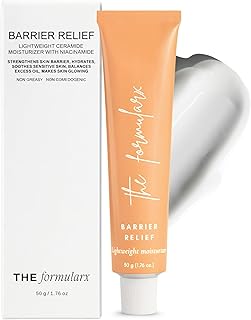
The Formularx Barrier Relief Ceramide Moisturizer
This is one of the better fits for readers whose barrier is damaged from over-cleansing, acids or retinoid irritation but who still break out easily. Ceramides align with the evidence on barrier lipids, while the lightweight format is more practical for oily and combination skin than heavier creams.
- Ceramide-led formula suits the evidence-backed barrier-lipid approach
- Lightweight positioning makes it more usable for oily and acne-prone skin
- Niacinamide is generally well tolerated in cosmetic use and can support a simplified routine
- Expensive at ₹629 for 50 Gram compared with other ceramide options here
- May feel too light for severe dryness or peeling
- Niacinamide can still irritate some individuals depending on formulation tolerance

The Formularx Peptide Ceramide Moisturizer
For a damaged barrier, a nourishing cream with ceramides makes more sense than adding more treatment serums. This option is better aligned to the article’s subtraction-first repair protocol for dry, sensitive skin, where reducing transepidermal water loss matters more than chasing brightening or exfoliation claims.
- Ceramides fit the evidence-backed barrier repair strategy
- More nourishing profile is useful when TEWL and tightness are the main problems
- 4.3 rating from 626 reviews is decent for a targeted barrier cream
- ₹629 for 50 g is costly if you need generous twice-daily use
- Peptides are not the main evidence-backed reason to buy it for barrier repair
- Richer texture may feel heavy on oily skin
Purging vs. Irritation: How to Tell the Difference
Purging and irritation are not the same. Purging is a temporary increase in cell turnover caused by a retinoid or exfoliant, producing blackheads and whiteheads in areas where you already break out. Barrier irritation produces red papules, tenderness and stinging in new locations, and it usually worsens if you keep using the product.
The evidence base for purging as a distinct, measurable phenomenon is weaker than the evidence for irritation. A 2024 acne review supports that topical retinoids can irritate skin early and that acne treatments generally take about six to eight weeks to work, but it did not verify a universal purging timeline.
| Criterion | More likely purging | More likely irritation |
|---|---|---|
| Timing | After a retinoid or exfoliant | After almost any new active |
| Location | Existing breakout zones | New areas |
| Lesion type | Blackheads, whiteheads, familiar bumps | Red papules, stinging, flaking |
| Product | Retinoid or exfoliant | Any irritating product |
| If continued | May settle | Usually worsens |
If the skin burns, scales, feels hot, or breaks out in new zones, stop the product. That is a safer rule than trying to talk yourself into “maybe it is purging.”
Purging vs irritation quick rules
- Purging should stay in places where you normally get acne.
- Irritation often spreads to places that were previously clear.
- Purging is about clogged pores coming up faster.
- Irritation is about inflammation, barrier stress and product intolerance.
- If in doubt, stop the product.
How Long Does Skin Barrier Repair Actually Take?
Most damaged skin barrier signs and repair timelines are ranges, not exact clocks. Mild irritation from active overload often starts settling within about two weeks of simplified care. Moderate cases may take several weeks. Severe or long-standing cases can take six to eight weeks or longer, especially if eczema, rosacea or contact allergy is also present.
Your barrier is recovering when products no longer sting on application, skin feels comfortable after washing rather than tight, and flaking has stopped. Full repair is best judged when you can reintroduce a previously tolerated active without renewed redness or stinging after a few uses.
A 2025 review found barrier recovery begins within hours to days after acute disruption and does not simply wait for a full turnover cycle. That does not mean visible recovery is instant. It means the popular “exactly 28 days” rule is too simple.
Use these week markers instead of counting calendar days too closely:
- Week 1: Stinging starts to reduce. Washing feels less punishing.
- Week 2: Tightness after washing improves. Redness fades faster.
- Week 3: Flaking and rough texture reduce. Irritation breakouts slow down.
- Week 4: You can patch test the first active if skin stays calm.
Do not reintroduce actives until all three are true:
- moisturiser does not sting
- skin does not feel tight after washing
- visible flaking has stopped
When It Is Not Barrier Damage: Eczema, Rosacea and Contact Dermatitis
Not every red, stingy face is showing damaged skin barrier signs and repair needs from over-exfoliation. Weeping, crusting, intense itch, visible blood vessels, a sharp product-related rash border, or redness that stays symmetrical across the face can point to eczema, rosacea or contact dermatitis instead. Those patterns need medical assessment, not more trial-and-error shopping.
Atopic dermatitis, or eczema, often looks itchier and angrier than routine barrier irritation. It may weep, crust, or appear symmetrically. A 2016 review found atopic dermatitis is associated with filaggrin gene mutations that impair barrier function, which helps explain why some people keep reacting even to mild products.
Rosacea is different again. Think persistent central facial redness, visible blood vessels, flushing after heat, alcohol or spicy food, and stinging that does not settle with a bland routine. A source on persistent facial redness and rosacea features supports considering rosacea when redness and flushing do not improve with simple skin care.
Contact dermatitis often has a timing clue. DermNet says allergic contact dermatitis usually develops more than 12 hours after exposure and peaks around 48 hours, while strong irritants may trigger reactions within minutes or hours. A new sunscreen, fragrance, hair dye, preservative or essential oil blend is a common trigger.
If you are also worried about marks after irritation, avoid harsh DIY fixes. Why irritating home remedies like lemon can worsen post-inflammatory pigmentation after barrier damage is worth reading before trying home acids on already reactive skin.
See a dermatologist the same week if:
- symptoms are not improving after four weeks of simplified care
- redness is spreading
- skin is weeping or crusting
- there is swelling, severe pain or fever
- the rash keeps worsening after stopping actives
Safety and when to see a doctor
Burning, swelling, oozing, crusting, severe pain, or a rash that keeps worsening after stopping actives needs medical evaluation. That pattern can fit contact dermatitis, infection or an inflammatory skin disease rather than simple barrier irritation, according to American Academy of Dermatology guidance on contact dermatitis symptoms.
Suspected allergic contact dermatitis from skincare, sunscreen, hair dye, fragrance or preservatives is another reason to stop experimenting. A source on patch testing as the criterion standard supports seeing a dermatologist for patch testing rather than repeatedly trialling new products.
Pregnancy and retinoids need a separate line because the safety issue is clear. The European Medicines Agency states topical retinoids are contraindicated in pregnant women and women planning pregnancy as a precaution. The U.S. Food and Drug Administration label for tazarotene also states it is contraindicated in pregnancy.
Persistent facial redness, flushing, visible blood vessels or stinging that does not improve with a bland routine should raise suspicion for rosacea. A source on rosacea features supports medical assessment when flushing and visible vessels persist.
Hand eczema or dermatitis linked to wet work, detergents, disinfectants or occupational exposure also deserves early care. A source on occupational irritant dermatitis supports reducing exposure early because chronic cases are harder to clear.
Affiliate disclosure: some product links in this article are affiliate links. Products were independently selected on formula fit, price and public review data. No hands-on testing was performed for this article, and no named clinical reviewer is attached to this publication.
Myths that keep damaged barriers damaged
Myth: A damaged skin barrier always repairs itself in exactly 28 days.
A 2025 review of skin barrier physiology does not support that fixed timeline. Barrier recovery can begin within hours to days after acute disruption. Visible recovery often still takes weeks.
Myth: Niacinamide above 5% is proven to cause flushing in most sensitive-skin users.
The reviewed safety assessment did not verify a clear irritation threshold above 5%, and niacinamide was reported as non-stinging up to 10% in clinical testing. Niacinamide is usually well tolerated, but any active can sting on a compromised barrier depending on the full formula and the individual’s skin.
Myth: Purging is the reason for every breakout after starting a retinoid.
The 2024 acne review supports that retinoids can irritate skin early and that acne treatments take six to eight weeks to work, but it does not validate purging as the explanation for every flare.
Myth: AHAs and BHAs always thin the skin and destroy the barrier.
A human study of 4% glycolic acid twice daily for three weeks did not show disrupted lipid lamellae or increased TEWL. Exfoliating acids can be useful, but overuse can irritate skin. Barrier risk depends on the formula, strength and frequency.
A real-world case: active overload in Mumbai
Composite illustrative case: A 28-year-old Mumbai reader routine is a good example of damaged skin barrier signs and repair after active overload. She used glycolic acid 7% three mornings a week, niacinamide 10% most mornings, and retinol 0.5% four nights a week over six weeks, with a foaming cleanser twice daily. The first symptom was not flaking. It was a sharp sting from sunscreen around the nostrils and upper lip, followed by tightness after washing and patchy makeup over the cheeks.
By week 6, the cleanser that used to feel normal gave a hot prickly feeling for about 20 seconds. The sunscreen that had once dried invisible now felt peppery on application. Flaking around the mouth and nose showed up first. New red bumps on the cheeks came later. In week 1 after stopping actives, the burning dropped first and washing felt less punishing. By week 3, the roughness and evening tightness improved, and the sunscreen no longer stung. That pattern does not prove every case will settle in three weeks. It shows what realistic improvement can look like when the trigger is too many actives skin damage rather than an underlying skin disease.
Where the evidence is missing, and why that matters
Very little barrier-repair trial evidence is specific to Indian populations, Indian climates or darker Fitzpatrick skin types. Most identified clinical studies were conducted in Europe, East Asia or mixed international settings. That does not make the evidence useless. It does mean direct extrapolation to Indian heat, humidity, pollution and skin-of-colour concerns should be cautious.
There is also no strong head-to-head evidence comparing the popular Indian barrier creams in your cart. The literature supports ingredient classes such as ceramides, petrolatum and glycerin more than named Indian-market products. So if another site tells you one Indian barrier cream is “clinically the best,” ask for the actual comparative trial.
Hard-water evidence is also weaker than social media claims suggest. The best study reviewed was epidemiologic, mostly from a UK cohort, measured hardness as calcium carbonate, and did not test Indian TDS thresholds or direct barrier-lipid outcomes.
The evidence base for purging is weaker than the evidence for irritation. Acne guidance supports counselling about irritation and realistic treatment timelines, but not a standardised diagnostic definition of purging with a universal clock.
Methodology note: products were shortlisted from publicly available Indian marketplace listings for gentle cleansers and barrier moisturisers that fit the ingredient logic discussed in the evidence. Prices and ratings were taken from the supplied Amazon India listings. Formulas were assessed from public ingredient positioning and product descriptions. No hands-on testing was performed.
Frequently Asked Questions
What are the signs of a damaged skin barrier?
The most suggestive damaged skin barrier signs and repair clues are prickling or heat after applying routine products, tightness soon after washing, flaking with oiliness, new scattered bumps, and redness that lingers. If several appear together, barrier damage is a strong possibility, but eczema, rosacea, seborrhoeic dermatitis and contact dermatitis can look similar.
How long does it take to repair a skin barrier?
Mild irritation often starts settling within about two weeks of simplified care. Moderate cases may take several weeks. Severe or long-standing cases can take six to eight weeks or longer. A 2025 review supports that recovery starts before a full 28-day cycle, but visible improvement still takes time.
Am I over-exfoliating?
Over exfoliation signs include stinging, new sensitivity, flaking, tightness after washing and redness that started after adding or increasing acids or retinoids. The exact rule that more than three AHA or BHA uses per week always means over-exfoliation was not supported by a named source, so frequency should be judged alongside strength, layering and your own tolerance.
Why does my skin sting when I apply products?
Why does my skin sting is usually a barrier question, but not always. A weakened barrier can let ingredients reach living skin more easily, so even bland products can prickle. Allergic or irritant contact dermatitis can also cause skin burning after applying products, especially if the reaction is delayed or keeps worsening.
Which ingredients repair the skin barrier?
Ceramides, cholesterol and fatty acids are the most structurally relevant ingredients because they match the barrier’s lipid matrix. Glycerin and hyaluronic acid help hydration, and petrolatum helps reduce water loss. A triple-lipid formula is more physiologically complete than ceramides alone, but direct head-to-head human evidence is limited.
Should I stop all actives if my skin barrier is damaged?
If a routine is clearly causing damaged skin barrier signs and repair needs, pausing the irritating actives is usually the safest step. That often means stopping exfoliating acids, retinol, vitamin C and any product that stings. Niacinamide does not need a blanket ban, but if a niacinamide serum burns on your skin, pause it too.
Can a damaged skin barrier cause acne?
Barrier dysfunction is linked to acne-prone, reactive skin, and irritation can trigger scattered inflamed bumps. But acne, rosacea and dermatitis can overlap. If the bumps are new, tender and come with flaking or stinging, irritation is more likely than a normal acne flare.
Is skin purging the same as irritation from barrier damage?
No. Purging usually stays in your usual acne zones and is tied to cell-turnover products. Irritation from barrier damage causes red bumps, tenderness, flaking and stinging, often in new areas, and usually gets worse if you keep using the product.
How will I know when my skin barrier is repaired?
Repair is likely when products no longer sting, skin does not feel tight after washing, and visible flaking has stopped. A practical confirmation is tolerating a previously safe active for a few uses without renewed redness, burning or roughness.
Can a damaged skin barrier be repaired?
Yes, most cases can improve if the cause is overuse of actives, harsh cleansing or environmental irritation. The usual answer to how to repair skin barrier problems is subtraction first: remove triggers, keep the routine plain, and give the skin time. If symptoms persist or worsen, think beyond barrier damage and get assessed.
Which oil is best for skin barrier repair?
No standalone facial oil has stronger evidence than a well-formulated barrier cream or petrolatum for reducing water loss. Linoleic acid matters biologically, but the clinical evidence is stronger for full moisturisers than for oils alone.
What products destroy the skin barrier?
The usual problem is not one cursed product. It is repeated overuse of glycolic acid, salicylic acid, retinol, harsh foaming cleansers, alkaline soaps, physical scrubs and fragranced products on already irritated skin. Too many actives skin damage is more common than one product causing instant collapse.