

Anyone searching how to remove tan and pigmentation naturally needs one distinction first. A sun tan fades on its own as skin cells turn over and shed pigmented surface cells. Persistent dark spots, especially post-inflammatory hyperpigmentation and melasma, are a different biological process and do not respond to generic tan-removal remedies. Daily broad-spectrum sunscreen is the non-negotiable first step, then evidence-backed actives such as niacinamide and alpha arbutin can help.
Key takeaways
- A UV-induced tan fades naturally as the skin sheds pigmented cells, but post-inflammatory hyperpigmentation and melasma are driven by different mechanisms and need different treatment. A fixed two-to-six-week promise is too specific for the evidence located, though that range is common in mild cases according to turnover biology from a 2025 narrative review.
- Lemon juice applied to the face contains furanocoumarins, also called psoralens, that react with UVA radiation to cause phytophotodermatitis, a chemical burn that can leave darker and longer-lasting pigmentation than the original tan, according to DermNet’s 2021 review.
- Daily broad-spectrum SPF 30 or higher sunscreen is the single most evidence-supported step for melasma and post-inflammatory hyperpigmentation. A 2024 review of sunscreen use in hyperpigmentation care found SPF 30 or greater was recommended across the evidence base.
- Niacinamide, alpha arbutin, kojic acid, azelaic acid, and ascorbic acid, which is vitamin C, each have some published evidence for reducing hyperpigmentation. But many studies are small or heterogeneous, so exact rankings and timelines need caution.
- Symmetrical dark patches on the upper lip, cheeks, or forehead that worsen in summer and do not settle with sunscreen alone should be assessed by a dermatologist, because melasma is hormonally linked and often needs prescription treatment.
The Short Answer: Tan Fades, Pigmentation Needs a Plan
How to remove tan and pigmentation naturally starts with naming the problem correctly. A UV tan is surface darkening after sun exposure and usually fades gradually as pigmented keratinocytes are shed with epidermal turnover, but the exact timeline varies with UV dose, skin type, and ongoing exposure, according to a 2025 narrative review. Post-inflammatory hyperpigmentation and melasma involve ongoing melanin overproduction, so the usual tan removal home remedies that work for little beyond time will not fix them.
Most bad advice lumps every dark patch together. Post-inflammatory hyperpigmentation can start after acne, eczema, waxing, or irritation, and melasma is strongly linked to hormones, pregnancy, and oral contraceptive use, according to 2025 American Academy of Dermatology guidance and a 2019 review on hormonal modulation of melasma.
Sunscreen comes first. A 2024 review of sunscreen use in hyperpigmentation care found broad-spectrum sunscreen was one of the best-supported parts of treatment for pigmentation disorders, especially alongside other topicals.
Tan, PIH, or Melasma: Which One Do You Actually Have?
A sun tan is a temporary darkening caused by melanin produced in response to UVB radiation, and it fades as skin cells shed. Pigmentation, especially post-inflammatory hyperpigmentation or melasma, involves deeper or hormonally driven melanin overproduction that does not resolve on the same timeline. The difference between tan and pigmentation matters because the wrong treatment can waste months or make marks darker.
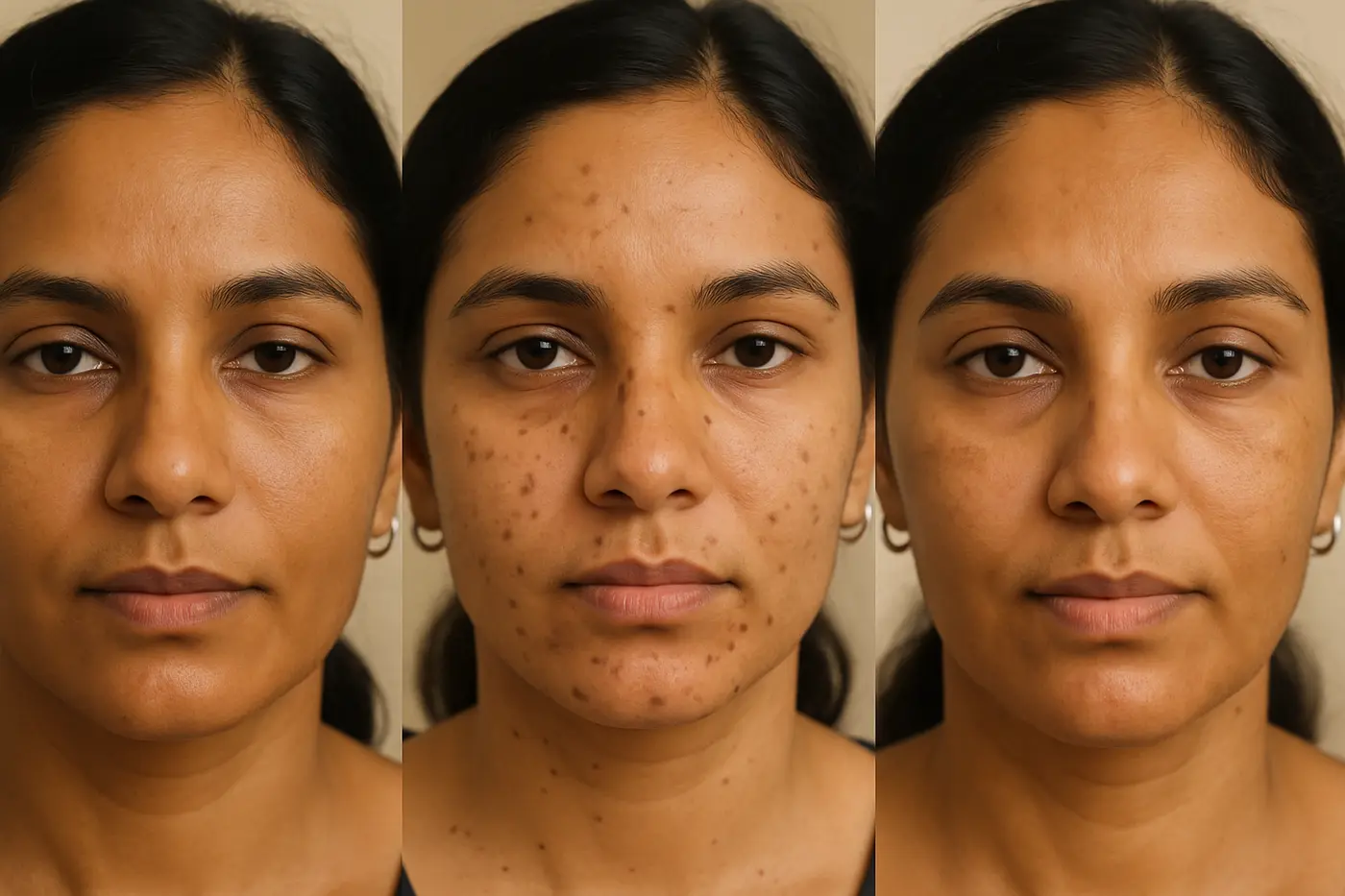
Use the checklist below as a reader simplification, not a diagnosis. The pattern is based on American Academy of Dermatology guidance on melasma and DermNet pattern descriptions. Persistent, symmetrical, changing, or distressing patches need clinician assessment.
UV-Induced Tan
UV-induced tan usually appears on sun-exposed areas such as the forehead, nose, cheeks, arms, neck, and feet. UVB radiation is the primary driver of UV-induced tanning via melanocyte stimulation and melanin production, according to a 2021 review of skin pigmentation biology. The darkening often starts within hours to days after exposure and then fades gradually as excess pigment is shed with epidermal turnover.
A beach-day tan often looks flat and diffuse rather than spotty. At day three it can look a little muddy across the forehead and nose, then by week four the edges soften if sunscreen is strict. What usually slows progress is another commute, another weekend in the sun, or trying harsh scrubs that leave the skin tight and stingy.
Post-Inflammatory Hyperpigmentation (PIH)
Post-inflammatory hyperpigmentation, or PIH, starts after inflammation. Acne, eczema, cuts, burns, irritating products, and waxing can all trigger it, according to 2025 American Academy of Dermatology guidance. Waxing-induced PIH can happen around the upper lip, sideburns, and jawline because repeated friction and inflammation leave marks where the trigger was, a pattern also reflected in a 2024 systematic review of PIH in skin of colour.
PIH often looks patchy rather than symmetrical. It sits exactly where the trigger was. And PIH is more common, more severe, and often more persistent in darker skin tones, especially Fitzpatrick skin type scale III to VI, according to a 2024 systematic review of 1,356 patients in skin of colour.
PIH after acne or waxing usually has sharper borders than a tan. In week one after a pimple or threading session, the mark can look red-brown or purple-brown. By week eight, sunscreen plus one gentle active may flatten the colour, but picking, rubbing, or adding three acids at once often makes the mark darker first.
Melasma
Melasma is associated with hormonal factors including pregnancy and oral contraceptive use, according to a 2019 review. It usually appears as symmetrical grey-brown or brown patches on both cheeks, the forehead, bridge of the nose, or the upper lip, often in a butterfly pattern.
Melasma also tends to worsen in summer or after even modest sun exposure. And melasma is chronic. American Academy of Dermatology guidance from 2023 describes relapse as common without ongoing sun protection, which is why generic advice about dark spots on face treatment at home often fails badly here.
Upper-lip or cheek melasma often fools people because the skin is not rough, sore, or spotty. It can look almost like a shadow. After four weeks of random brightening products, many people see no change. After eight to 12 weeks of strict sunscreen and one active, the patch may look less dense, but heat and one missed sunny week can bring it back fast.
Reader Checklist
| Observable clue | UV tan | Post-inflammatory hyperpigmentation (PIH) | Melasma |
|---|---|---|---|
| Location | Sun-exposed areas only | Exactly where acne, rash, waxing, or injury happened | Cheeks, forehead, upper lip, nose |
| Symmetry | Often uneven | Usually uneven or spot-like | Usually symmetrical on both sides |
| Onset trigger | Sun exposure | Inflammation or friction | Hormones plus sun, often pregnancy or OCPs |
| Response to sunscreen alone | May gradually improve | Helps prevent worsening, but old marks linger | Helps, but often not enough alone |
If a dark patch sits only where the sun hits, came soon after a beach day or commute, and slowly lightens with strict sunscreen, it is probably a tan. If it began after acne or waxing, it is more likely PIH. If it is symmetrical across the cheeks or upper lip and flares every summer, think melasma vs pigmentation, and get a dermatologist involved early.
Lemon, scrubs, and random masks do not address the real driver. They often add more irritation, which means more pigment.
Why Lemon Is the Worst Common Advice (And What Else to Avoid)
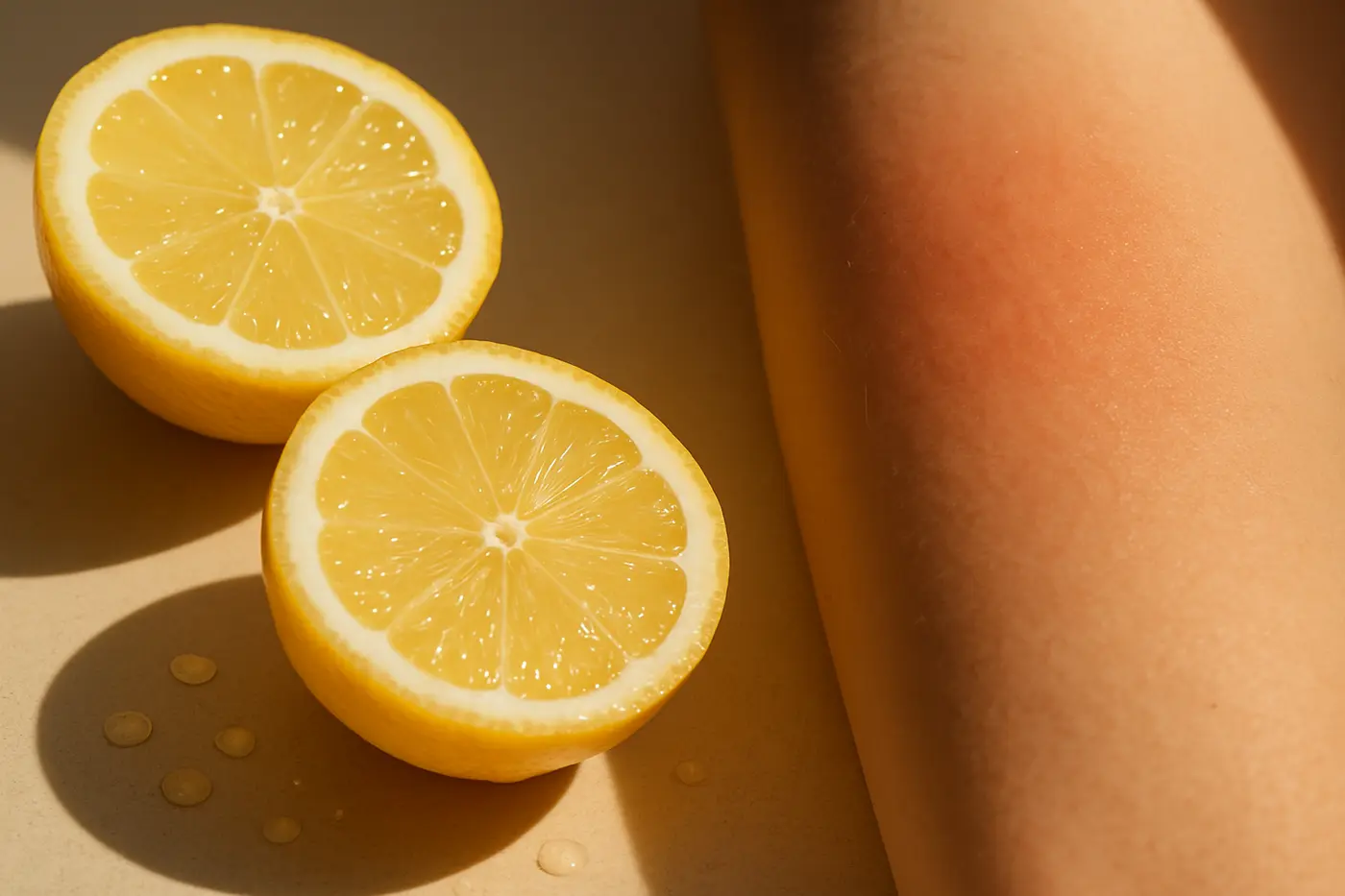
Lemon juice does not reliably remove tan or pigmentation and can make both worse. Citrus contains furanocoumarins that react with UVA radiation to trigger phytophotodermatitis, a chemical burn that causes post-inflammatory hyperpigmentation darker and more persistent than the original tan. DermNet’s 2021 review states that the pigmentation after phytophotodermatitis may last for years.
Lemon Juice and Phytophotodermatitis
Furanocoumarins, also called psoralens, in citrus juice react with UVA radiation to cause phytophotodermatitis, according to DermNet’s 2021 review. In plain language, lemon on skin plus sunlight can trigger a photocontact injury.
The reaction is not mild brightening. It can be redness, burning, blistering, and then post-inflammatory hyperpigmentation. And that pigmentation can outlast the original tan by months or even years, which makes the advice worse than useless. So if you have ever searched does lemon remove tan, the honest answer is no, and it can leave you with a harder problem.
Baking Soda, Toothpaste and Aggressive Scrubs
Baking soda is another bad idea. Skin surface pH is normally mildly acidic, averaging below 5 in many measurements, and alkaline exposures can impair barrier function, according to a 2006 review on skin pH and barrier function. That means applying baking soda is biologically plausible as an irritant, not a safe tan-removal method.
Toothpaste is not better. Toothpaste can contain abrasives, detergents, flavouring agents, and fluoride compounds that irritate facial skin. The likely outcome is contact dermatitis, then more pigmentation after the irritation settles.
And aggressive scrubbing is a direct risk in Indian skin tones. Mechanical over-exfoliation triggers post-inflammatory hyperpigmentation, particularly in Fitzpatrick III to VI skin tones, according to 2025 American Academy of Dermatology guidance and a 2024 systematic review in skin of colour. If you keep rubbing a mark to “remove” it, you may be teaching melanocytes to make more melanin.
Common myths to stop believing
- Myth: Lemon juice removes tan and pigmentation naturally and safely.
Say instead: Do not apply lemon juice to skin for tan or pigmentation. Citrus exposure plus sunlight can cause phytophotodermatitis and leave darker, longer-lasting marks than the original tan, according to DermNet’s 2021 review. - Myth: Baking soda scrubs remove tan without harming skin.
Say instead: Skip baking soda. There is no good evidence it removes tan safely, and irritating the skin can worsen pigmentation rather than improve it, based on barrier biology from the 2006 skin pH review. - Myth: Natural home remedies can clear melasma in a few days.
Say instead: Melasma usually needs consistent sun protection and evidence-based treatment over weeks to months, and stubborn cases often need a dermatologist, according to the 2019 melasma review. - Myth: Any sunscreen is enough for pigmentation if the SPF number is high.
Say instead: Choose a broad-spectrum sunscreen you will apply generously every day, and for melasma or PIH in deeper skin tones consider tinted formulas with visible-light protection. A 2014 randomized trial of 68 patients found visible-light-protective sunscreen performed better for melasma than a UV-only broad-spectrum sunscreen when both groups also used hydroquinone.
Sunscreen First: Why Nothing Else Works Without It
UV exposure is the main signal that tells melanocytes to produce more melanin. Without daily broad-spectrum SPF 30 or higher, any topical active is working against ongoing UV stimulation and will show limited effect. Broad-spectrum sunscreen is a core part of treatment and prevention for melasma and PIH, and a 2024 review of sunscreen use in hyperpigmentation care supported its use, especially when combined with other depigmenting therapy.
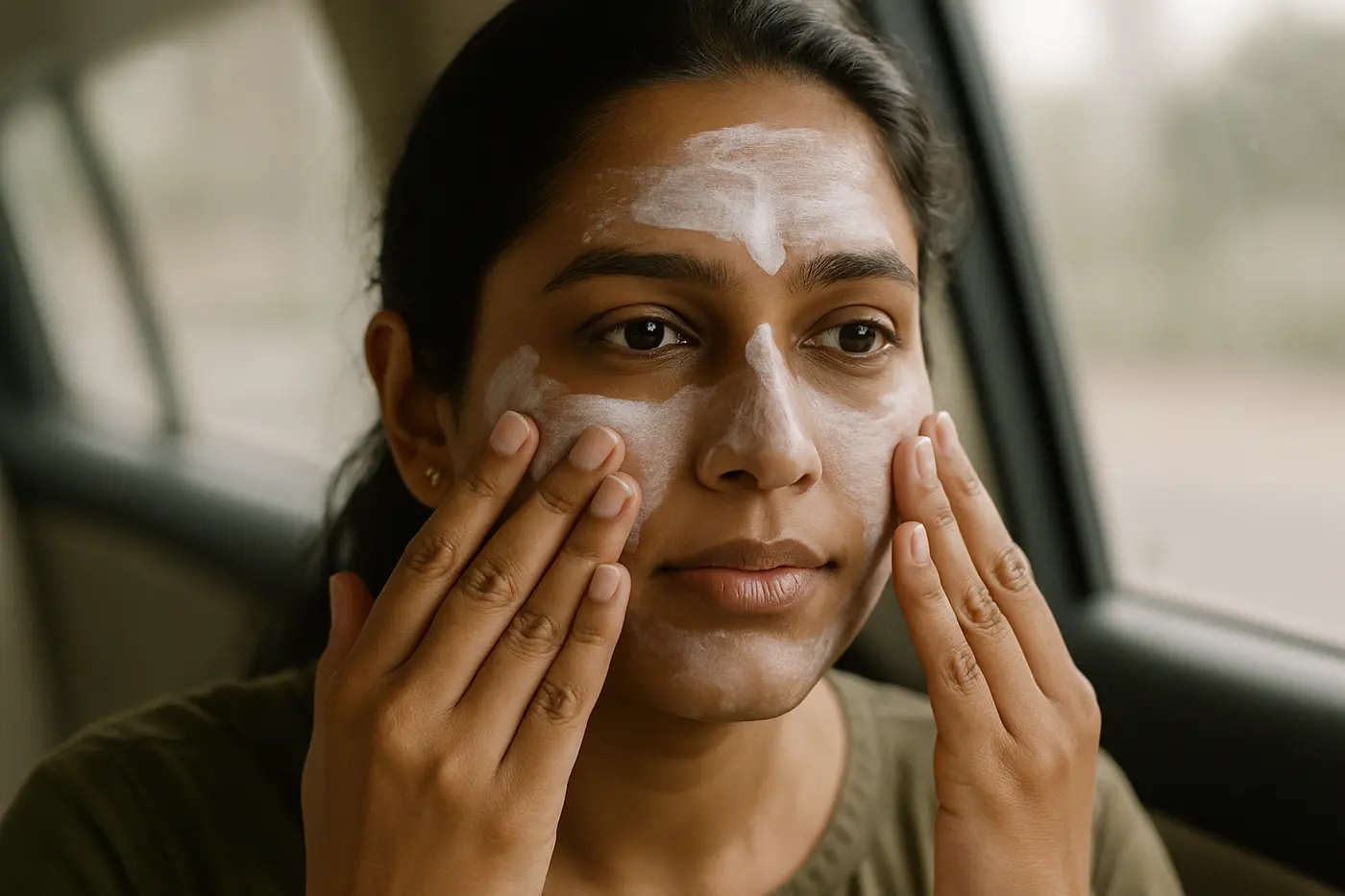
For Indian conditions, SPF 50 is often the more practical choice because people under-apply sunscreen, and the exact amount of sunscreen to apply and why underapplying makes pigmentation treatment fail matters as much as the label. Broad-spectrum matters because you need UVA plus UVB coverage, not just a high SPF number. UVA can penetrate ordinary window glass more effectively than UVB, according to a 2023 clinician review on photoprotection, so indoor and in-car exposure can still contribute to pigment worsening.
Visible light is an underrecognized driver of melasma and PIH in skin of color, according to a 2024 review on tinted sunscreens in skin of color, which is why tinted sunscreens with iron oxides can matter more than standard untinted SPF alone. A 2014 randomized trial of 68 patients under intense solar conditions found a broad-spectrum sunscreen with visible-light protection performed better for melasma than a regular UV-only sunscreen when both groups also used hydroquinone.
Use broad-spectrum sunscreen every morning. Reapply every two hours outdoors. If you are comparing physical and chemical sunscreen, the practical difference is simple: mineral filters sit on the skin and reflect or scatter some radiation, while chemical filters absorb UV energy, according to the 2023 clinician review on photoprotection. Pick the one you will wear enough of. For pigmentation, consistency beats theory.
What the Evidence Actually Supports: Actives That Work
Niacinamide, alpha arbutin, kojic acid, azelaic acid, and ascorbic acid each have published clinical or mechanistic evidence for reducing hyperpigmentation, while tranexamic acid has emerging evidence, especially for melasma. Visible results usually take weeks, not days, and the evidence is uneven across ingredients. Many consumer claims about exact percentages are more precise than the independent clinical data.
The Evidence-Backed Actives at a Glance
| Ingredient | Study range | Vehicle | Duration | What evidence supports | ₹ range |
|---|---|---|---|---|---|
| Niacinamide | Evidence does not establish optimal OTC concentration | Topical cream in human data | About 8 weeks in cited human work | Mechanistic support for reduced melanosome transfer | ₹250 to ₹900 |
| Alpha arbutin | Evidence does not establish optimal OTC concentration | Varies | Varies | Tyrosinase inhibition, limited clinical proof | ₹400 to ₹1,200 |
| Kojic acid | 2% in cited melasma trial | Cream | 12 weeks | Clinical melasma improvement in RCT | ₹250 to ₹900 |
| Azelaic acid | Mostly 20% in RCTs | Cream or gel | 8 to 24 weeks | Randomized evidence for melasma | ₹300 to ₹1,500 |
| Ascorbic acid | 5% in cited RCT | Cream | 16 weeks | Some melasma benefit, weaker than hydroquinone | ₹350 to ₹1,800 |
| Tranexamic acid | Topical concentrations varied across trials | Topical, oral, injected | Mostly 8 to 12 weeks | Emerging melasma benefit across forms | ₹500 to ₹1,800 |
Niacinamide is useful, but the evidence is weaker than the internet makes it sound. A 2005 mechanistic study with a human clinical component supports reduced melanosome transfer, but the evidence does not establish an optimal OTC concentration. If you are trying how to remove tan and pigmentation naturally with niacinamide, do not judge it before about 8 to 12 weeks.
Alpha arbutin is widely sold in India, but the concentration claims are ahead of the independently verified clinical evidence. A 2018 review supports the tyrosinase-inhibition rationale, but evidence does not establish an optimal OTC concentration.
Kojic acid has one of the cleaner evidence stories among nonprescription pigment actives. A 2013 randomized single-blind trial in 80 patients with melasma used a 2% kojic acid cream over 12 weeks and found improvement. Kojic acid can still sting, and if stinging turns into persistent burning or scaling, stop rather than pushing through irritation.
Azelaic acid deserves more attention than it gets. A 2023 meta-analysis of six randomized studies with 673 patients found azelaic acid may perform at least as well as hydroquinone in pooled MASI outcomes. Most randomized data used 20% cream or gel over 8 to 24 weeks, so do not judge azelaic acid before about 8 to 12 weeks.
Ascorbic acid, or vitamin C, makes sense on paper and has some clinical support. But the evidence base is limited and heterogeneous, and even a 2004 split-face randomized trial of 16 women used 5% ascorbic acid for 16 weeks and found vitamin C improved melasma but was less effective than hydroquinone.
Tranexamic acid is where dermatologist care often starts to matter. A 2024 meta-analysis of 22 randomized studies with 1,280 patients found benefit across multiple melasma severity scores, but topical concentrations varied and oral treatment is not for self-start use.
A simple routine works better than a crowded one. If you are trying how to remove tan and pigmentation naturally, pick sunscreen plus one active for 8 to 12 weeks before deciding it failed, unless irritation forces you to stop.
Method note: products were shortlisted from public ingredient lists, stated actives, format, price, and user ratings visible on Amazon.in on the drafting date. Formulas were assessed from public listings only. No hands-on testing was performed.
We may earn a commission from purchases made through these links, at no extra cost to you. Products are chosen on evidence and value, never on commission.

Be Bodywise Pigmentation Cream 100gm
This is one of the few candidates that names evidence-linked pigment ingredients, especially kojic acid, in a leave-on format rather than a wash-off scrub. The added lactic acid and retinol may help texture and gradual tone evening on thicker body skin, but it is not a substitute for sunscreen or prescription melasma care.
- Contains kojic acid, which fits the article’s evidence-backed depigmenting actives
- Leave-on cream format gives longer contact time than a quick wash-off pack, which is a reasonable editorial inference for pigmentation care
- Lactic acid and urea can help rough, darker body areas where texture and pigmentation overlap
- Rs 549 is expensive for a body cream if you need regular use on large areas
- Retinol and acids can sting or irritate, which may worsen marks in sensitive skin
- Better suited to body areas than facial melasma

Dermistry 1% Kojic Acid Pigmentation Face Pack Mask
Kojic acid is one of the better-supported pigment ingredients in the evidence set, and this product states 1% kojic acid clearly. It is still a face pack, so contact time is limited compared with a leave-on serum or cream, and the review count is small.
- States 1% kojic acid, an active that matches the evidence better than generic tan-removal claims
- Lower price at Rs 279 than many leave-on pigmentation products
- More evidence-aligned than scrub-based or lemon-based options in this list
- Wash-off mask format is less convincing for pigmentation than a leave-on product
- Only 54 reviews, so buyer feedback is limited compared with more established products
- Small 50ml size may not last long with regular use
A Note on Prescription Options
Hydroquinone and tretinoin belong in dermatologist territory. Hydroquinone remains a drug ingredient used under medical supervision in prescription contexts in the United States, and tretinoin is a prescription-only topical retinoid drug under U.S. FDA status. In India, access patterns differ, but the safety principle does not.
Also avoid steroid-containing anti-pigmentation creams sold over the counter. Unsupervised use of topical steroid-containing facial creams can cause cutaneous atrophy, acneiform eruptions, telangiectasia, and dyschromia, and misuse in India is well documented, according to a 2014 review on topical corticosteroid misuse in India. If a cream promises fast fairness or overnight spot removal, that is a red flag.
Realistic Timelines: Months, Not Days
A mild to moderate sun tan typically fades without treatment as pigmented surface cells are shed with epidermal turnover, but the exact timeline varies and a universal 28-day turnover claim was not robustly verified in the evidence set. Deeper or repeated UV exposure can take much longer. Claims such as remove tan in 5 minutes or one week are not consistent with skin biology.
A 2025 narrative review supports the idea that epidermal turnover contributes to shedding excess pigment, but not a fixed timeline for everyone. For PIH and melasma, the timelines are much longer because the problem is not just old pigment waiting to shed. It is ongoing pigment production.
A 2023 systematic review of PIH outcomes in 877 patients found complete response was uncommon, only 5.4 percent with topicals and 2.4 percent with combination therapies. If PIH is still actively darkening because acne or eczema is ongoing, treat the trigger first, which matches American Academy of Dermatology guidance.
| Condition | Natural fade | Sunscreen only | Sunscreen + topical | Prescription territory |
|---|---|---|---|---|
| UV tan, mild to moderate | Usually gradual fade | Stops re-darkening | Often not needed | Rare |
| UV tan, deep or repeated exposure | Weeks to months | Important | May help residual unevenness | Rare |
| PIH | Often months | Prevents worsening | Often 3 to 6 months | If no improvement after 3 months |
| Melasma | Persistent, relapse-prone | Essential | Often 6 to 12 months | Common |
If you are trying how to remove tan and pigmentation naturally, the practical benchmark is simple. Do not judge niacinamide or azelaic acid before about 8 to 12 weeks, because that matches the duration used in the cited human studies and reviews. People often quit at week six because the patch looks the same in bathroom light, then restart something harsher and end up irritated.
Composite illustrative case
A 32-year-old woman develops diffuse thinning four months after delivery and also notices a symmetrical brown shadow on the upper lip and cheeks. Ferritin is 18 ng/mL. The hair shedding pattern fits postpartum telogen effluvium, while the facial pattern fits melasma more than a tan. The evidence-supported first step is strict daily broad-spectrum sunscreen, because the American Academy of Dermatology places sun protection at the center of melasma self-care. A gentle active such as azelaic acid can be reasonable because a 2023 meta-analysis of randomized trials supports azelaic acid in melasma. At four weeks, the patch may look only slightly softer. At eight weeks, the edges may look less dense if sunscreen use is consistent. At 12 weeks, improvement can be visible but incomplete, and relapse risk remains. Because pregnancy-related and postpartum pigment patterns can persist, clinician review is sensible if the patches are distressing or spreading.
India Context: Why UV Is a Year-Round Problem Here
Published Indian UV Index data show that major cities such as Chennai, Mumbai, and New Delhi frequently reach very high to extreme midday UV Index values, and a 2024 Kerala UV Index analysis also showed substantial UV levels during monsoon periods. The practical point is clear: Indian UV exposure is often high enough to keep pigmentation active.
UVA can penetrate ordinary window glass more effectively than UVB, according to a 2023 clinician review, so indoor and in-car exposure can still contribute to pigment worsening. Hard water in cities such as Delhi and Chennai does not directly cause pigmentation, but barrier disruption and irritation matter when you are already using acids or scrubs, which is biologically plausible from the 2006 review on skin pH and barrier function.
People with Fitzpatrick III to VI skin tones also need a different expectation. PIH is more common, more severe, and often more persistent in darker skin tones, according to a 2024 systematic review. That is one reason Indian readers often feel a mark “never fades,” even when the trigger has stopped.
Heat, sweat, and hard water can make sunscreen adherence harder in real life, so how to choose a sunscreen texture that oily or acne-prone skin will actually wear daily in Indian weather matters if you keep skipping application.
UV by Indian City: A Quick Reference
| City | Midday UVI | Common concern | Practical note |
|---|---|---|---|
| Delhi | Frequently very high | Tan plus PIH | Dry weather can increase sensitivity |
| Mumbai | Frequently very high | Melasma and PIH | Monsoon cloud is not full protection |
| Chennai | Very high to extreme | Melasma and tanning | Pick a texture you will reapply |
| Bengaluru | Often high | PIH plus incidental tanning | Milder weather can mislead you |
| Kolkata | Frequently very high | Tan, PIH, melasma | Commute exposure adds up |
When to See a Dermatologist: Prescription Territory
See a dermatologist if dark patches are symmetrical, appear on the upper lip or cheeks, worsen in summer, or have not improved after three months of consistent sunscreen and evidence-backed topicals. Melasma often needs prescription options such as hydroquinone or tretinoin that cannot be safely self-managed. And any sudden change in a dark patch needs medical assessment to rule out other causes.
Melasma is the clearest reason to stop guessing. If the patch is symmetrical and linked to pregnancy, oral contraceptive use, or repeated summer flares, think melasma rather than a simple tan. Start strict photoprotection, but do not expect home remedies to clear it.
A dermatologist may discuss hydroquinone, tretinoin, or combination formulations. They may also discuss clinic procedures such as chemical peels or laser in selected cases. The right option depends on diagnosis, skin tone, irritation history, and pregnancy status.
Please also treat steroid creams as a safety issue. Unsupervised steroid-containing fairness or anti-pigmentation creams can cause skin thinning, acneiform eruptions, visible vessels, and dyschromia, according to the 2014 Indian misuse review. If you have been using one, stop self-treating and get help.
Other clear triggers to seek care:
- Dark patches that are symmetrical on the cheeks, forehead or upper lip, especially with pregnancy, oral contraceptive use or recurrence after sun exposure. Consider melasma rather than a simple tan. Start strict photoprotection, but seek a dermatologist if the pigmentation is persistent, spreading or distressing because melasma often needs prescription treatment and relapse prevention, according to a 2019 review.
- Burning, blistering or streaky dark marks after lemon, lime, celery or other plant or citrus exposure plus sun. Stop all DIY treatment and seek medical care if the reaction is painful, blistering or extensive. This pattern is consistent with phytophotodermatitis and can leave prolonged hyperpigmentation, according to DermNet.
- Use of steroid-containing fairness or anti-pigmentation creams bought OTC or without clear medical supervision. Stop unsupervised steroid use and see a dermatologist, especially if you notice thinning skin, acneiform eruptions, redness, visible vessels or worsening discoloration, according to the 2014 Indian misuse review.
- Pregnancy or trying to conceive while considering oral tranexamic acid, hydroquinone or prescription retinoids for pigmentation. Do not self-start these treatments in pregnancy. Seek clinician guidance because pregnancy changes the differential diagnosis and some pigment treatments are not appropriate for unsupervised use in pregnancy.
- Pigmentation after acne, eczema or repeated irritation that keeps recurring while the underlying inflammation is still active. Treat the trigger first. If acne, eczema or another inflammatory condition is ongoing, see a dermatologist because continued inflammation can keep generating new PIH even while old marks fade, according to the American Academy of Dermatology.
Frequently Asked Questions
Does lemon juice remove tan or dark spots?
No. Lemon juice contains furanocoumarins that react with UVA radiation to cause phytophotodermatitis, a chemical burn that produces post-inflammatory hyperpigmentation darker than the original tan. Applied to the face in sunlight, lemon juice can worsen the very dark spots it is meant to treat, according to DermNet.
What is the difference between a sun tan and pigmentation?
A sun tan is temporary darkening from UVB-triggered melanin production and then gradual shedding of pigmented surface cells. Pigmentation, especially post-inflammatory hyperpigmentation or melasma, involves deeper or hormonally driven melanin overproduction that persists much longer and does not respond to standard tan-removal remedies.
How long does a sun tan take to fade on its own?
A mild to moderate sun tan often fades gradually as pigmented keratinocytes are shed with epidermal turnover, but the exact timeline varies with UV dose, skin type, and ongoing exposure. Repeated or intense UV exposure can extend the process for much longer. If a dark patch stays fixed for months, especially with symmetry or recurrence, it may not be a simple tan.
Do home remedies work for dark spots and pigmentation?
Most popular home remedies, including lemon, potato juice, and tomato pulp, lack good controlled clinical evidence for pigmentation. Some can irritate skin and worsen PIH. Evidence-backed over-the-counter actives such as niacinamide, kojic acid, azelaic acid, and alpha arbutin are more plausible choices, but sunscreen still matters more.
Which ingredient actually fades pigmentation?
Niacinamide, alpha arbutin, kojic acid, azelaic acid, ascorbic acid, and tranexamic acid all have some level of evidence for pigmentation. Azelaic acid and tranexamic acid have particularly useful melasma data. But results are gradual, and many exact concentration claims in marketing are stronger than the independently verified evidence.
Can pigmentation come back after treatment?
Yes. Melasma is chronic and relapse is common, especially without ongoing photoprotection, according to American Academy of Dermatology guidance from 2023. PIH can also recur if acne, eczema, friction, or waxing keeps triggering new inflammation.
Is upper-lip darkness after threading the same as upper-lip melasma?
No. Threading or waxing marks usually sit exactly where friction happened and often look uneven or broken up. Upper-lip melasma is more often symmetrical and can look like a soft brown shadow that returns every summer. If the upper-lip darkness started after hair removal and stings with products, think irritation first. If the upper lip and cheeks darken together, think melasma and get assessed.
What should I do if kojic acid stings after three uses?
Short-lived tingling can happen, but persistent burning, scaling, or shiny tight skin means the barrier is getting irritated. Stop the kojic acid for a few days, keep sunscreen steady, and use a bland moisturizer. When you restart, use less often. If the mark looks darker after the irritation, that is a sign to stop rather than push through.
When should I see a dermatologist about dark patches?
See a dermatologist if dark patches are symmetrical, appear on the upper lip or cheeks, worsen each summer, or show no improvement after three months of daily sunscreen and a sensible over-the-counter active. Also get assessed if a patch changes shape, colour, or size, or if you have used steroid creams.
How can I reduce tanning and pigmentation?
Use broad-spectrum sunscreen every day, preferably SPF 30 at minimum and often SPF 50 in Indian conditions. Stop irritation first, especially acne, eczema, harsh scrubs, or lemon use. Then add one evidence-backed active, not five at once. If the pattern is symmetrical or recurrent, see a dermatologist early.
Can tanned skin become white again?
Your skin returns toward its natural baseline shade after a tan fades, but skincare cannot turn your skin into a different natural colour safely. If the darkening is actually PIH or melasma, the goal is reducing excess pigment, not whitening.
How do I remove 100% tan naturally?
You cannot force 100 percent removal overnight. A true tan fades gradually as pigmented cells are shed. The safest approach is strict sun protection and time. If the mark does not behave like a fading tan, it is probably not a tan, and home remedies will not solve it.
How do Koreans remove tan?
There is no nationality-specific shortcut in skin biology. Tans fade with reduced UV exposure and normal skin turnover, and pigmentation responds to diagnosis-specific treatment. The useful question is whether your dark patch is a tan, PIH, or melasma, then choosing the right plan.