

Dandruff vs dry scalp comes down to one treatment-changing difference: dandruff is usually an oily, Malassezia-linked flaking problem, while dry scalp is a moisture-barrier problem. In practice, dandruff vs dry scalp matters because the wrong fix can keep the cycle going. Oiling often worsens dandruff vs dry scalp confusion, while harsh anti-dandruff washing can make a dry scalp feel tighter and stingier.
Key takeaways
- In dandruff vs dry scalp, dandruff flakes are often large, oily and yellowish because Malassezia yeast metabolises scalp sebum and speeds up skin-cell shedding. Dry scalp flakes are usually small, white and powdery because the skin barrier lacks moisture, not because of fungal activity.
- In dandruff vs dry scalp, applying coconut or mustard oil to a dandruff-prone scalp can worsen flaking because a 2005 review described Malassezia yeast as lipophilic and dependent on sebaceous lipids. Oiling can help dry scalp, but it can also keep readers switching between dryness and dandruff without fixing either.
- For dandruff vs dry scalp, OTC shampoos containing zinc pyrithione or ketoconazole target the Malassezia pathway behind dandruff. Dry scalp usually responds better to sulphate-free shampoos and scalp moisturisers.
- In dandruff vs dry scalp, Indian climate can shift the pattern. Monsoon humidity is commonly reported to aggravate dandruff-prone scalps, while hard water and winter dryness can push some scalps towards post-wash tightness and fine flaking.
- See a dermatologist if flaking comes with bleeding, open sores, hair loss, marked redness, thick plaques, or no improvement after four weeks of correct treatment. Adult dandruff shampoos are not for cradle cap unless a clinician directs it.
Dandruff vs Dry Scalp: The 5-Point Comparison Table
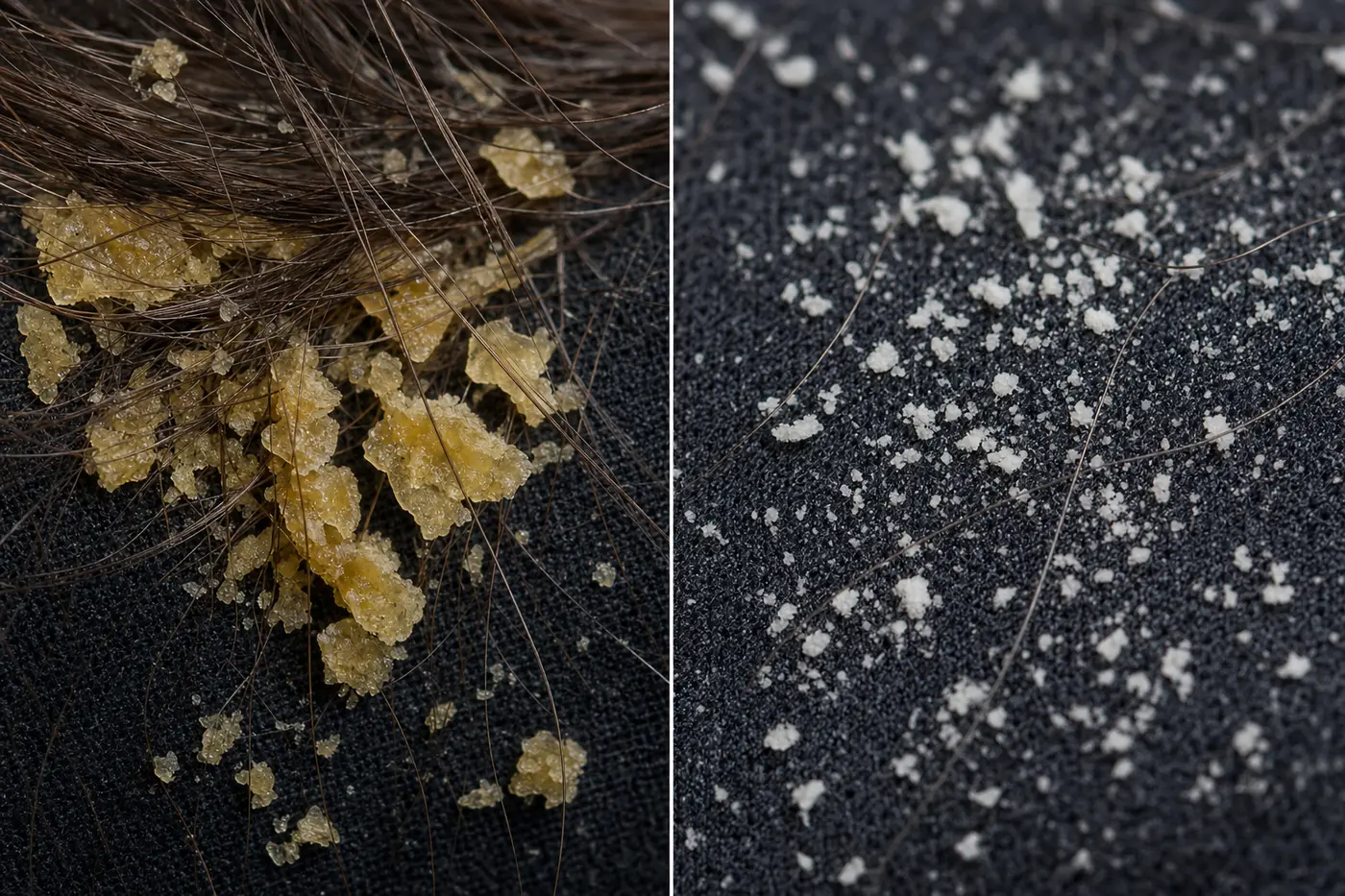
In dandruff vs dry scalp, flakes, scalp feel, and response to washing matter more than any one clue. Dandruff vs dry scalp often shows up as larger, stickier flakes with oiliness versus finer, powdery flakes with tightness, but the 2020 cohort study of 84 women found that dandruff can present with either oily or dry scaling.
| What to compare | Dandruff | Dry scalp | Quick verdict | Response to oiling | India-specific modifier |
|---|---|---|---|---|---|
| Flake size and colour | Often larger, off-white or yellowish | Usually smaller, white, powdery | Bigger, stickier flakes point more towards dandruff, but not always | Oil often makes flakes heavier and more adherent | Monsoon humidity can make dandruff flakes clump more. Winter dryness can make dry scalp flakes look finer |
| Scalp feel | Often oily between washes | Tight, rough, uncomfortable after washing | Greasy roots suggest dandruff. Tightness suggests dryness | Oiling may briefly soothe itch but worsen true dandruff later | Mixed signs are common where humidity and hard water overlap |
| Itch pattern | Itch often comes with scalp buildup and oil | Itch often feels worse right after washing or in dry weather | Itch plus grease points one way. Itch plus tightness points the other | Dandruff itch may flare after oiling | Office AC can mimic winter dryness even in humid cities |
| Response to washing | Often looks better after active shampoo and regular cleansing | Often feels worse after harsh shampoo | Improvement with antifungal shampoo suggests dandruff | Dry scalp may improve if washing is gentler | Hard water can blunt the comfort you expect after washing |
| Response to oiling | Often worsens | Often improves | This is one of the most useful Indian-context clues | Stop oiling if flakes are large and greasy | Traditional weekly oiling can keep dandruff cycling |
What Dandruff Actually Is: Malassezia, Sebum and Why Your Scalp Stays Oily
Dandruff in the dandruff vs dry scalp question is an oily, inflammatory flaking pattern linked to Malassezia yeast, scalp sebum, and individual skin sensitivity. In dandruff vs dry scalp, a greasy scalp between washes, visible buildup, and larger adherent flakes point more towards dandruff than a simple moisture problem.
Dandruff is not just “dirty scalp” or “winter dryness”. A 2005 review described Malassezia yeast as a core cause of dandruff and explained that Malassezia globosa and Malassezia restricta are lipophilic, which means they feed on scalp sebum. The same review said dandruff depends on three things acting together: Malassezia, sebaceous secretions, and your skin’s sensitivity.
A 2015 review found that Malassezia is implicated in dandruff in about 50% of the global adult population. That helps explain why dandruff is common and recurrent.
The mechanism matters. Malassezia metabolises sebum into oleic acid, and the 2005 review linked that byproduct to irritation, inflammation, and faster skin-cell turnover. Those extra skin cells do not shed invisibly. They clump into visible flakes.
Sebaceous glands keep producing sebum, and the yeast keeps using it. A 2025 review added that dandruff also involves barrier dysfunction, inflammation, and lipid oxidation, which helps explain why some scalps stay reactive even after the flakes partly improve.
A 2016 microbiome study found that scalp bacteria were more closely related to dandruff severity than fungi, with Staphylococcus and Propionibacterium balance linked to severity. The simple “yeast only” story is incomplete.
The American Academy of Dermatology distinguishes dry scalp from dandruff by noting that dry scalp happens when skin loses too much water, while dandruff is often associated with seborrheic dermatitis and may need medicated shampoo rather than gentler cleansing alone.
What Dry Scalp Actually Is: A Moisture-Barrier Problem, Not a Fungal One
Dry scalp in dandruff vs dry scalp is a water-loss and barrier problem, not a fungal overgrowth problem. In dandruff vs dry scalp, dry scalp usually feels tight, rough, or stingy after washing, and the flakes are often smaller and more powdery than the flakes seen with oily dandruff.
The American Academy of Dermatology says dry skin happens when skin loses too much water. On the scalp, that means the barrier is not holding onto moisture properly. The result is tightness, itch, and small powdery flakes.
Harsh cleansing can push the scalp in that direction. Harsh cleansing products can dry and irritate the scalp by stripping natural oils, but I did not find a primary scalp-specific trial proving that over-washing with sulphate shampoos worsens dry scalp as a distinct clinical condition. Still, if your shampoo is heavy in sodium lauryl sulphate or sodium laureth sulphate and your scalp feels stripped after every wash, that clue matters.
Hard water is another likely trigger, especially in Indian cities. A 2017 clinical study showed that hard water can increase deposition of sodium lauryl sulfate on skin, which gives a plausible reason some people feel drier or more irritated after washing. Direct evidence for scalp dryness is limited.
Weather changes fit the same barrier story. Cold, dry air lowers ambient humidity and increases water loss from skin. That is why dry scalp often gets worse in winter and in air-conditioned offices.
Dry scalp also tends to travel with dry skin elsewhere. If your arms, shins, or hands are also dry, the scalp problem is more likely part of a general dryness pattern than an isolated dandruff problem. Unlike dandruff, there is no evidence here that dry scalp is driven by Malassezia overgrowth or excess sebum.
Direct evidence for “dry scalp” as a distinct trial-defined condition is sparse. Most better-quality research focuses on dandruff, seborrhoeic dermatitis, eczema, xerosis, or barrier physiology rather than a standardised dry-scalp diagnosis.
The Lotus Femcare FLAKE CHECK: A 4-Step Self-Test You Can Do Right Now
This dandruff vs dry scalp self-check is a non-diagnostic summary of common clues, not a validated test. Dandruff vs dry scalp cannot be separated reliably from psoriasis or seborrhoeic dermatitis by a mirror check alone, and this quick check should not be used for children, infants with cradle cap, or severe inflamed scalp disease.
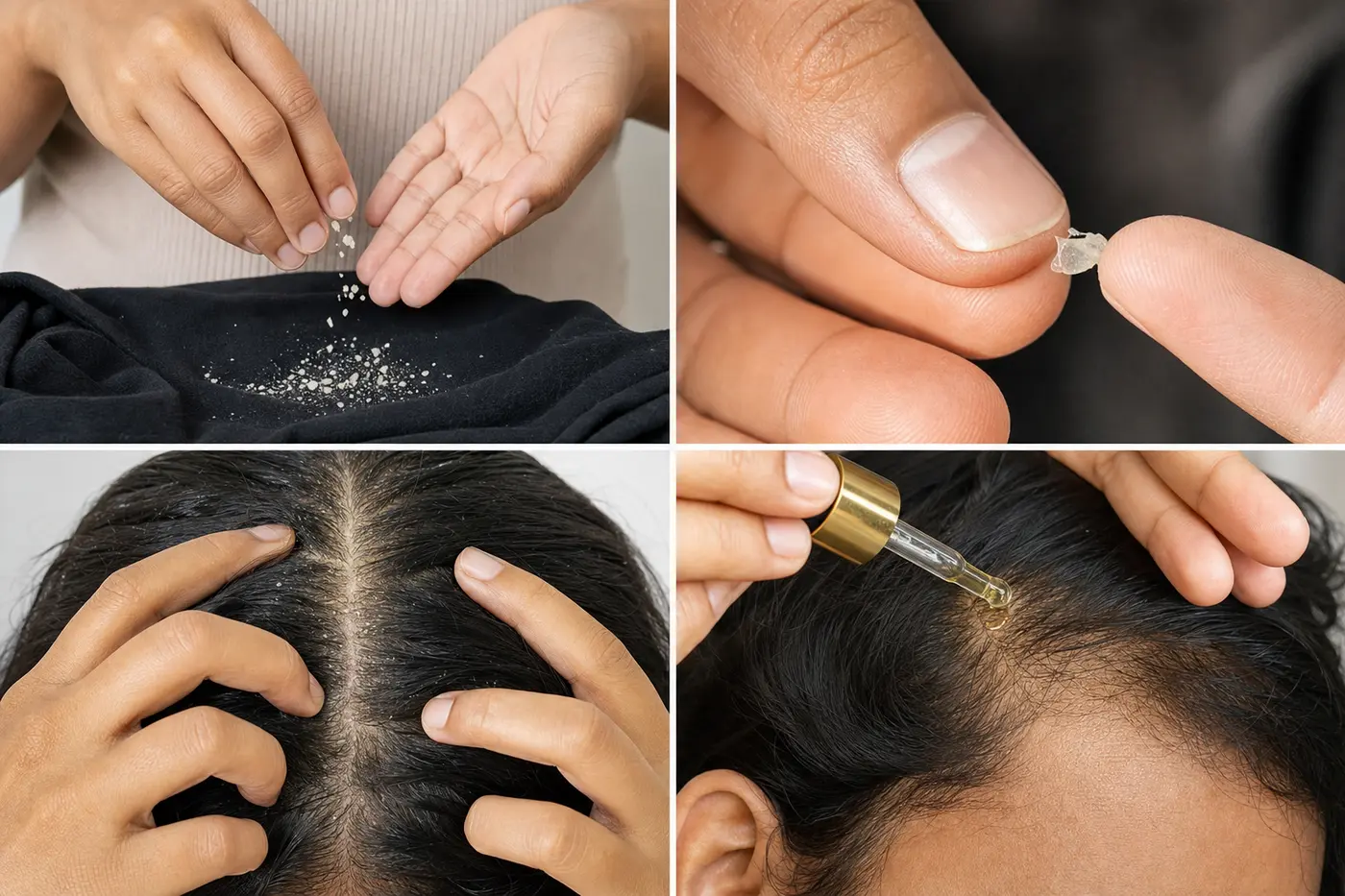
Press a flake between two fingers. If it feels greasy or leaves an oily smear, dandruff is more likely. If it crumbles dry and powdery, dry scalp is more likely. Scalp feel after 24 hours without washing helps confirm the pattern.
- Check the flakes on dark fabric.
Shake a few flakes onto a black T-shirt, pillow cover, or dark cloth. Larger off-white or yellowish flakes that clump suggest dandruff. Fine white dust-like flakes suggest dry scalp. - Press one flake between your fingers.
If the flake smears or feels waxy, dandruff is more likely. If it crumbles dry and disappears like powder, dry scalp is more likely. - Assess your scalp 24 hours after the last wash.
A greasy scalp with visible buildup points towards dandruff. A tight, itchy, uncomfortable scalp with little oil points towards dryness. - Think back to what happened after oiling.
If coconut oil, mustard oil, or sesame oil made flaking heavier or itchier the next day, that supports dandruff. If light oiling reduced tightness and flakes, dry scalp is more likely.
How to read the result:
Three or four dandruff indicators mean you should look first at antifungal shampoos. Three or four dry-scalp indicators mean you should look first at gentle cleansing and hydration. A mixed result is common after harsh shampoos or in places where humidity and hard water overlap.
There is one important correction here. The 2020 cohort study of 84 women showed that dandruff can present with either oily or dry scaling. Do not rely on one clue alone. Use the full pattern.
If burning, stinging, marked redness, widespread rash, thick plaques, or failure after OTC treatment used as directed is part of the picture, stop guessing and seek medical care.
Why Oiling Your Scalp Helps One Condition and Worsens the Other
In dandruff vs dry scalp, oiling can be the fork in the road. Dandruff vs dry scalp behaves differently because dandruff is linked to a lipid-loving yeast, while dry scalp is linked to water loss and barrier weakness. Oiling may calm a dry, tight scalp, but it can make a dandruff scalp feel heavier, itchier, and dirtier by the next day.
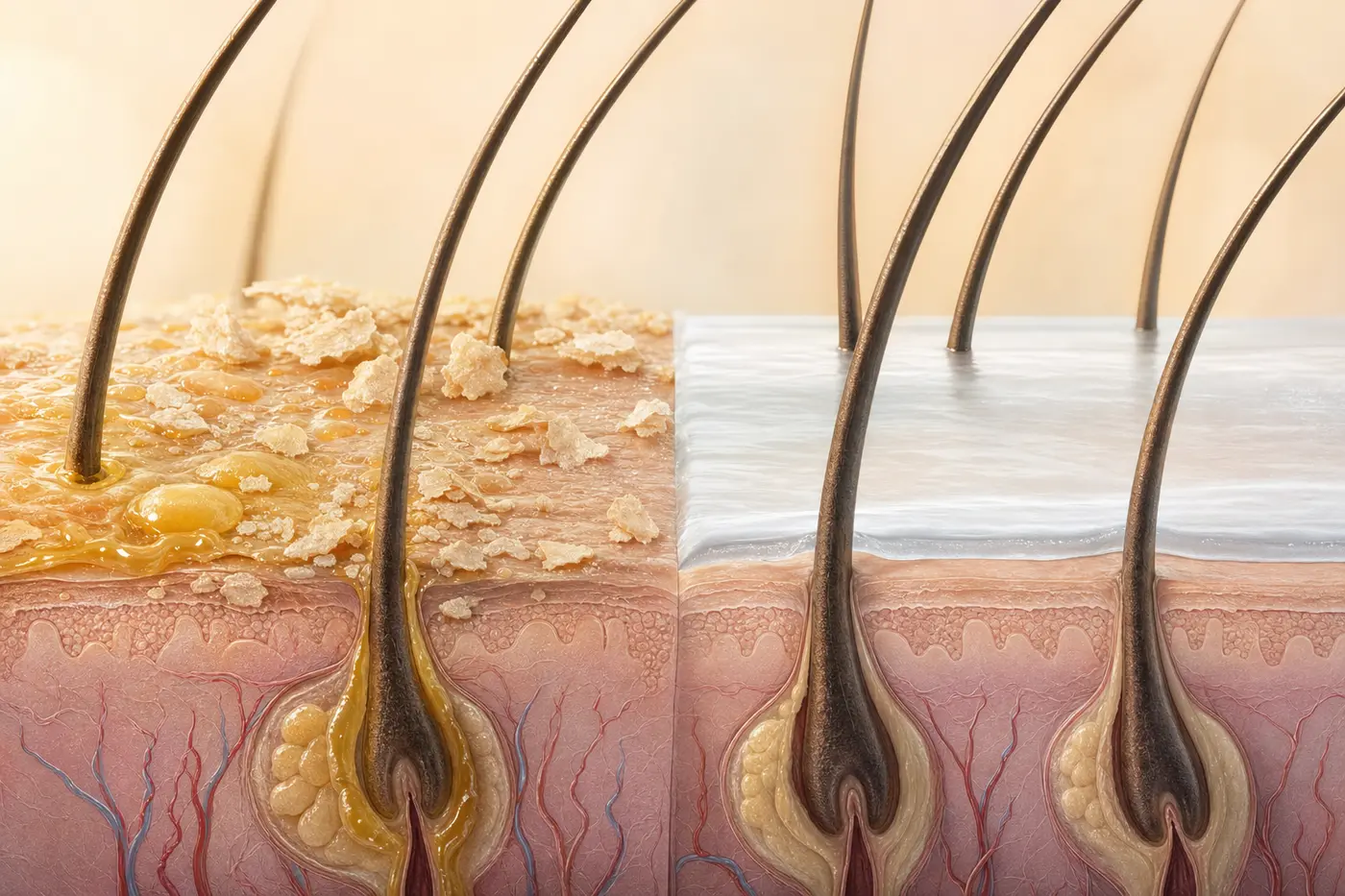
A 2005 review described Malassezia yeast as lipophilic and dependent on sebaceous lipids. The same review linked dandruff flaring to irritating free fatty acids produced when the yeast breaks down those lipids.
That is why traditional scalp oiling can backfire in dandruff vs dry scalp. Coconut oil, mustard oil, and sesame oil all add more lipid substrate on top of the scalp surface. If the real problem is dandruff, you may feel less friction for a few hours, but the scalp often looks greasier by the next day, flakes cling harder near the roots, and the post-wash scalp can still smell stale. That short-lived comfort is one reason dandruff vs dry scalp gets misread.
Dry scalp is different. A 2014 randomised, double-blind clinical trial of topical virgin coconut oil improved barrier measures in mild to moderate pediatric atopic dermatitis, which is not the same as scalp dryness but does support the idea that some oils can reduce water loss in dry skin. So the advice here is modest: light oiling can help some dry scalps feel less tight, but it is not a proven dry-scalp cure.
A practical way to think about dandruff vs dry scalp is to watch the next 24 hours, not the next 20 minutes. If oiling makes the scalp feel soothed at night but itchier, flatter, and more coated by morning, dandruff is more likely. If a small amount of oil or a leave-on moisturiser reduces that papery post-wash tightness without making the roots greasy, dry scalp is more likely.
One common mixed pattern in dandruff vs dry scalp is a dandruff-prone scalp that has also been irritated by harsh shampoos. In that situation, oiling the scalp itself often muddies the picture. Treat the dandruff first, then reduce stripping and add limited moisturising only if the scalp still feels rough.
How to Treat Dandruff: Actives, Contact Time and Rotating Shampoos
Dandruff treatment in dandruff vs dry scalp means targeting Malassezia with medicated shampoo, using enough contact time, and reassessing after about four weeks. Dandruff vs dry scalp matters here because antifungal shampoos can help greasy, itchy, recurrent flakes, while the same routine may leave a truly dry scalp tighter, stingier, or rougher after washing.
Move the safety limits up front. Adult dandruff shampoo is not recommended for children with cradle cap unless a clinician directs it. Stop the product if burning, stinging, or irritation develops, and seek care earlier for marked redness, widespread rash, thick plaques, or severe inflammation.
Start with actives that target the fungal pathway. Zinc pyrithione has antifungal activity against Malassezia and clinical efficacy in dandruff shampoos, but it should not be presented as effective only at exactly 1%, because the FDA OTC monograph allows 0.3% to 2% in rinse-off products. Mechanistically, a 2018 in vitro study found that zinc pyrithione appears to inhibit Malassezia restricta through several routes. That is lab evidence, not a human efficacy trial.
Ketoconazole at 2% has some of the clearest trial support in dandruff vs dry scalp because it directly targets the dandruff pathway. In a 1993 randomised controlled trial of 246 patients with moderate to severe dandruff, ketoconazole 2% shampoo improved adherent dandruff scores, irritation, and itching versus placebo. In a 2002 multicentre randomised trial of 331 volunteers, ketoconazole 2% outperformed zinc pyrithione 1% after four weeks in severe dandruff or scalp seborrhoeic dermatitis, with 73% versus 67% improvement in total dandruff severity score.
Selenium sulphide also has evidence. The same 1993 trial found that selenium sulphide 2.5% was superior to placebo for moderate to severe dandruff, and ketoconazole appeared better tolerated because all nine adverse experiences in that trial occurred in the selenium sulphide group. Selenium sulphide can leave more residue on the hair shaft and may feel heavier after rinsing, so readers with coloured hair or very dry lengths often prefer to be cautious.
Contact time matters. A 2008 clinical trial found that contact time of 3 to 5 minutes before rinsing improves efficacy of antidandruff shampoos. The American Academy of Dermatology also recommends following label directions carefully and allowing some shampoos to remain on the scalp for up to 5 to 10 minutes before rinsing.
In real use, week one of dandruff vs dry scalp treatment often feels disappointing. The scalp may still look flaky right after drying, especially if the flakes were thick and adherent to begin with. Itch usually improves first. Visible flakes often improve over weeks two to four if the shampoo is actually left on long enough. A common mistake is lathering and rinsing in under a minute, then deciding the product failed.
Another common mistake in dandruff vs dry scalp is oiling the scalp the night before a medicated wash. That can make the shampoo feel less effective because the scalp starts the wash more coated. If the scalp burns, stings, or feels raw after a medicated shampoo, stop rather than pushing through.
About frequency, the American Academy of Dermatology states that seborrheic dermatitis is treated with dandruff shampoos used as directed, that contact time matters, and that rotating shampoos may help if one no longer works as well. Straight, oily hair often tolerates more frequent washing than dry, curly, or textured hair.
International expert consensus on scalp seborrheic dermatitis describes scalp seborrheic dermatitis as a chronic, relapsing inflammatory condition. That means dandruff treatment should be framed as control and maintenance, not a one-off cure. A practical four-week assessment point makes sense, then many people need some form of maintenance use if the scalp tends to relapse.
Coal tar and piroctone olamine also exist in this category. Coal tar is listed in the FDA OTC monograph for dandruff, seborrheic dermatitis, and psoriasis in specified formulations. Piroctone olamine appears in many cosmetic anti-dandruff shampoos, but the strongest evidence set supplied here is richer for ketoconazole, selenium sulphide, and zinc pyrithione.
OTC Shampoo Comparison: Active Ingredient and Price per 100ml (Amazon.in)
In dandruff vs dry scalp shopping, price comparisons are not efficacy comparisons. Amazon listings may omit active concentrations, so some products below cannot be matched cleanly to the trial concentrations discussed above.
| Product | Active | Concentration | Pack size | Price INR | Cost/100ml |
|---|---|---|---|---|---|
| Selsun Abbott Suspension Anti Dandruff Shampoo | selenium sulphide | Not disclosed | 120 ml | ₹398 | ₹331.67 |
| Scalpe Pro Daily Anti-Dandruff Shampoo | climbazole | Not disclosed | 100 ml | ₹174 | ₹174.00 |
| Minimalist Anti-Dandruff Shampoo | piroctone olamine, climbazole, salicylic acid | Not disclosed | 100 ml | ₹418 | ₹418.00 |
| WishCare Hydrating Anti Dandruff Shampoo | piroctone olamine, salicylic acid | Not disclosed | 250 ml | ₹414 | ₹165.60 |
| Dove Dandruff Care Shampoo | Not clearly disclosed | Not disclosed | 180 ml | ₹182 | ₹101.11 |
We may earn a commission from purchases made through these links, at no extra cost to you. Products are chosen on evidence and value, never on commission.

Selsun Abbott Suspension Anti Dandruff Shampoo
This is the clearest evidence-led pick for dandruff because selenium sulphide is one of the actives supported in the article evidence for reducing flakes, irritation, and itching. It suits readers whose scalp seems oily or whose dandruff keeps returning despite cosmetic shampoos.
- Uses selenium sulphide, an active supported by the evidence for dandruff
- Better fit for dandruff than dry scalp because it targets the Malassezia pathway
- Well-reviewed with 17700 reviews
- At ₹398 for 120 ml, it is pricier than basic anti-dandruff options
- May feel too treatment-focused for people who wash frequently or have a dry-feeling scalp

Scalpe Pro Daily Anti-Dandruff Shampoo
This is a practical dandruff shampoo for readers who need an affordable antifungal-led option for regular use. The title clearly states a climbazole formulation, which makes it more relevant to dandruff than products built around botanicals alone, but the concentration is not disclosed, so it cannot be evidence-matched to a trial concentration.
- Antifungal-led positioning fits the evidence-backed dandruff pathway better than herbal shampoos
- ₹174 price makes it easier to maintain regular use
- Large review base with 30500 reviews
- The title does not state the active concentration, so strength is less clear than with some medicated shampoos
- A daily-use anti-dandruff shampoo may still be too much for very dry or easily irritated scalps

Minimalist Anti-Dandruff Shampoo
This formula lists climbazole and piroctone olamine, both relevant to dandruff control, plus salicylic acid to help lift adherent flakes. For this article, its biggest advantage is being fragrance-free, which can matter when readers are confusing dandruff vs dry scalp and react badly to heavily fragranced scalp products. The listing does not disclose concentrations, so it cannot be tied cleanly to a trial concentration.
- Includes antifungal-focused ingredients relevant to dandruff care
- Fragrance-free, which is useful for easily irritated scalps
- Salicylic acid can help loosen stubborn flakes
- At ₹418, it is not a budget pick
- Clarifying actives may be too much for people whose real issue is dry scalp rather than dandruff
Composite illustrative case
A 32 year old woman develops diffuse shedding four months after delivery, with ferritin at 18 ng/mL, and also notices white flakes on dark clothes. In dandruff vs dry scalp, the first step is not to blame every shed hair on the flakes. Postpartum telogen effluvium, the shedding that starts a few months after a body stress, can overlap with scalp symptoms. If the scalp is greasy by the next day, the flakes cling near the roots, and itch improves first with ketoconazole 2% used twice weekly and left on for five minutes, that pattern supports dandruff. If the scalp instead feels tight right after washing, the flakes are fine and dusty, and a gentler cleanser plus leave-on moisturiser reduces sting within one to two weeks, that pattern supports dry scalp. Low ferritin and postpartum shedding still need separate medical assessment. Dandruff vs dry scalp changes the scalp plan, but it does not explain every hair symptom on its own.
How to Treat Dry Scalp: Gentle Cleansing, Barrier Repair and Hard-Water Solutions
Dry scalp treatment in dandruff vs dry scalp means reducing stripping, improving moisture retention, and checking whether water quality is part of the problem. Dandruff vs dry scalp matters because a scalp that feels tight after washing, stings with medicated shampoo, and sheds tiny white flakes often needs gentler cleansing and hydration before anything stronger.
Start with a gentler shampoo base. Harsh cleansing products can dry and irritate the scalp by stripping natural oils, but I did not find a primary scalp-specific trial proving that over-washing with sulphate shampoos worsens dry scalp as a distinct clinical condition. Even so, if your shampoo uses sodium lauryl sulphate or sodium laureth sulphate high in the formula and your scalp feels squeaky and itchy after every wash, switching to a sulphate-free or milder cleanser is reasonable.
Then add hydration. Scalp moisturisers and leave-on serums using glycerin, hyaluronic acid, and panthenol may help attract and hold water in the upper skin layers, but I did not find a supplied scalp-specific trial proving those ingredients for dry scalp as a distinct condition. They are best framed as reasonable barrier-support measures, not proven dry-scalp cures.
Water quality matters too. The 2017 clinical study on hard water and surfactant deposition offers a plausible mechanism for why some people feel drier or more irritated after washing. If you suspect how hard water and mineral buildup can worsen scalp dryness and post-wash roughness, a shower filter or an occasional chelating shampoo with EDTA can help remove buildup. The scalp-specific evidence is limited, but the pattern is common enough to test practically.
Keep water lukewarm. Hot water increases moisture loss and often makes a dry scalp sting more after the shower. In real use, the first week of a dry-scalp routine often feels less dramatic than readers expect. The flakes may still show on a black top, but the scalp should feel less tight within one to two weeks if the diagnosis is right. A good sign is less sting after washing. A bad sign is increasing grease, heavier flakes, or itch that shifts from dry to coated.
About oils, light use is the safer frame. Occlusive or emollient oils can improve skin hydration and barrier function in dry skin, but the evidence is stronger for coconut oil and general dry-skin conditions than for scalp-specific dry scalp trials. So light oiling can be a comfort measure, not a proven cure.

WishCare Hydrating Anti Dandruff Shampoo
This one is useful because it combines piroctone olamine and salicylic acid with a hydrating positioning, making it easier to recommend to readers who are stuck in the dandruff vs dry scalp middle ground and say stronger shampoos leave the scalp rough. It is not a dry-scalp treatment, but it may feel less stripping.
- Contains piroctone olamine, a relevant antifungal dandruff ingredient
- Hydrating positioning makes it easier for users who find harsh shampoos stripping
- Better value than the 120 ml version at ₹414 for 250 ml
- Still an anti-dandruff shampoo, so it is not the right fix for true dry scalp alone
- Includes multiple exfoliating claims, which may not suit very sensitive scalps

Dove Dandruff Care Shampoo
This is not the most treatment-focused dandruff shampoo in the list, but it earns a place because dandruff vs dry scalp is often unclear at the start. It is a lower-cost option for readers who need a gentler-feeling wash while they work out whether the problem is mild dandruff, dryness, or both. The listing used for pricing did not clearly disclose the active concentration.
- ₹182 price is accessible for repeat use
- More suitable than harsh treatment shampoos for readers worried about over-drying
- Useful as a step-down or trial option when the diagnosis is not obvious
- Less directly aligned with the strongest antifungal evidence than selenium sulphide or antifungal-led shampoos
- May be too mild for stubborn dandruff that keeps returning
India-Specific Triggers: Hard Water, Monsoon Humidity and Winter Dryness
In dandruff vs dry scalp, Indian conditions can blur the picture because humidity may aggravate dandruff-prone scalps while hard water and winter air may worsen post-wash dryness. Dandruff vs dry scalp is often harder to read when a scalp feels greasy at the roots but rough after rinsing, especially in cities with both mineral-heavy water and humid weather.
A 2017 clinical study found that hard water can increase sodium lauryl sulfate deposits after washing, which gives a plausible barrier-disruption mechanism, but direct evidence for scalp dryness is limited. Humid weather may aggravate dandruff in some people, but I did not find a primary source supporting a precise cutoff such as humidity above 80%.
- Mumbai, especially June to September:
Warm, sweaty monsoon months are commonly reported to aggravate dandruff-prone scalps and seborrhoeic dermatitis. A practical tip in dandruff vs dry scalp is to wash often enough to keep buildup under control, and to read why monsoon humidity can aggravate dandruff-prone scalps and related shedding if the scalp also seems to shed more in monsoon. - Delhi, especially November to February:
Dry winter air and indoor heating or office AC can push the scalp towards tightness and fine flaking. Hard water may add another irritant layer through mineral and surfactant residue. Practical tip: add a scalp moisturiser, keep showers lukewarm, and consider a shower filter. - Chennai:
Chennai can create a mixed pattern that is clinically plausible rather than proven by direct city-specific trials. Humidity may support dandruff while hard water can leave the scalp feeling rough and stripped. Practical tip: do not assume every flake needs oiling. - Bengaluru:
Bengaluru is milder overall, but some readers still report seasonal flares, especially if they already have seborrhoeic dermatitis. Practical tip: if flakes return at the same time each year, keep an active dandruff shampoo ready instead of waiting for a full flare. - Air-conditioned offices all year:
AC can mimic winter dryness even in coastal cities. If the scalp feels fine outdoors but itchy and tight after a day indoors, dryness may be part of the picture.
India-specific climate and water-exposure data for dandruff vs dry scalp are limited. These patterns are best read as clinically plausible and commonly reported, not as proven city-level causal rules.
What If Neither Improves? Seborrhoeic Dermatitis, Psoriasis and When to Stop Self-Treating
A flaky scalp that does not improve in the dandruff vs dry scalp framework may be something else, especially seborrhoeic dermatitis or scalp psoriasis. Dandruff vs dry scalp stops being a useful home distinction when the scalp shows thick plaques, marked redness, spread beyond the scalp, or persistent symptoms despite correct OTC treatment.
Seborrhoeic dermatitis is a chronic inflammatory condition associated with Malassezia and usually affects oily, sebaceous areas such as the scalp, eyebrows, sides of the nose, and ears, according to a 2024 international expert consensus. Scalp psoriasis produces thick, silvery-white plaques with well-defined edges, which a 2001 review described as sharply demarcated erythematosquamous lesions with silver-white scaling.
The key difference is plaques versus loose flakes. Dandruff usually sheds. Psoriasis forms thicker attached scale. Seborrhoeic dermatitis also tends to spread beyond the scalp in a recognisable pattern.
If flaking does not improve after trying over-the-counter dandruff treatment as directed, the American Academy of Dermatology advises stopping the guessing and seeing a dermatologist, because psoriasis, eczema, fungal infection, or seborrhoeic dermatitis may need different treatment.
If irritation develops while using medicated shampoo, AAD guidance on seborrheic dermatitis treatment supports stopping the product and telling a clinician, especially because burning, stinging, itch, or irritation can occur.
Myths That Keep People Stuck
Dandruff vs dry scalp gets harder to fix when readers follow rules that sound neat but are poorly supported. The most common myths involve shampoo rotation, humidity cutoffs, and oils being treated like proven scalp medicines.
- Myth: Rotating antifungal actives prevents dandruff ingredients from becoming ineffective because the scalp fungus develops resistance like bacteria do.
I found expert advice to rotate shampoos if one seems less effective, but not good primary evidence that routine rotation prevents clinically meaningful antifungal resistance in dandruff. Say instead: if one dandruff shampoo stops helping, a dermatologist may suggest switching or rotating actives because different ingredients work in different ways, but this is a practical treatment strategy rather than a proven resistance-prevention rule. - Myth: Humidity above 80% makes Malassezia grow faster and directly causes dandruff flares.
No primary source in this evidence set supported a specific humidity threshold. Say instead: hot, sweaty, or humid conditions may aggravate dandruff or seborrhoeic dermatitis in some people, but the literature I found does not support a precise humidity cutoff. - Myth: Jojoba oil is proven to reduce transepidermal water loss and treat dry scalp.
The evidence I found for jojoba was mixed and not scalp-specific. Say instead: some oils can help dry skin by improving barrier function, but scalp-specific evidence is stronger for general emollient care than for jojoba as a proven dry-scalp treatment.
When to See a Dermatologist: Signs That Go Beyond Dandruff or Dry Scalp
See a dermatologist when dandruff vs dry scalp no longer looks simple, especially if treatment used correctly for four weeks does not help or if the scalp shows inflammation, plaques, or spread beyond the hairline. Dandruff vs dry scalp is a useful home distinction for mild cases, but it is not enough for severe, persistent, or unusual scalp disease.
A flaky scalp that does not improve after four weeks of correct treatment, or that is accompanied by bleeding, open sores, or noticeable hair shedding alongside the flaking, may indicate seborrhoeic dermatitis, scalp psoriasis or another condition that requires clinical diagnosis. If you are unsure how to judge whether hair shedding alongside scalp flakes is normal or a reason to worry, use that as a separate check rather than assuming all shedding comes from flakes.
- Bleeding or open sores on the scalp
- Hair shedding occurring alongside flaking
- No improvement after four weeks of correct treatment
- Flaking spreading to the face, eyebrows, ears, or chest
- Severe itch that disrupts sleep
- Marked redness, widespread rash, or burning from medicated shampoo
- Thick silvery plaques rather than loose flakes
- Flaking in an infant with cradle cap, because AAD says dandruff shampoo is not recommended for children with cradle cap unless a clinician says so
AAD guidance also says severe dandruff, marked redness, significant itch, or widespread rash should prompt medical care rather than continued self-treatment.
Mild dandruff does not directly cause hair loss. More inflamed scalp disease can be associated with increased shedding, but if hair fall is noticeable, the safer move is assessment rather than assumption.
This article is informational. It does not replace clinical diagnosis.
Frequently Asked Questions
How do I know if it is dandruff or dry scalp?
In dandruff vs dry scalp, start with the full pattern, not one clue. Press a flake between your fingers. Dandruff flakes often feel greasy and may leave an oily smear, while dry scalp flakes crumble dry. Then check your scalp 24 hours after washing. Greasy roots point towards dandruff. Tightness and itch with little oil point towards dry scalp. If oiling made it worse before, dandruff is more likely.
Are dandruff flakes bigger than dry scalp flakes?
Usually, yes. In dandruff vs dry scalp, dandruff flakes are often larger, off-white or yellowish, and may stick to hair because they carry sebum. Dry scalp flakes are usually smaller, brighter white, and fall onto shoulders more easily. But dandruff can also present with dry scaling, so use scalp feel and oiling response too.
Can oiling make dandruff worse?
Yes. In dandruff vs dry scalp, oiling is one of the most useful clues. Malassezia, the yeast linked to dandruff, is lipophilic and uses fatty acids from oil as fuel, according to a 2005 review. Applying coconut, mustard, or sesame oil can worsen flaking on a dandruff-prone scalp. Oiling may help a dry scalp, but it is usually the wrong move for active dandruff.
Does washing hair daily cause dandruff?
No. Dandruff vs dry scalp matters here because dandruff is driven by Malassezia overgrowth, not by washing frequency. For dandruff, regular washing with an active shampoo and enough contact time before rinsing helps. For dry scalp, harsh daily washing can make tightness and irritation worse, especially if the shampoo is strong and the water is hot.
Can hard water cause a flaky scalp?
Hard water can contribute to a flaky scalp, especially a dry-feeling one. A 2017 clinical study found that hard water increases sodium lauryl sulfate deposition on skin, which offers a plausible barrier-disruption mechanism. It does not directly prove scalp dryness, but it fits what many readers notice after washing.
Does dandruff cause hair fall?
Mild dandruff does not directly cause hair loss. More inflamed conditions such as seborrhoeic dermatitis can be associated with increased shedding, but dandruff vs dry scalp is not a reliable way to explain significant hair fall. If shedding is noticeable, get assessed instead of assuming it is simple dandruff.
Does monsoon weather make dandruff worse in India?
It often seems to for people who already have dandruff or seborrhoeic dermatitis. The careful version is this: hot, sweaty, or humid conditions may aggravate dandruff in some people, but the literature I found does not support a precise humidity threshold. If your scalp gets greasier in monsoon, active shampoos usually make more sense than oiling.
When is a flaky scalp something more serious?
See a dermatologist if flaking does not improve after four weeks of correct treatment, or if it comes with bleeding, open sores, marked redness, hair shedding, or spread to the eyebrows, ears, or face. Thick silvery plaques also need evaluation because scalp psoriasis can look very different from routine dandruff.
What naturally kills dandruff?
The evidence set for this article does not support a reliable natural cure that matches the evidence for antifungal shampoos. Oils are not a cure for dandruff and can worsen it. If you want the best-supported OTC options, look at shampoos with zinc pyrithione, ketoconazole, or selenium sulphide.
How do I get rid of a dry scalp?
Treat dry scalp like a barrier problem. Use a gentler shampoo, avoid very hot water, and consider a scalp moisturiser. If hard water is part of the problem, a shower filter or a chelating shampoo with EDTA may help reduce residue and post-wash roughness.
How to tell if dry scalp is fungal?
A fungal scalp problem usually behaves more like dandruff or seborrhoeic dermatitis than simple dryness. In dandruff vs dry scalp, greasy buildup, larger adherent flakes, and worsening after oiling point away from dry scalp. Tightness, fine white flakes, and improvement with gentler washing point towards dryness. If the pattern is unclear, do not self-diagnose.