

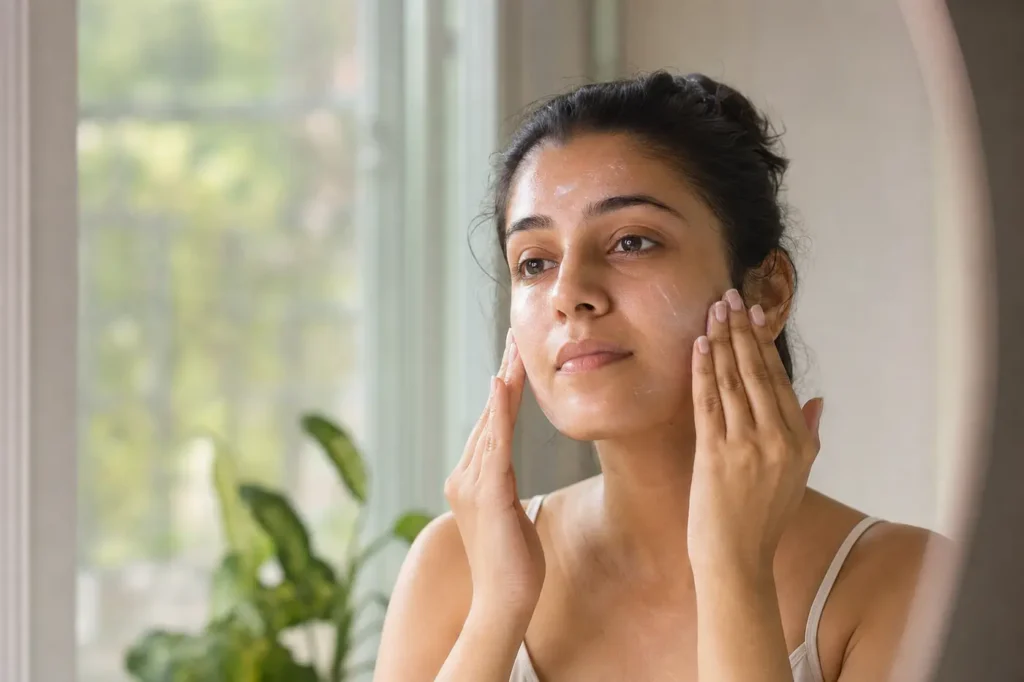
Knowing how much sunscreen to apply on face changes how much protection you actually get. Apply roughly two finger-lengths of sunscreen, along the index and middle finger from base to tip, to cover your face and neck together. Use much less, and labelled protection drops sharply. The shortcut is practical, but the exact amount varies with nozzle size, product thickness, and the area you are covering.
Key takeaways
- SPF ratings are established at 2 mg per square centimetre in laboratory testing, but real-world studies consistently find under-application. A 1997 study concluded that most users probably achieve a mean SPF between 20 percent and 50 percent of what the label suggests because they apply less than the recommended amount.
- For readers asking how much sunscreen to apply on face, the simplest shortcut is about a quarter teaspoon for face only, and two finger-lengths for face and neck together.
- The American Academy of Dermatology recommends reapplying sunscreen every two hours when outdoors, and sooner after sweating or water exposure.
- Sunscreen sticks and cushion compacts are usually more practical over makeup than loose powders or SPF setting sprays. Powder and mist can help as touch-ups, but the evidence reviewed does not support treating them as a full-dose replacement.
- UVA radiation passes through standard soda-lime window glass, while UVB radiation is largely blocked. If you sit near a window or commute by car daily, morning sunscreen still matters.
How Much Sunscreen Should You Actually Apply on Your Face?
If you want a clear answer to how much sunscreen to apply on face, separate face only from face plus ears and face plus neck. The tested SPF dose is 2 mg/cm², but at home the useful goal is a generous, even film over the skin you want to protect, not a thin cosmetic layer.
| Area | Practical dose | Common shortcut | Notes |
|---|---|---|---|
| Face only | About 1.25 ml | About 1/4 teaspoon | Best for readers asking how much sunscreen to apply on face alone |
| Face + ears | More than face alone | 1/4 teaspoon plus extra | Ears are often missed, especially around rims and behind edges |
| Face + neck | About 2 finger-lengths | Two-finger rule sunscreen | Finger rules vary with nozzle width and product viscosity |
A 2009 clinical trial in 15 Asian volunteers found that expected SPF values require application at 2.0 mg/cm². That is why how much sunscreen to apply on face is not a cosmetic detail. It changes the protection on skin.
And coverage matters as much as volume. A 2017 observational study of 57 people using UV imaging found that facial sunscreen application commonly misses high-risk areas around the eyelids and medial canthus even when users think the whole face is covered. So do not stop at the cheeks and forehead. Go up to the hairline, around the nose, over the temples, and carefully around the eyes.
A practical problem with how much sunscreen to apply on face is that two fingers can feel like a lot on oily skin. In humid weather, a full morning layer can feel shiny for the first 10 to 15 minutes, especially with creamier formulas. Gel sunscreens usually settle faster, while thicker silicone or mineral formulas can pill if you rub too long over skincare that has not dried.
Method note: Product picks in this article were shortlisted from public Amazon.in listings using stated SPF, PA rating, format, pack size, price, and intended use. Prices and ratings are the supplied listing values for this edit. Formula comments are based on public label claims and format, not hands-on wear testing. No products were provided by brands.
We may earn a commission from purchases made through these links, at no extra cost to you. Products are chosen on evidence and value, never on commission.

Deconstruct Gel Sunscreen for Oily skin SPF 50
This SPF 50 PA++++ gel is positioned for oily skin and uses a lightweight format, which matters because users often apply too little when a sunscreen feels heavy. It is a sensible daily option for office wear, commuting, and repeat use on humid days.
- SPF 50 PA++++ meets the article’s evidence-based need for broad-spectrum SPF 30+
- Gel texture can improve compliance for oily skin users who otherwise under-apply
- Reasonable price at ₹249 for a daily face sunscreen
- 50 g size can run out quickly if you use the proper face amount and reapply
- No water-resistant positioning in the title, so it is a weaker fit for sweaty outdoor days
- May not feel moisturizing enough for dry skin
Why the Dose Gap Matters: Lab SPF vs What You Actually Get
Applying less sunscreen does not reduce protection in a neat straight line. Protection drops faster than most people expect, which is why how much sunscreen to apply on face matters so much in daily use. Thin layers waste the SPF printed on the tube, especially for people using sunscreen mainly for pigmentation control.
SPF (Sun Protection Factor) is measured at 2 mg per square centimetre, the ISO 24444 test dose. But published studies measuring real-world sunscreen use generally find under-application, from about 0.48 mg/cm² in schoolchildren to around 1.33 mg/cm² for facial application in one 2021 comparative study. That study had manufacturer-linked involvement, so treat the exact figures with caution, but the direction is clear: people use too little.
Lower application thickness substantially reduces achieved protection. In a manufacturer-funded 2012 clinical trial, SPF 70 and SPF 100 products applied at 0.5 mg/cm² still yielded measured SPFs of 19 and 27. Higher labelled SPF can partly compensate for under-application, but it does not remove the need to apply enough product.
Under-applying also cuts UVA protection, not just UVB protection. A 2016 in vitro study found that when the applied amount was reduced by half, PF-UVA, the product’s UVA protection factor, was divided by an average factor of 2.2. That matters if your main concern is tanning, photoageing, hyperpigmentation, or melasma.
For Indian skin tones, this is not a side issue. A 2022 review noted that UVA1 is an established driver of hyperpigmentation, especially in skin of colour. And the 2026 Australasian Journal of Dermatology review authors make the same point clearly: in skin of colour, long-wave UVA1 is a critical driver of hyperpigmentation and skin aging.
How to Measure Without a Scale: Two-Finger Rule, Quarter Teaspoon and What They Actually Deliver
The easiest way to answer how much sunscreen to apply on face at home is to use a simple shortcut, then spread it evenly. The two-finger rule sunscreen method is best for face and neck together, while a quarter teaspoon is the usual estimate for face only. Neither shortcut is exact for every bottle.
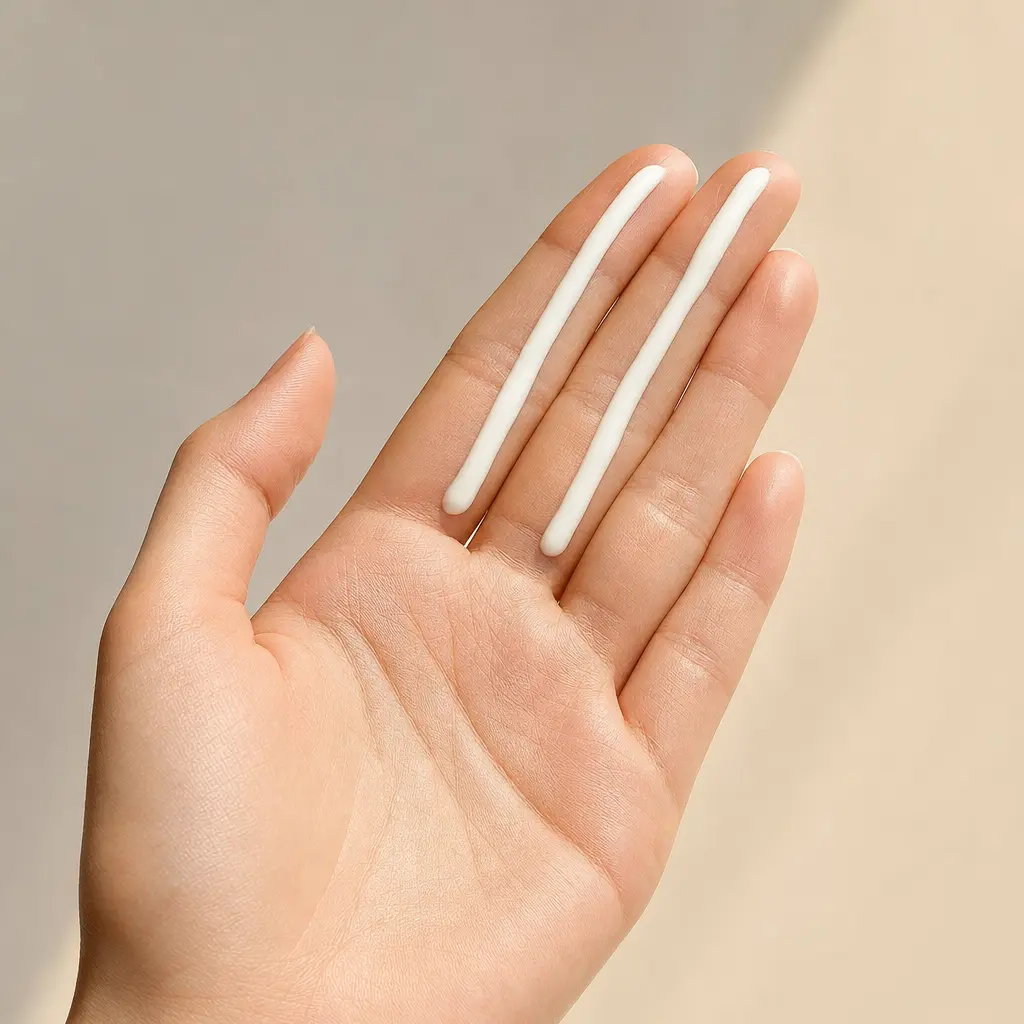
- Use the two-finger rule sunscreen method for face and neck together. Squeeze product in two straight lines, one on the index finger and one on the middle finger, from base to tip. Then dot it across the forehead, cheeks, nose, chin, jawline, neck, and blend.
- Use the quarter teaspoon method for face alone. A quarter teaspoon is the usual practical estimate for the face by itself. If you also want the ears and front of the neck, you will need more than that.
- Use measuring spoons if you keep wondering, “am I applying enough sunscreen”. Seeing the volume outside the tube makes how much sunscreen to apply on face easier to judge than squeezing directly onto skin.
- Treat finger rules as approximations. Finger length, nozzle width, and product thickness vary. A runny fluid can spread farther than a dense cream, and a narrow nozzle can dispense much less product over the same finger length.
- Build coverage before you chase elegance. If one thick layer pills, split the same total amount into two thin passes with a short pause between them.
A useful detail from the evidence is that technique improves with practice. A 2000 cohort study found that median sunscreen thickness on the face improved from 0.33 mg/cm² at baseline to 1.51 mg/cm² at six months after education. Technique is trainable.
Reapplication in Indian Conditions: When Two Hours Is Not Enough
How often to reapply sunscreen India depends more on the situation than the city. The American Academy of Dermatology recommends reapplying every two hours outdoors and sooner after sweating, swimming, or towel drying. In practice, heavy sweat, rubbing, and patchy wear are the reasons sunscreen stops looking even before the clock says two hours.
For an outdoor commute, how much sunscreen to apply on face still matters at reapplication, not just in the morning. If you sweat through the upper lip, sides of the nose, and hairline by the time you reach work, the sunscreen film is already less even there. A water-resistant formula is more forgiving, but it is not waterproof.
For an indoor office day, readers asking do i need to reapply sunscreen indoors usually do not need a strict two-hour timer. One solid morning application is often enough if you stay away from windows and do not sweat much. A midday top-up makes more sense if you sit in direct daylight, drive at lunch, or walk outdoors again.
For a beach or pool day, follow the label’s water-resistance window and reapply after water exposure. The American Academy of Dermatology notes that water-resistant products are labeled for 40 or 80 minutes, not as waterproof.
For a dry winter day with little sweating, the standard outdoor two-hour rule is still the anchor. The difference is that the film usually stays on skin more evenly, so the sunscreen may feel less urgent to top up even though the rule has not changed.
One worked example makes the friction clearer. Picture an office commuter in Mumbai with oily skin using an SPF 50 gel. At 8:30 am, a full two-finger morning layer can feel slightly slippery for five to ten minutes, then settle to a soft shine. By 11 am, after a train ride, a short walk, and face wiping with a tissue, the nose crease, upper lip, and sides of the forehead are usually the first areas to look patchy. A stick top-up improves convenience, but if you drag it hard across makeup or sweaty skin, the base often breaks around the nostrils first. The common mistake is one fast swipe per cheek and assuming reapplication is done. It is not.

RE’ EQUIL Ultra Matte Dry Touch Sunscreen 50G
This SPF 50 PA++++ sunscreen is positioned as water and sweat resistant, which matches the article’s evidence that sunscreen should be reapplied every two hours outdoors and sooner after sweating or water exposure. The matte format also helps users who dislike shine.
- SPF 50 PA++++ supports the article’s broad-spectrum protection advice
- Water and sweat resistant positioning suits Indian heat and outdoor use
- Matte finish can make full application easier for oily skin users
- ₹549 for 50G is expensive if you apply the proper amount and reapply often
- Matte dry-touch textures can feel less comfortable on dry skin
- 50G size is not ideal for heavy daily users watching cost per dose
Reapplying Sunscreen Over Makeup: An Honest Ranking of What Actually Works
The best method for sunscreen reapplication over makeup is the one that lets you put on enough product without lifting the base too badly. In practice, sticks and cushion formats are easier than powders and mists, but none of them work well if you apply only a token layer.
- Sunscreen stick
Best practical option. Use multiple overlapping passes per zone, because one quick swipe is not a full reapplication. Exact pass counts vary by stick size and formula, so no single number fits every product. Pat with clean fingers or a sponge after application instead of dragging. Around the nose, under the eyes, and over active acne are the places where patchiness shows first. - Cushion compact sunscreen
Good second choice. Press, do not drag. Build in thin layers across the whole face, especially the forehead, cheekbones, nose bridge, and jawline. Cushion top-ups usually look better than sticks over fresh makeup, but they can still disturb concealer around the nostrils. - Cream or lotion applied with a sponge
Effective if you can tolerate a little disturbance. Dispense onto the back of the hand, pick up with a sponge, and press onto skin. This takes longer, but it gives better control than rubbing with palms. - Loose powder SPF
Useful for shine control, weak as a sole sunscreen step. A 2019 observational study of 84 participants found that SPF moisturizers provide worse facial and eyelid coverage than sunscreen in routine use, and powder formats face the same real-world problem of thin, patchy coverage. - SPF setting spray or mist
Most convenient. Least trustworthy for dose. A 2020 comparative study found that spray sunscreens can be applied unevenly or too thinly in real-world use. One light mist is not a full reapplication.
For readers asking how much sunscreen to apply on face over makeup, the honest answer is that most people still under-apply. The finish looks better when you use less, but the protection is weaker. If makeup matters that day, a stick or cushion is usually the least bad compromise.
Indoors and Through Glass: What Indian Desk Workers and Commuters Need to Know
Indoor sunscreen use depends on exposure, not just location. Standard window glass blocks most UVB but still lets UVA through, so readers asking do i need to reapply sunscreen indoors should think about windows, car travel, and pigment concerns, not only whether they are technically inside.

A 2006 review on photoprotection by window glass and automobile glass states that ordinary window glass filters out UVB and transmits UVA and visible light. And a 2022 review on long UVA notes that UVA1 contributes to photoageing and pigmentation.
For indoor-primary days, the World Health Organization advises broad-spectrum sunscreen of at least SPF 30 on uncovered skin as one part of a broader sun-protection strategy that also includes shade and clothing. Look for strong UVA labeling too, such as PA+++ or higher.
Car glass is uneven. Front windshields often have more protective treatment, but side windows may not. If you drive daily in daylight, especially with the same side of the face toward the window, cumulative exposure adds up.
If you have melasma or stubborn post-inflammatory hyperpigmentation, visible light protection also matters. A 2014 randomised trial in 68 melasma patients found that a UV-plus-visible-light sunscreen delivered 15 percent greater MASI improvement and 28 percent greater colorimetric improvement than a UV-only sunscreen over eight weeks. Tinted, iron-oxide-containing sunscreen is worth discussing with a dermatologist.
What Does Not Extend Your Protection: SPF Stacking, Higher Numbers and Other Myths
SPF numbers do not add up when you layer products. Final protection depends on the total film on skin, the UVA and UVB coverage of each layer, and how evenly you apply them, which is why how much sunscreen to apply on face still matters more than stacking several SPF labels.
A 2021 comparative study with manufacturer-linked involvement found that final protection depends on the total film formed on skin, the spectral coverage of each product, and how evenly they are applied, not simple label addition.
Higher SPF is still useful, but not for the reason brands imply. American Academy of Dermatology guidance states that SPF 30 blocks about 97 percent of UVB rays and SPF 50 blocks about 98 percent. So SPF 50 is not twice as good as SPF 25. The real value is the safety buffer when you under-apply.
Reapplication does not increase your SPF number above the label. Reapplication restores the film lost to sweat, water, rubbing, and patchy wear. It brings you back toward the product’s intended protection.
SPF-containing moisturizers and cosmetics are often applied less effectively than dedicated sunscreen and may leave more facial areas uncovered. In a 2019 observational study of 84 participants, SPF moisturizer left 16.6 percent of the whole face uncovered versus 11.1 percent with sunscreen, and 20.9 percent of eyelid regions missed versus 14.0 percent with sunscreen. Use them as backups, not as your only broad-spectrum sunscreen.
And heat matters, but the evidence needs honesty. Avobenzone is photolabile and can degrade with UV exposure unless stabilized in the formulation, and regulators advise protecting sunscreen products from excessive heat and direct sun. So the sensible advice is simple: do not leave sunscreen in a parked car or on a sunny windowsill.
Safety and When to See a Doctor
Stop using sunscreen and seek medical advice if sunscreen causes rash, stinging, swelling, or persistent irritation. Sunscreen labeling includes the warning to stop use and ask a doctor if rash occurs. Do not apply sunscreen to damaged or broken skin unless a clinician advises otherwise.
For infants younger than 6 months, ask a doctor before sunscreen use. Shade, clothing, and avoiding direct sun matter most in that age group.
Melasma, recurrent hyperpigmentation, or pigment that keeps worsening despite sunscreen needs medical assessment. A 2014 randomised trial in 68 melasma patients found better pigment outcomes with UV-plus-visible-light sunscreen than with UV-only sunscreen, which is why some people need tinted iron-oxide products plus medical treatment.
Photosensitive disorders and extreme sun sensitivity also need specialist advice. Application technique can improve a lot with education, as shown in the 2000 cohort study, but some conditions need more than a better routine.
Composite illustrative case
A 32 year old woman develops diffuse thinning four months after delivery and has ferritin at 18 ng/mL. She also has melasma on the cheeks and asks how much sunscreen to apply on face because she is using only a thin layer to avoid greasiness. The evidence-supported first step is to treat the hair shedding as a separate issue from sun protection, while correcting iron deficiency with her clinician and recognising that postpartum telogen effluvium often improves over months. For the face, a realistic plan is a full morning sunscreen layer, usually about a quarter teaspoon for face only or two finger-lengths for face and neck, with better UVA and visible-light coverage if pigmentation is the main concern. In the first two weeks, the main friction is cosmetic: shine, pilling, and missed areas near the eyes. By month two, the routine usually feels less awkward because the amount no longer looks excessive. If pigmentation still worsens despite consistent use, dermatologist review is more useful than switching randomly between tubes.
How Long Does a Sunscreen Bottle Last? A Rupee-Per-Dose Reality Check
A sunscreen bottle lasts far fewer days than most people expect when you use the right amount. For readers asking how much sunscreen for face and neck, a 50 ml bottle used at about 1.25 ml per face-and-neck application gives about 40 uses, so daily morning use finishes it in roughly 40 days.
| Product | Pack size | Price | Cost/dose | Cost/30 days |
|---|---|---|---|---|
| Neutrogena Ultra Sheer Sunscreen SPF 50+ | 80 g | ₹647 | ₹10.11 | ₹303.30 |
| Lakme Sunscreen For Bright Skin SPF 50 | 100 ml | ₹335 | ₹4.19 | ₹125.70 |
| Deconstruct Gel Sunscreen for Oily skin SPF 50 | 50 g | ₹249 | ₹6.23 | ₹186.90 |
| RE’ EQUIL Ultra Matte Dry Touch Sunscreen | 50 g | ₹549 | ₹13.73 | ₹411.90 |
The prices below use the product data supplied for Amazon.in listings. Cost per correct dose is calculated from the listed pack size and a 1.25 ml daily face-and-neck application. For creams and lotions, this is an approximation because grams and millilitres are not perfectly interchangeable, but it is close enough for a real-world buying decision.
Most daily-use sunscreens in this list cost about ₹4 to ₹14 per correct face-and-neck dose. That is the real sunscreen quantity per application cost. The bigger money mistake is often buying a small elegant tube, using too little because it feels expensive, and then wondering why pigmentation is not improving.

Neutrogena Ultra Sheer Sunscreen SPF 50+ 80 g
This is a broad-spectrum SPF 50+ PA++++ sunscreen in an 80 g size, which suits the article’s point that most people under-apply and run through sunscreen faster than expected. The water-resistant claim also makes it a practical pick for commuting, outdoor work, and sweaty weather.
- SPF 50+ and PA++++ align with the article’s recommendation to use at least SPF 30 broad-spectrum sunscreen
- 80 g size makes correct dosing and repeat use more realistic than small tubes
- Water-resistant claim suits sweating and outdoor use where reapplication may be needed sooner
- Higher upfront spend at ₹647
- Ultra Sheer textures can feel less comfortable than lighter gel sunscreens for some oily-skinned users
- Not the easiest pick if you want a very invisible, makeup-friendly finish

Lakme Sunscreen For Bright Skin SPF 50 100 ml
This SPF 50 PA++++ sunscreen comes in a 100 ml bottle, which directly fits the article’s dose-gap and rupee-per-dose sections. A larger pack helps readers use sunscreen generously instead of rationing it, especially when applying to face and neck every day.
- SPF 50 PA++++ fits the article’s recommendation for broad-spectrum SPF 30 or higher
- 100 ml size is practical for correct dosing and regular reapplication
- ₹335 is strong value for a larger sunscreen bottle
- Bottle format is less portable than a small tube for on-the-go reapplication
- A larger pack is inconvenient if you like to test textures before committing
- May not suit users specifically looking for a very matte finish
Frequently Asked Questions
How much sunscreen should I apply on my face?
For readers asking how much sunscreen to apply on face, the practical answer is about a quarter teaspoon for face only. If you are covering face and neck together, two finger-lengths is the common shortcut. The goal is an even film, not a thin layer that disappears instantly.
What is the two-finger rule for sunscreen?
The two-finger rule sunscreen method means drawing two lines of sunscreen, one on the index finger and one on the middle finger, from base to fingertip, then applying that amount to face and neck. It is a practical shortcut, not a calibrated dose, because nozzle size and formula thickness vary.
How much sunscreen should I put on my face?
If you mean face only, use about a quarter teaspoon. If you mean face, ears, and neck, use more. That is why how much sunscreen to apply on face and how much sunscreen for face and neck are not the same question.
What is the 3-finger rule for sunscreen?
The three-finger rule is a less common shortcut where sunscreen is squeezed along three fingers instead of two, usually to cover face, neck, and ears. It can help larger faces or very fluid formulas, but there is no single validated finger rule that fits every product.
How often should I reapply sunscreen in India?
For how often to reapply sunscreen India, use the American Academy of Dermatology rule as the anchor: every two hours outdoors, and sooner after sweating, swimming, or towel drying. A sweaty commute, sports, or beach time usually needs earlier top-ups than a calm winter walk.
How do I reapply sunscreen over makeup?
For sunscreen reapplication over makeup, a stick or cushion compact is usually the most workable option. Use overlapping passes or pressed layers, then pat instead of dragging. One fast swipe or one light mist is not a full reapplication.
Do SPF powders and mists actually protect?
They can add some protection, but they are weak as the only reapplication step. The 2020 comparative study on spray sunscreen showed that spray products can be applied unevenly or too thinly in real-world use.
Do I need sunscreen indoors or near a window?
Yes, if you spend time near a bright window or commute by car. The 2006 review on window glass and automobile glass states that ordinary window glass blocks most UVB but still transmits UVA and visible light.
Do I need to reapply sunscreen indoors?
Readers asking do i need to reapply sunscreen indoors usually do not need to if they stay away from windows and do not sweat much. A midday top-up is more sensible if you sit in direct daylight, drive during the day, or step outside again.
Does sunscreen expire or stop working in heat?
Yes, sunscreen can expire, and heat can damage product stability over time. Replace bottles that smell odd, separate, or change colour or texture, and avoid storing sunscreen in a parked car or on a sunny windowsill.
Is SPF 50 too high for face?
No. SPF 50 is not too high for facial skin. American Academy of Dermatology guidance notes that SPF 30 blocks about 97 percent of UVB rays and SPF 50 blocks about 98 percent.
Is SPF 50 twice as good as SPF 25?
No. The difference is not double. The main benefit of SPF 50 is a better margin when real-life application is thinner than the tested dose.
How long does 50 ml of sunscreen last?
At about 1.25 ml per face-and-neck application, a 50 ml bottle gives about 40 uses. If the same bottle seems to last much longer, that often means the sunscreen quantity per application is too low.
Why is my sunscreen not working?
Common sunscreen not working reasons are using too little, missing the eyelids and nose folds, not reapplying after sweat, relying on SPF makeup alone, and choosing weak UVA protection for pigmentation-prone skin.
Which sunscreen type is better for pigmentation, mineral or chemical?
The label matters more than the category alone. A 2010 in vitro study found that avobenzone and zinc oxide provided stronger long-wave UVA protection than titanium dioxide alone in similar broad-spectrum products. For melasma, tinted iron-oxide sunscreens may help more than UV-only formulas.