

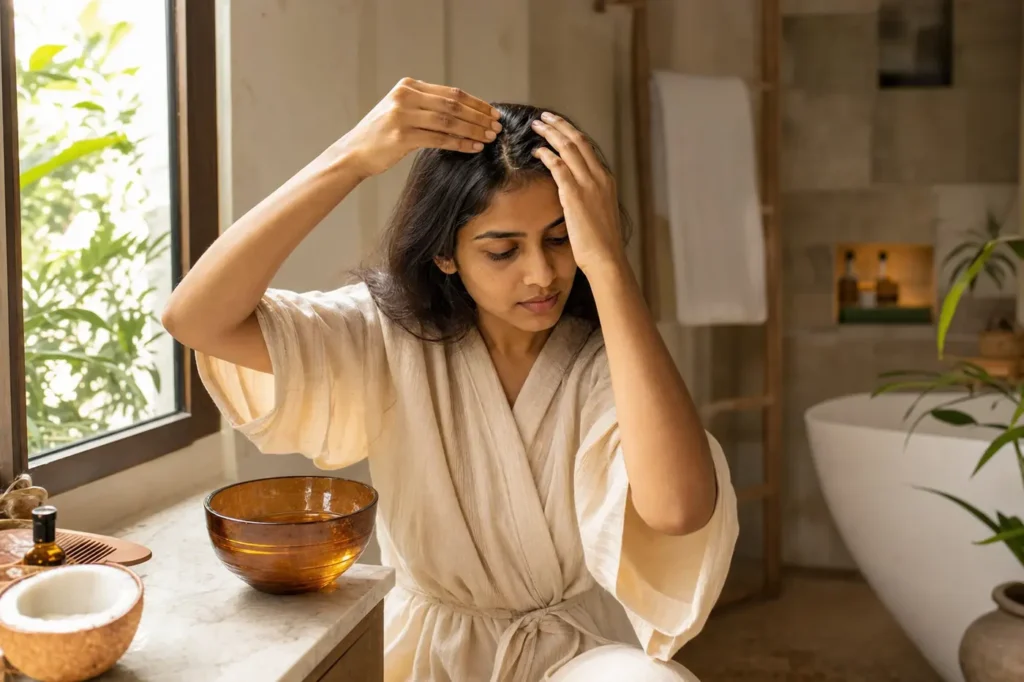
The best hair oil for hair fall in India depends on what “hair fall” means in your case. Hair oil reduces protein loss and mechanical breakage, making hair more manageable and less prone to snapping, but it cannot stop hair fall caused by hormonal changes, nutritional deficiency or androgenetic alopecia. For breakage-type shedding, a lightweight plant-based oil used twice weekly is genuinely useful. For root-level loss, see a dermatologist.
Key takeaways
- Coconut oil is the only hair oil with peer-reviewed evidence showing it reduces protein loss from both undamaged and damaged hair when applied before washing, according to a 2003 Journal of Cosmetic Science laboratory study funded by Marico.
- Hair oiling cannot treat hormonal hair loss such as postpartum telogen effluvium, androgenetic alopecia, or hair fall caused by iron or ferritin deficiency. These need diagnosis and treatment.
- A 2002 randomised controlled trial in the Journal of Dermatology found that onion juice applied twice daily for six weeks produced hair regrowth in 73.9 percent of participants with alopecia areata, versus 13.3 percent with tap water. That does not prove onion oil works for diffuse hair fall.
- Overnight oiling is commonly discouraged in dandruff-prone or seborrhoeic scalps, but no primary clinical study in the reviewed source set directly showed that overnight scalp oil occlusion increases Malassezia proliferation.
- Among the six oils reviewed here, DABUR Vatika Rosemary Hair Growth Oil and Parachute Advansed Ayurvedic Coconut Hair Oil are the strongest low-cost research-based picks for different needs. DABUR fits readers who want a rosemary-led scalp oil. Parachute fits readers whose main problem is breakage.
What Does Hair Oil Actually Do, And What It Cannot Do
Hair oil reduces protein loss and mechanical breakage but does not stop hair fall caused by hormonal changes, nutritional deficiency or androgenetic alopecia. A 2003 Journal of Cosmetic Science laboratory study found that coconut oil significantly reduced protein loss in both undamaged and damaged hair when applied before washing, but the study was manufacturer-funded by Marico and was not a human clinical trial. That matters because hair fibre protection and true hair-loss treatment are not the same thing.
If your hair is snapping during detangling, shedding short broken pieces, or feeling rough after every wash, oil can help. It lowers friction, improves slip, and makes lengths easier to comb. The effect is real, but much smaller than most marketing claims.
If your hair is coming out from the root, oil is not the answer. Root-level shedding happens in telogen effluvium, the delayed shedding that often starts two to four months after a trigger such as childbirth, illness, crash dieting or major stress, and in androgenetic alopecia, the patterned thinning driven by genetics and hormones. DermNet notes that acute telogen effluvium usually becomes noticeable two to four months after the trigger, can affect up to 50 percent of scalp hair, and often improves over about six to nine months as the trigger resolves.
The American Academy of Dermatology says shedding 50 to 100 hairs a day is normal. More than that, especially with a widened part, visible scalp, or a clear trigger a few months earlier, needs a medical lens before a shopping list.
The Breakage vs. Root-Loss Test: Which Type of Hair Fall Do You Have?
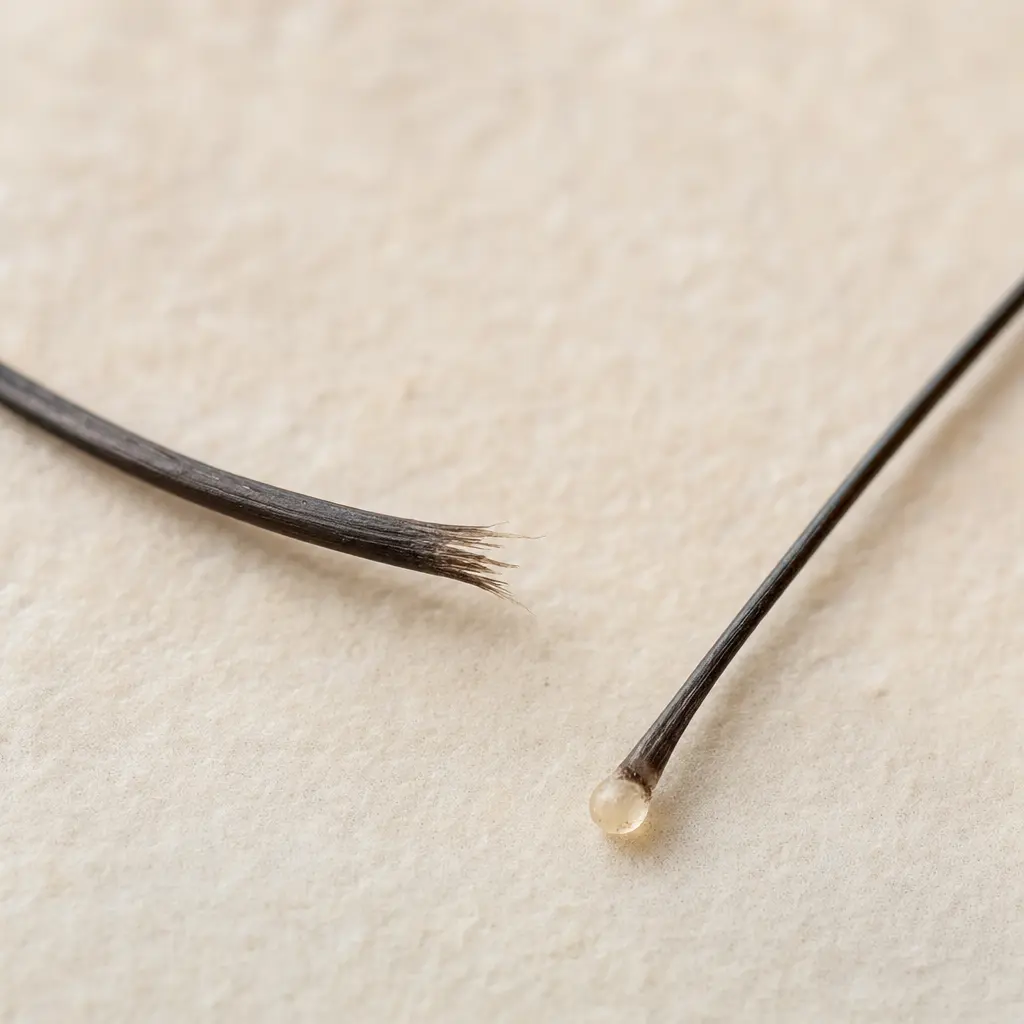
Use the Lotus Femcare Breakage vs. Root-Loss Test before you buy anything. Question one: is the shed hair shorter than about 2 cm, with no white bulb at one end and often a tapered or frayed end? That points to breakage. Question two: does the shed hair have a small white bulb at one end? That points to root loss.
This distinction changes what you should buy. Breakage responds to fibre care, gentler washing, less heat, and pre-wash oiling. Root loss does not. Root loss needs you to think about telogen effluvium, iron deficiency, thyroid disease, androgenetic alopecia, or inflammatory scalp disease.
See a dermatologist instead of buying an oil if you have sudden patchy loss, smooth bald patches, eyebrow loss, body-hair loss, shedding lasting more than six months, or visible thinning along the part line. Alopecia areata, chronic telogen effluvium and female pattern hair loss need proper diagnosis. Oil cannot do that job.
What to Look for in a Hair Oil: Carriers, Actives and What to Avoid
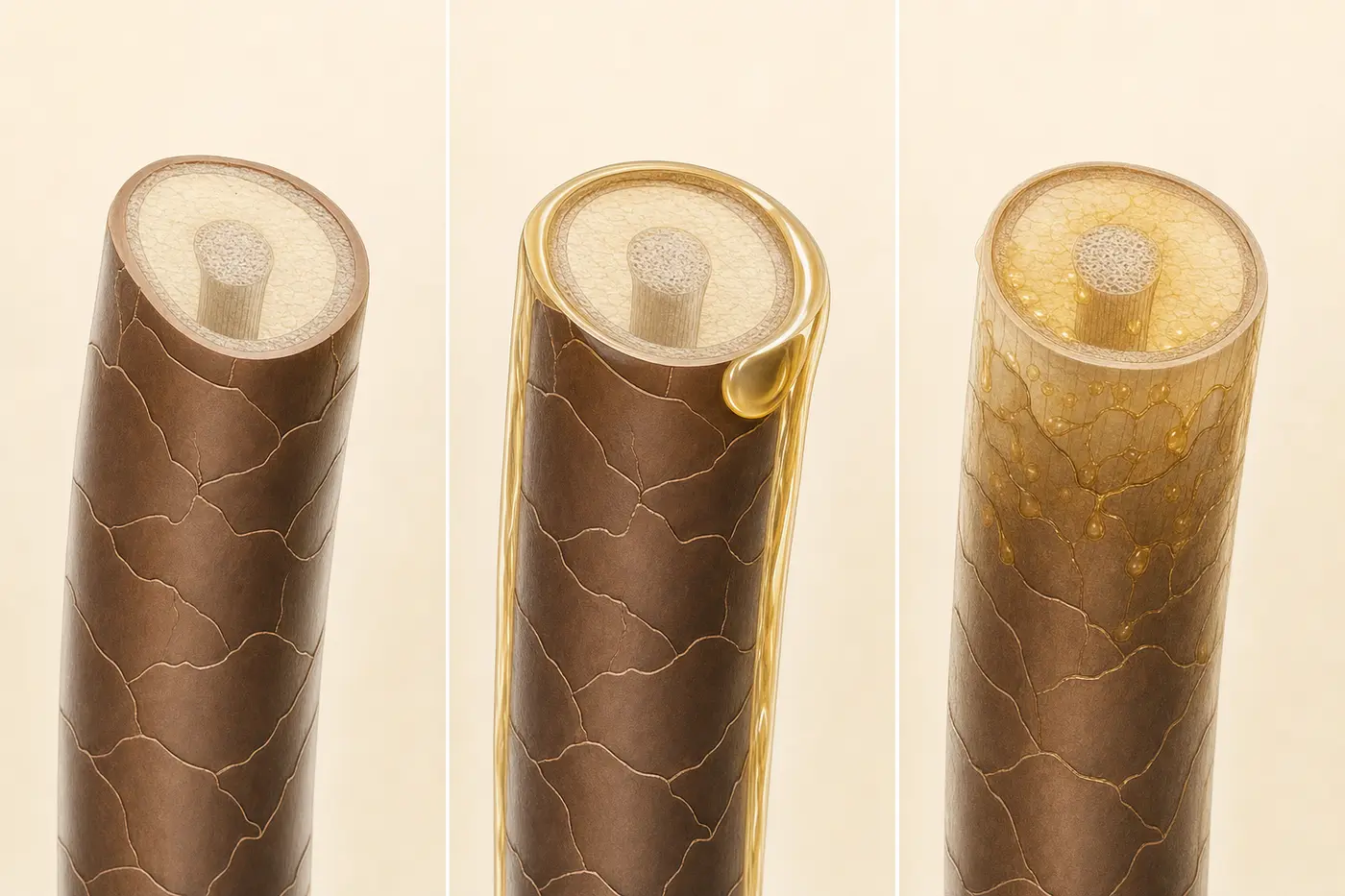
Mineral oil coats the hair shaft without penetrating it, providing slip and shine but no protein-loss reduction. Plant oils such as coconut and some other triglyceride-rich oils can penetrate the hair fibre in laboratory studies, and coconut oil has the clearest evidence for reducing protein loss. For breakage-linked hair fall, that is the mechanism worth paying for.
Start with the first five ingredients. They usually make up most of the formula. If coconut oil, sesame oil, or another carrier you actually want is buried after perfume and colour, the label is doing more work than the oil.
Fragrance matters more than most brands admit. If parfum, fragrance, or a stack of essential oils appears high on the list, the formula may smell expensive while doing very little for hair breakage. Strong fragrance and essential-oil-heavy blends can also irritate reactive scalps, especially if you already have dandruff, itching, or scent-triggered headaches.
For oily scalps, lighter-feeling carriers are usually easier to tolerate if the formula includes them. For dry lengths and winter roughness, heavier oils such as castor or sesame can feel better, though feel is not the same as proof. Castor in particular is very thick. Many people love the finish and hate the wash day.
About Ayurvedic labels, be strict. “Ayurvedic hair oil” on a bottle usually means a traditional herb story plus a cosmetic formula. It does not mean the finished product has been tested in a human trial for hair fall. Eclipta alba, better known as bhringraj, and Phyllanthus emblica, better known as amla, have traditional use and some preclinical data. That is not the same as proven regrowth in women with routine shedding.
Hard water needs a calmer explanation than most social media gives it. One small Indian laboratory study of 15 samples found no significant effect of hard-water exposure on hair tensile strength or elasticity, while separate hair-fibre literature suggests alkaline pH can increase cuticle damage and breakage. So blame harsh cleansers and high-pH products before blaming Delhi or Chennai water alone.
Pre-wash oiling can still help in hard-water cities. Not because hard water is proven to wreck hair on its own, but because a lubricated fibre handles washing and friction better. And a 2014 review on shampoo pH suggests alkaline hair products can increase negative charge, friction, cuticle damage and fibre breakage, so product pH may matter more than hard-water fearmongering.
Ingredient Breakdown: What the Evidence Says About Each Active
A 2002 randomised controlled trial in the Journal of Dermatology found onion juice applied twice daily produced hair regrowth in 73.9 percent of alopecia areata patients versus 13.3 percent with tap water. A 2015 randomised trial in the SKINmed journal compared rosemary oil with 2 percent minoxidil in 100 people with androgenetic alopecia and found comparable hair count increases at six months, with less scalp itching in the rosemary group. Those are the two most specific human outcome studies in this category, and neither proves that every onion or rosemary hair oil for hair growth India marketplaces sell will regrow hair.
Coconut Oil
Cocos nucifera, or coconut oil, has the strongest evidence in this article for reducing breakage-related damage. A 2003 Journal of Cosmetic Science laboratory study reported that coconut oil significantly reduces protein loss in both undamaged and damaged hair when applied before washing. The same paper said coconut oil also helped as a post-wash grooming product, but the pre-wash result is the more useful real-world takeaway.
The proposed mechanism is lauric acid. The paper argued that lauric acid in coconut oil has high affinity for hair proteins, which may help reduce protein loss. But the study was manufacturer-funded by Marico Industries and was not a human clinical trial, so treat the claim as useful but not final.
And one correction matters here. A 2024 laboratory paper suggested penetration is not unique to coconut oil and can occur with multiple plant oils. So the honest wording is this: a 2003 laboratory study proposed that coconut oil can penetrate the hair shaft better than mineral oil because of its triglyceride structure and affinity for hair proteins, but newer research suggests penetration is not unique to coconut oil and can occur with multiple plant oils.
Evidence grade: laboratory evidence for fibre protection, weak confidence.
Bhringraj
Eclipta alba, or bhringraj, is one of the most common herbs in ayurvedic hair oil for hair fall products. The problem is the evidence level. A 2008 animal study found that topical Eclipta alba preparations promoted hair follicle cycling in male albino rats. A 2014 animal study in nude mice also found increased hair density and hair length compared with controls.
That is preclinical evidence, not a human randomised trial. No human randomised trial data in the reviewed source set showed bhringraj regrows hair in women with telogen effluvium, androgenetic alopecia, or routine breakage.
Evidence grade: animal study only, weak confidence.
Amla
Phyllanthus emblica, or amla, shows up in almost every traditional Indian hair oil. Marketing often presents amla as an antioxidant and a 5-alpha reductase blocker. The antioxidant part is plausible from broader plant chemistry. The 5-alpha reductase claim needs more caution.
Amla is often discussed as a potential 5-alpha-reductase inhibitor in hair-care marketing, but no primary peer-reviewed in vitro study in the reviewed source set directly establishes this claim for Phyllanthus emblica alone. So amla belongs in the “traditional use and plausible mechanism” bucket, not the “clinically proven hair-loss treatment” bucket.
Evidence grade: traditional use plus indirect mechanistic discussion, weak confidence.
Onion Seed Oil
Nigella sativa, also called black seed or kalonji, is not the same thing as onion juice from Allium cepa. Brands blur this constantly. The actual positive human study here is a 2002 Journal of Dermatology RCT of 38 people with alopecia areata, a patchy autoimmune hair-loss condition. Onion juice applied twice daily produced hair regrowth in 73.9 percent of patients versus 13.3 percent with tap water, and by six weeks 20 of 23 patients in the onion-juice group had regrowth.
That does not mean commercial onion oil blends work for diffuse shedding, postpartum hair fall, or female pattern thinning. And it definitely does not mean Nigella sativa oil has the same evidence. Nigella sativa oil contains thymoquinone, but no primary human hair-breakage study in the reviewed source set showed that black seed oil reduces hair breakage.
Evidence grade: onion juice has one small human RCT in alopecia areata. Onion oil and black seed oil do not have equivalent hair-fall evidence in this source set.
Rosemary Oil
Rosmarinus officinalis, or rosemary oil, has the best human growth-related evidence among the oils discussed here. In a 2015 randomised comparative trial, 100 patients with androgenetic alopecia were assigned to rosemary oil or 2 percent minoxidil for six months. Both groups had significant hair-count increases at six months, with no significant difference between groups, and scalp itching was more frequent in the minoxidil group.
The trial population was people with androgenetic alopecia, not postpartum shedding or routine breakage. The comparator was 2 percent minoxidil. The duration was six months. The study supports rosemary as a plausible scalp active, but it does not validate undisclosed rosemary concentrations in marketplace oils. The source set does not establish that commercial bottles with vague “rosemary infused” claims match the trial preparation or dose.
The timeline matters. In the rosemary-versus-minoxidil trial, neither group showed a significant hair-count change at three months. Improvement appeared at six months. That is one of the most useful facts in the whole article because it stops people quitting after three weekends.
But keep the scope narrow. This result applies to androgenetic alopecia in that specific trial. It does not prove rosemary oil fixes postpartum shedding, iron-deficiency hair loss, or breakage from rough handling.
Evidence grade: human RCT, moderate confidence.
Castor Oil
Ricinus communis, or castor oil, is probably the most overclaimed oil in this category. Castor oil contains ricinoleic acid with anti-inflammatory properties but has no clinical trial evidence for hair growth in the reviewed source set. A 2024 review discussing castor oil and ricinoleic acid did not provide human hair-growth trial evidence. That means thick feel, shine and reduced dry look are real possibilities. Faster growth is not established.
Texture is the second issue. Castor oil is very heavy and hard to wash out. On fine hair, it can turn one wash into two. On dandruff-prone scalps, that extra residue is often not worth it.
Evidence grade: no human hair-growth trial evidence, weak confidence.
The 6 Best Hair Oils for Hair Fall in India: Tested and Reviewed
The best hair oil for hair fall in India is not one bottle for every woman. For breakage-type hair fall, a coconut-heavy pre-wash oil makes the most sense. For readers who want a rosemary-led scalp oil, a low-cost rosemary pick is easier to justify than an expensive vague herb blend. These are research-based picks, not hands-on lab tests.
A short methodology note matters here. Products were shortlisted from widely available Amazon India listings, then assessed by formula positioning, ingredient-story fit with the evidence, pack size, price, rating and review count. Prices and ratings below use the supplied source data for this article. Formula assessment was based on public product listings. No hands-on testing or patch-testing was performed for this guide.
Product Comparison Table: Price, Rating and Best Use
| Product | Price | Rating | Size | Best for | Skip if |
|---|---|---|---|---|---|
| Parachute Advansed Ayurvedic Coconut Hair Oil 300ml | ₹166.32 | 4.2/5 | 300 ml | Breakage, dry lengths, budget | Oily scalp, active dandruff |
| Parachute Advansed Bhringraj & Hibiscus Coconut Hair Oil | ₹189 | 4.1/5 | 300 ml | Traditional weekly oiling | Very oily scalp |
| DABUR Vatika Rosemary Hair Growth Oil 100Ml | ₹149 | 4.3/5 | 100 ml | Budget rosemary trial | Sensitive scalp |
| Brillare 10% Rosemary Hair Oil | ₹283 | 4.4/5 | 100 ml | Clear rosemary percentage | Needs cheapest cost per ml |
| Soulflower Rosemary Mint Light Hair Oil | ₹338 | 4.2/5 | 225 ml | Lighter rosemary feel | Fragrance-sensitive scalp |
| Indulekha Bringha Ayurvedic Hair Oil 100 ml | ₹395 | 4.1/5 | 100 ml | Comb applicator users | Evidence-first shoppers |
We may earn a commission from purchases made through these links, at no extra cost to you. Products are chosen on evidence and value, never on commission.

Parachute Advansed Ayurvedic Coconut Hair Oil 300ml
This is the most evidence-aligned buy if your hair fall is really breakage, not root loss. The reason is simple: coconut oil has the clearest support for reducing protein loss in the hair fibre, and this bottle is cheap enough to use properly as a pre-wash oil instead of rationing it. The herbal positioning is secondary. Coconut is doing the heavy lifting here.
- Coconut oil is the best-supported ingredient in the evidence set for reducing protein loss
- Good value at ₹166.32 for 300 ml
- Useful as a pre-wash oil for dry lengths and rough ends
- Herbal blend claims are stronger than the evidence provided for most added herbs
- Can feel heavy on fine hair or oily scalps
- Not a stand-alone treatment for pattern hair loss

Parachute Advansed Bhringraj & Hibiscus Coconut Hair Oil
This works best when used for the same reason as plain coconut-heavy oils: reducing dryness and friction-related breakage. Bhringraj has some animal data, but not the same level of human evidence as coconut for hair-fibre protection or rosemary for growth-related outcomes.
- Coconut base makes the formula more evidence-aligned than many herb-only oils
- Affordable at ₹189 for 300 ml
- Better fit for breakage control than many vague multi-herb oils
- Bhringraj support in the evidence is preclinical rather than strong human trial evidence
- Likely heavier than a light serum-style oil
- Less suitable for women who wash daily and dislike residue

DABUR Vatika Rosemary Hair Growth Oil 100Ml
This is a low-cost way to try a rosemary-led oil if you care more about scalp application than length coating. Rosemary has the best human regrowth-related evidence among oils in this article, but the exact delivered rosemary concentration is not clearly stated in the product title, which limits how precisely you can compare it with the 2015 rosemary trial.
- Rosemary is one of the few actives in the evidence set with human trial support
- Very accessible price at ₹149
- Coconut oil in the title may also help with hair-fibre dryness
- Title does not clearly state the rosemary concentration
- Essential-oil-led formulas can irritate sensitive scalps
- 100 ml bottle may run out quickly with frequent scalp application

Brillare 10% Rosemary Hair Oil
Among the rosemary options, this stands out because the title states 10% rosemary hair oil and also lists olive and castor components. Rosemary has the best human evidence here for growth-related outcomes, but castor should be treated as supportive texture oil, not proven regrowth medicine.
- Rosemary is supported by a human trial in the evidence set
- Title gives clearer percentage disclosure than many rivals
- Higher rating than most candidates at 4.4
- Only 100 ml, so price per ml is not the cheapest
- Includes castor oil, which lacks clinical hair-growth evidence in the provided sources
- May feel too rich for fine or limp hair

Soulflower Rosemary Mint Light Hair Oil
This is a practical middle ground for readers interested in rosemary but put off by very dense oils. The title suggests a lighter format and includes rosemary as the main reason to consider it. Mint can feel cooling, though that does not equal proven hair-growth benefit.
- Rosemary aligns with the strongest human growth evidence among oil actives here
- 225 ml size is more practical than tiny essential-oil bottles
- Likely easier to use for people who avoid very sticky oils
- Mint and aromatic components may irritate reactive scalps
- Title makes several broad claims beyond what the evidence supports
- Not as cheap as basic coconut oils for routine breakage care

Indulekha Bringha Ayurvedic Hair Oil 100 ml
This is a reasonable traditional pick if you specifically want bhringraj and a comb applicator for scalp placement. The evidence base is weaker than for coconut or rosemary, with bhringraj supported mainly by animal data in the provided sources rather than strong human trials.
- Comb applicator can make scalp application easier
- Contains bhringraj, which has some preclinical support
- Large review base may help buyers judge user experience
- 100 ml is expensive relative to larger coconut-based options
- Bhringraj evidence is weaker than rosemary human data and coconut fibre-protection data
- Applicator bottles can be less convenient to clean and may dispense unevenly
Observed-use notes: what these textures are like in real routines
These are practical texture notes, not efficacy claims. They explain what often makes people quit a hair oil by week six even when the formula itself is reasonable.
- Parachute Advansed Ayurvedic Coconut Hair Oil 300ml: about 1 to 2 teaspoons is enough for shoulder-length hair as a pre-wash. The smell is classic coconut-herbal, not sharp. Spreadability is easy on lengths. Residue is moderate. One shampoo is often enough if you keep it to lengths, but scalp application can need a second wash on fine hair. Day-2 roots can feel flat on oily scalps.
- Brillare 10% Rosemary Hair Oil: about 1 teaspoon usually covers a sectioned scalp. The smell is more herbal and active-led than plain coconut. Spreadability is good, but castor in the blend can leave a richer film. Fine hair may need two shampoos. If your scalp already gets itchy by day 2, this is not the safest blind buy.
- Soulflower Rosemary Mint Light Hair Oil: about 1 teaspoon for scalp plus half teaspoon for lengths is usually enough. The smell is fresher and more noticeable because of mint. The oil feels lighter than castor-heavy blends. Wash-out is easier than thick champi oils. People who hate sticky roots usually tolerate this style better, but fragrance-sensitive scalps may not.
Composite illustrative case: postpartum shedding versus breakage
A 32-year-old woman notices diffuse thinning that started four months after delivery. Her ferritin is 18 ng/mL. She is losing long hairs with white bulbs after showering, not short snapped pieces. That pattern fits telogen effluvium more than breakage, and DermNet describes telogen effluvium as delayed shedding that often settles as the trigger resolves. In that scenario, the evidence supports checking iron status, reviewing thyroid and diet if needed, and using gentle hair care. A coconut-heavy pre-wash oil can help the lengths feel less rough, but it will not correct low ferritin or change the follicle cycle. A realistic timeline is less shedding over months, not a dramatic week-two result. If the part keeps widening or shedding continues beyond six months, she needs dermatology review for chronic telogen effluvium or female pattern hair loss.
Mini-scenario: postpartum handfuls of long bulb hairs
Three months postpartum, handfuls of long hairs with white bulbs after showering usually point to shedding from the root, not breakage. The best hair oil for hair fall in India cannot fix that on its own. A coconut-heavy oil may make the lengths softer and reduce tangling, but postpartum telogen effluvium is a follicle-cycle problem. Stop self-treating and seek medical advice if shedding is severe, if the part is widening, or if iron deficiency symptoms are present.
Mini-scenario: bleached hair snapping into short pieces
Bleached hair snapping into short pieces while combing is a fibre-damage problem. That is where the best hair oil for hair fall in India can actually help, especially a coconut-heavy pre-wash oil. The goal is less friction, less protein loss and easier detangling. Stop relying on oil alone if the scalp is also itchy, if broken hair is mixed with lots of full-length bulb hairs, or if breakage continues despite reducing heat and chemical processing.
How to Oil Your Hair Correctly: Scalp, Lengths and Timing
Short-contact pre-wash oiling is the most practical routine for most people because it gives fibre benefits with less residue. Overnight scalp oiling is often a poor fit for dandruff-prone or itchy scalps, and people with active flaking or follicular bumps should avoid scalp oiling until the scalp problem is treated.
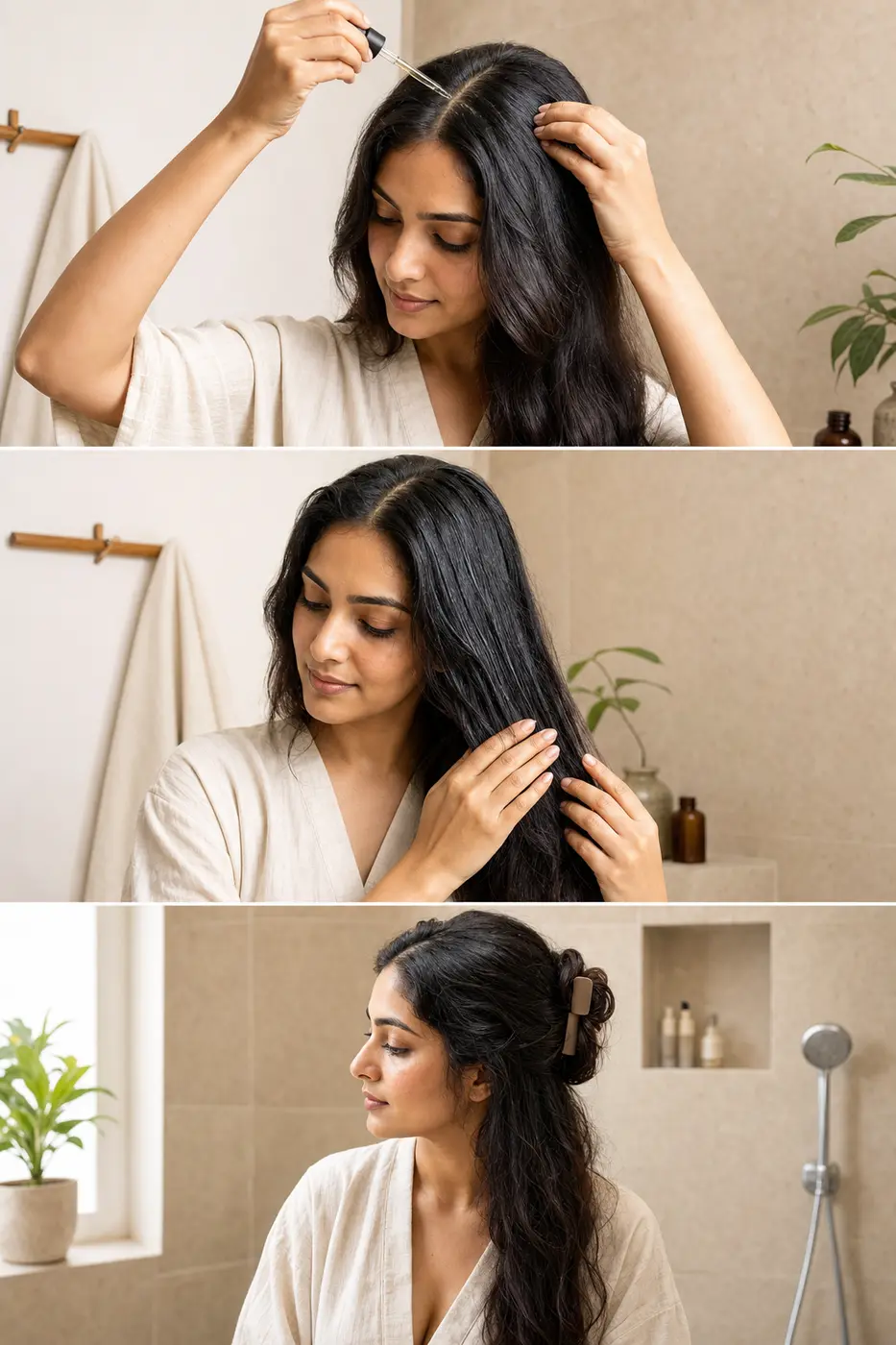
- Decide whether your scalp needs oil at all.
If your main issue is dry lengths, put oil on the mid-lengths and ends only. If your scalp feels tight, dry, or you enjoy a pre-wash massage without dandruff or folliculitis, you can apply lightly to the scalp. - Use pre-wash oiling for most people.
Thirty to sixty minutes is enough for a standard pre-wash routine. Coconut-heavy oils make the most sense here because the evidence for protein-loss reduction is strongest in pre-wash use. - Use post-wash oiling only on lengths.
A drop or two on damp ends can reduce friction and frizz. Do not oil the scalp after washing unless a dermatologist has told you to. - Do not assume overnight is better.
No direct clinical trial in this evidence set proves overnight oiling improves hair-fall outcomes. And prolonged scalp occlusion is often poorly tolerated by people with dandruff-prone, seborrhoeic, or folliculitis-prone scalps. - Wash out oil the easy way.
Apply shampoo to dry or barely damp oiled hair first. Massage it in. Then add water and emulsify. This often removes oil in one wash and avoids harsh double-shampooing. - Get the frequency right.
This is practical editorial guidance, not a trial-based prescription. Two to three times per week suits many hair types. Very dry hair may tolerate more. Oily scalps often do better with once or twice weekly, or lengths-only oiling.
Worked routines by hair type
Fine, oily hair: Use half to 1 teaspoon of a lighter oil on mid-lengths and ends only, 30 minutes before washing, once weekly. Skip scalp oiling if roots go flat by day 2. One shampoo is usually enough.
Thick, dry hair: Use 1 to 2 teaspoons on lengths and up to 1 teaspoon on the scalp, 45 to 60 minutes before washing, twice weekly. Coconut-heavy oils usually wash out more easily than castor-heavy blends.
Dandruff-prone scalp: Avoid routine scalp oiling during flares. If lengths are dry, use a small amount on the lower half of the hair only, then wash out after 30 minutes. Treat the scalp first with antifungal care if flaking is active.
City-specific guidance
| City condition | What to do |
|---|---|
| Delhi or Chennai hard water | Use a coconut-heavy pre-wash oil before shampoo. Clarify monthly if buildup is obvious. |
| Mumbai monsoon humidity | Choose lightweight oils only. Skip overnight oiling. Keep oil off flaky scalps. |
| North Indian dry winter | Heavier oils are easier to tolerate. Dry lengths benefit most from lengths-only oiling. |
Who Should Not Oil Their Hair: Three Conditions That Make Oiling Harmful
People with active seborrhoeic dermatitis, Malassezia folliculitis, or moderate-to-severe dandruff should avoid scalp oiling until the condition is treated. Oiling an already-inflamed scalp increases occlusion and can worsen symptoms in people prone to these conditions. Consult a dermatologist before oiling if your scalp is itchy, flaky, or covered in bumps.
- Seborrhoeic dermatitis
Malassezia is strongly associated with dandruff and seborrhoeic dermatitis and is an important therapeutic target, but current reviews describe the condition as multifactorial, involving host immune response, barrier dysfunction and scalp microbiome changes rather than a single primary driver in every case. The treatment priority is not cosmetic oil. It is antifungal therapy. - Malassezia folliculitis
This shows up as itchy follicular bumps or pustules, often near the hairline, forehead, upper back or chest. A 2023 position statement described it as a distinct follicular eruption caused by symptomatic yeast colonisation of hair follicles. The 2015 Danish guideline said systemic antifungal treatment is usually more effective than topical therapy alone. - Active dandruff
If flaking is moderate or severe, treat the scalp first. A 2002 randomised trial of 331 people found ketoconazole 2 percent shampoo outperformed zinc pyrithione 1 percent shampoo after four weeks in severe dandruff or scalp seborrhoeic dermatitis.
Use ketoconazole 2 percent shampoo first, then see a dermatologist if the problem keeps returning. Do not keep adding oil to an inflamed scalp and hope it turns into moisture.
Myths About Hair Oil and Hair Fall That Need to Die
Myth: Hair oil can regrow hair in androgenetic alopecia on its own.
The evidence does not support that claim. Rosemary oil has one decent human trial in androgenetic alopecia, but established drug treatment such as minoxidil has stronger evidence. Say instead: hair oil may reduce friction, improve feel and, in a few cases, deliver weakly supported actives, but it should not be presented as a proven standalone regrowth treatment for pattern hair loss.
Myth: Overnight oiling is always better because longer contact time means better results.
No primary clinical study in the reviewed source set showed that overnight oiling improves hair-fall outcomes. Say instead: if you oil at all, frame it as a short-contact pre-wash or length-only routine unless a dermatologist advises otherwise.
Myth: Onion oil products have the same evidence as crude onion juice for alopecia areata.
Wrong condition, wrong format. The positive trial used crude onion juice in patchy alopecia areata. Say instead: one small trial studied crude onion juice in alopecia areata, and that evidence cannot be assumed to apply to onion oil products for routine shedding.
Myth: Castor oil is clinically proven to make hair grow faster and thicker.
No human clinical hair-growth trial for castor oil was identified in the reviewed source set. Say instead: castor oil is rich in ricinoleic acid and may improve slip or reduce the look of dryness, but clinical proof for hair growth is lacking.
Safety and When to See a Doctor
Sudden patchy hair loss, smooth bald patches, or eyebrow and body-hair loss need dermatology evaluation, not more oil. Alopecia areata and other inflammatory causes can look simple at first and then spread.
Diffuse shedding lasting more than six months, or shedding with a widened part or visible scalp, also needs a doctor. DermNet describes telogen effluvium as usually self-correcting, but it can unmask underlying female pattern hair loss, thyroid disease, or iron deficiency.
Itchy follicular bumps, pustules, or dandruff that worsens with oiling are another stop sign. Avoid scalp oiling and seek care because seborrhoeic dermatitis or Malassezia folliculitis may need antifungal treatment.
If you are pregnant or trying to conceive and are considering minoxidil or other drug treatments, do not self-start. Pregnancy-related shedding is often self-limited, and treatment choices need individual advice.
And one separate safety point: do not extrapolate “natural” safety from cosmetic use of castor oil. Evidence linked to castor oil safety concerns means ingestion and drug-like use should not be treated casually in pregnancy.
Where the Evidence Is Missing
Very limited independent human trials compare popular Indian hair-oil actives head to head for common female hair fall causes such as telogen effluvium or breakage. Most evidence is preclinical, mechanistic, or based on a different condition such as alopecia areata or androgenetic alopecia.
Evidence is also sparse for textured, chemically treated, heat-damaged, or heavily oiled hair in humid Indian climates. Laboratory fibre findings do not always map neatly onto Mumbai monsoon, Delhi hard water, weekly straightening and three different shampoos.
There is little direct evidence on overnight oiling versus short-contact pre-wash oiling for dandruff-prone or seborrhoeic scalps. That gap matters because real consumers oil overnight all the time, but the reviewed guideline literature does not directly test that practice.
The hard-water literature is small and inconsistent. One small Indian study found no significant effect on tensile strength or elasticity, so sweeping claims about hard water as a major cause of hair fall are not well supported.
For amla, sesame and black seed oil, marketing claims often outrun the primary clinical evidence. Ingredient chemistry and traditional use exist. Direct human outcome data remain thin.
Regulatory status: what is a cosmetic oil and what is an actual treatment
Topical minoxidil is an evidence-based hair-loss drug for androgenetic alopecia in some markets such as the United States. It is not a cosmetic hair oil ingredient.
Ketoconazole 2 percent shampoo is a medicated antifungal treatment, not a cosmetic oil. If dandruff or seborrhoeic dermatitis is driving your shedding, this has a stronger evidence base than any oil in this article.
Rosemary oil, onion oil, bhringraj, amla, black seed oil, castor oil and coconut oil sit under cosmetic or traditional-use frameworks depending on the market. On the reviewed evidence, they are not approved drug treatments for hair regrowth.
Frequently Asked Questions About Hair Oil and Hair Fall
Does hair oil actually stop hair fall?
Hair oil reduces protein loss and mechanical breakage but cannot stop hair fall caused by hormonal changes, nutritional deficiency or androgenetic alopecia. A 2003 Journal of Cosmetic Science study showed coconut oil significantly reduced protein loss in damaged and undamaged hair. For root-level shedding, see a dermatologist.
Which hair oil is best for hair fall in India?
The best hair oil for hair fall in India depends on whether you mean breakage or root shedding. For breakage-type hair fall on a budget, Parachute Advansed Ayurvedic Coconut Hair Oil is the strongest value pick here. For readers who specifically want rosemary, DABUR Vatika Rosemary Hair Growth Oil is the cheapest entry point. If shedding is from the root, no cosmetic oil is the best answer.
Does onion oil work for hair growth?
A 2002 randomised controlled trial in the Journal of Dermatology found onion juice applied twice daily produced hair regrowth in 73.9 percent of alopecia areata patients, versus 13.3 percent with tap water. Evidence for diffuse hair fall or hormonal hair loss is absent. Onion oil’s sulfur story is plausible, but the product evidence is missing.
How often should I oil my hair?
Use frequency as practical editorial guidance, not as a fixed medical rule. Once or twice weekly suits many oily scalps. Two times weekly is common for normal hair. Very dry lengths may tolerate more. If extra oiling forces repeated shampooing, the routine is too heavy for your hair type.
Should I leave hair oil on overnight?
Overnight oiling is often a bad trade for Indian scalps that already run sweaty, flaky or humid-weather reactive. Short-contact pre-wash oiling gives most of the practical benefit with less residue. People with active flaking, follicular bumps or seborrhoeic dermatitis should not oil overnight.
Is coconut oil good for hair fall?
Coconut oil is the best-evidenced hair oil for reducing protein loss from the hair fibre. A 2003 Journal of Cosmetic Science laboratory study found it significantly reduced protein loss, especially in pre-wash use. It helps breakage-related shedding. It does not treat root-level hair loss from hormones or deficiency.
Does oiling cause dandruff?
Oiling does not cause dandruff from nowhere, but it can worsen an already flaky scalp. Current reviews describe dandruff and seborrhoeic dermatitis as multifactorial, with Malassezia as one important factor. Treat the scalp first, then consider oiling the lengths if needed.
Can hair oil regrow hair?
Usually, no. Hair oil cannot regrow hair lost due to telogen effluvium, nutritional deficiency or most cases of androgenetic alopecia on its own. Rosemary oil has one useful human trial in androgenetic alopecia, but that is a narrow claim. Most other regrowth claims in this category do not have human trial support.
Which Indian hair oil is most effective for hair loss?
If “hair loss” means breakage, a coconut-heavy oil is the most evidence-aligned choice, and Parachute Advansed is the best budget example here. If “hair loss” means root shedding from the bulb, no cosmetic oil is the most effective option. Diagnosis is.
Which is India’s No. 1 hair fall expert oil?
No single bottle deserves that label for every woman. Different causes need different responses. Coconut-heavy oils are best supported for breakage. Rosemary has the best human trial data among oils for androgenetic alopecia. Postpartum or deficiency-related shedding needs medical evaluation, not branding.
Which is the best hair oil for reducing hair fall?
For reducing breakage-type shedding, choose a coconut-heavy pre-wash oil. For a rosemary-led option, Brillare and DABUR Vatika make more sense than expensive vague herb blends. For root-loss shedding, the best move is not a better oil. It is a dermatology visit.
What are the top 5 best hair oil brands in India?
Based on evidence alignment, ingredient clarity and value in this article, the strongest names are Parachute Advansed, DABUR Vatika, Brillare, Soulflower and Indulekha. If you want a traditional coconut-first option, Parachute Advansed Bhringraj & Hibiscus also fits well.