


How much hair fall is normal in a day depends on the hair cycle, your wash routine, and whether the shedding is stable or changing. The American Academy of Dermatology says losing 50 to 100 hairs a day is normal because some hairs naturally finish their growth cycle each day. Hair density, ethnicity, wash frequency, and styling habits all change what looks normal for you.
Key takeaways
- Losing 50 to 100 hairs per day is the widely cited normal range, but this figure comes from general dermatology guidance and older mixed evidence rather than a threshold validated specifically in Indian women.
- Wash-day shedding looks alarming because hairs that have already detached from the scalp stay trapped among other strands until water, shampoo, combing, or champi dislodges them all at once.
- A hair with a small white or translucent bulb at the root is usually a shed hair completing its natural cycle. A hair with no bulb and a snapped end is usually breakage, which points to a haircare problem rather than a scalp or systemic one.
- Shedding that increases after pregnancy, high fever, crash dieting, surgery, or major stress is called telogen effluvium. A 2020 review of the literature says telogen effluvium typically shows up 6 to 12 weeks after the trigger.
- See a dermatologist if your parting is visibly widening, scalp shows through in normal light, you notice patchy loss, shedding continues beyond three months, or hair fall comes with fatigue, irregular periods, or unexplained weight change.
How Much Hair Fall Is Normal in a Day? The Number, and Its Limits
How much hair fall is normal in a day is usually answered with 50 to 100 hairs, but that number is a rule of thumb, not a fixed cutoff. The American Academy of Dermatology uses that range in patient guidance. A 2019 cross-sectional trichoscopy study supports that healthy scalp density varies, and a 2016 review of hair and scalp diseases describes scalp hair growth at about 0.3 mm a day, which helps explain why steady replacement can hide normal shedding.
Losing 50 to 100 hairs per day is the range the American Academy of Dermatology considers normal. A 2016 review of hair and scalp diseases describes a healthy adult scalp as having about 80,000 to 120,000 terminal hairs. That means 100 shed hairs in a day is still less than 0.1 percent of the hair on your scalp.
The American Academy of Dermatology says losing 50 to 100 hairs per day is normal. But the evidence behind that rule is less neat than most listicles imply. A 2010 review of hair evaluation methods noted that the 50 to 100 figure is widely repeated in reviews and guidelines, yet the evidence base is older and mixed. The same review cited an observational study of 404 women without scalp disease that found a lower mean daily loss of 28 to 35 hairs over six weeks, not a universal 50 to 100 threshold.
Your own baseline matters more than one famous number. If how much hair fall is normal in a day for you has usually meant 30 to 40 hairs, then a clear rise for six weeks deserves attention even if some days still sit near the 100-hair mark.
There is some evidence that hair density differs across ethnic groups, but direct peer-reviewed head-to-head data comparing healthy Indian women with European women are limited. So no one should pretend the normal hair fall per day rule was established specifically in Indian women. Much of the shedding literature used in dermatology comes from non-Indian or mixed populations, and that is a real limit in the evidence.
The Hair Growth Cycle: Why Shedding Is Built In
The answer to how much hair fall is normal in a day starts with the hair cycle. Shedding is part of normal biology, not automatic proof of damage. Exogen is the shedding step of the cycle, when a club hair is released after telogen and before or during the next growth cycle, which is why some daily hair fall is expected in healthy scalps.
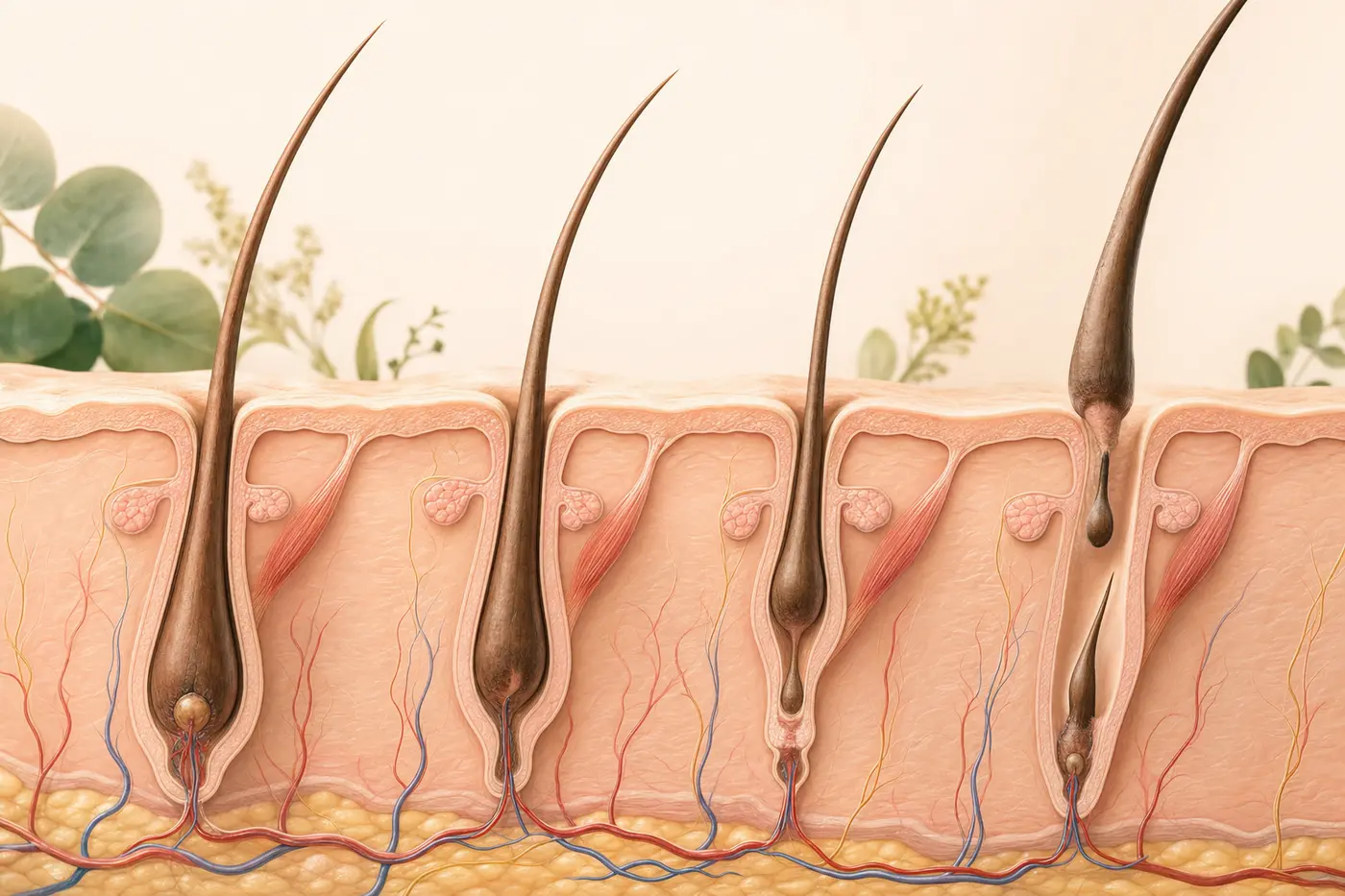
- Hair shedding is part of the normal growth cycle, not automatic proof of damage. Exogen is the shedding step of the cycle: the club hair is released after telogen and before or during the next growth cycle, which is why some daily hair fall is expected in healthy scalps.
- Most reviews describe roughly 80% to 90% of normal adult scalp hairs as being in anagen at a given time. The anagen phase is the active growth phase, and scalp anagen is usually described as lasting about 2 to 8 years, although some reviews cite 2 to 6 or 2 to 7 years depending on the source. A 2016 review of hair and scalp diseases also describes scalp hair growth during anagen as about 0.3 mm per day, or roughly 1 cm per month.
- Scalp catagen is usually described as lasting about 2 to 6 weeks, but some reviews narrow this to roughly 2 to 4 weeks or 3 to 6 weeks. Catagen is a short transition phase. The follicle stops active growth and prepares to rest.
- Most reviews describe about 10% to 20% of normal adult scalp hairs as being in telogen at a given time. Scalp telogen is commonly described as lasting about 2 to 4 months, with many reviews centering it around 3 months. Telogen is the resting phase, so hairs in this phase are no longer growing.
- Exogen follows telogen. That is the point when the club hair is released and shed. A new hair can then begin growing from the same follicle.
- Why does the 50 to 100 range make sense at all? If a scalp has about 80,000 to 120,000 terminal hairs, and about 10% to 20% are in telogen at any time, some of those resting hairs will naturally exit each day. That is why normal hair shedding vs hair loss is not the same thing.
Why Wash Day Looks Alarming, and Why It Usually Is Not
How much hair fall is normal in a day often looks very different on wash day. Hairs that have completed their growth cycle detach from the follicle but remain tangled in surrounding strands until water and friction dislodge them. If you wash every three days, you may see roughly three days of shed hairs at once, which can look like 150 to 300 hairs in one shower even when your daily shedding rate is normal.

This is why the 100 hairs a day myth causes so much panic. Women do not lose hair in neat daily bundles that can be counted like coins. Wash-day shedding often looks dramatic because hairs that were already in telogen may remain trapped until shampooing, brushing, or combing dislodges them, so the pile in the drain does not equal that day’s true shedding alone.
A normal wash-day clump often looks bigger than expected because long strands loop around each other and trap water. On the shower wall or drain cover, 60 to 80 long hairs can look like a dense dark wad. The same number in shoulder-length hair looks much smaller. If you pick up the strands and many have a tiny white bulb at one end, that points to shedding. If the strands are short, uneven, and have no bulb, that points more to breakage.
Indian routines make this effect even stronger. If you do champi, the Indian pre-wash oiling practice, massage and finger detangling can loosen extra club hairs before shampoo. That does not mean the oil caused the shedding. It usually means the oiling session exposed hairs that were already ready to come out.
Common counting mistakes also make how much hair fall is normal in a day seem worse than it is. Counting after a skipped wash, after aggressive detangling, or after pulling through knots on oiled hair mixes normal accumulated shedding with breakage. A wide-tooth comb used gently before washing gives a truer picture than forceful brushing through tangles.
Hard water adds another layer, especially in cities like Delhi and Chennai. Hard water means higher calcium and magnesium mineral content. Hard water is commonly blamed for hair roughness and breakage, but a small 2013 study of 15 volunteers found no significant effect of hard water on hair tensile strength or elasticity, and evidence that hard water directly increases shedding remains limited. Hard water may make hair feel rough, tangly, or harder to manage, which can make breakage look like hair fall, but current evidence does not clearly show root-level shedding from hard water itself.
Monsoon humidity changes what you see too. Frizz, swelling of the hair shaft, and extra tangling can make shed hairs cling to the rest of your hair until wash day. Seasonal variation in shedding has been reported, including a six-year study of 823 otherwise healthy women cited in a 2015 review that found annual periodicity with a maximal proportion of telogen hairs in July and a possible second peak in April. In Mumbai, that can overlap with humid weather and make the timing feel suspicious even when the shift is temporary. For more on seasonal and monsoon-related reasons shedding can look worse, including humidity, dandruff, and temporary telogen shedding, see our separate guide.
Read the week, not one shower. That is the better way to judge how much hair fall is normal in a day when you do not wash daily.
How to Assess Your Own Hair Fall: The Lotus Femcare Three-Point Check
How much hair fall is normal in a day is hard to judge from memory, so a simple home log can help. The Lotus Femcare Three-Point Check is this publication’s practical tracking method, not a validated diagnostic tool. Home counts are rough trend tools, and dermatologist assessment remains the standard when thinning is visible.
Collect hairs from your pillow each morning before combing, count drain hairs after washing and divide by days since your last wash, and photograph your parting in the same light monthly. Used together, these three checks can show a trend without counting every strand every day. Track the pattern for eight weeks before drawing conclusions.
Step 1: Do a morning pillow count
Check your pillow when you wake up, before combing or tying your hair. Count the visible strands and write the number in your phone notes or a small notebook. A low single-digit count can be normal, and some mornings you may see none at all.
Do not obsess over one odd day. A late-night detangling session, a tight bun, or a skipped wash can change the next morning’s number. What matters is whether the average starts climbing over several weeks.
Step 2: Count wash-day drain hairs, then divide by days since the last wash
After shampooing, collect the hairs from the drain cover or your hands and count them once. Then divide that number by the number of days since your last wash. If you washed after three days and counted 180 hairs, your adjusted daily average is 60.
This step is the most useful for women who wash two or three times a week. It corrects for the pile-up effect that makes a single wash look frightening. And it gives you a much better answer to how many hairs fall per day is normal for your own routine.
Step 3: Take a monthly parting photograph
Stand in the same place each month, ideally near a window in natural daylight. Make the same centre or side part, hold the phone at the same angle, and take one clear photo. Save it in an album labelled by month.
Photos show what raw counts can miss. If the number of shed hairs stays similar but your parting widens or scalp shows through more, the issue may be patterned thinning such as androgenetic alopecia rather than simple shedding.
Step 4: Use the gentle pull test carefully
The pull test means grasping about 60 hairs and pulling gently. A 2022 review on practical hair loss diagnosis says release of more than 6 hairs is considered a positive result indicating elevated shedding. But a positive pull test is only a screening clue, not a diagnosis. Reviews note that these bedside shedding tests are easy and inexpensive but are neither standardized nor diagnostic on their own.
Do not do the pull test every day. Once every one to two weeks is enough if you are tracking a sudden shedding phase.
Step 5: Track trends for eight weeks
Hair cycles move slowly. One dramatic shower, one oily scalp day, or one stressful week does not tell you much. Eight weeks gives enough time to see whether the trend is settling, rising, or starting to improve.
Step 6: Bring a record if you see a dermatologist
Write down your pillow counts, wash-day adjusted counts, pull-test dates, and monthly photos. Also note recent life events such as childbirth, fever, COVID-19, surgery, crash dieting, new medicines, or severe stress. That record is far more useful than saying, “I think I am losing a lot.”
Worked example: what normal accumulation can look like
A 28-year-old woman washes every three days and comes in worried because the drain looks full after shampoo. On wash day she counts about 170 hairs, sees 3 to 5 hairs on the pillow most mornings, and notices a few strands on her T-shirt during detangling. Her parting photos look the same over two months. She had a high fever about 10 weeks earlier. Visually, the shower clump looks large because her hair is waist length, but many strands are full length with a small bulb. That pattern can still fit normal accumulation plus a temporary telogen shed after illness. What would change the recommendation is a widening part, clear drop in ponytail volume, patchy loss, scalp symptoms, or counts that keep rising instead of settling by 10 to 12 weeks after the illness.
Shedding vs Breakage: How to Tell the Difference and Why It Matters
How much hair fall is normal in a day cannot be judged properly unless you separate shedding from breakage. A shed hair has a small white or translucent bulb at one end, the root that completed its cycle. A broken hair has no bulb, both ends are roughly the same diameter, and the strand is shorter than your full hair length. Shedding points to scalp or systemic causes. Breakage points to mechanical or chemical haircare damage.
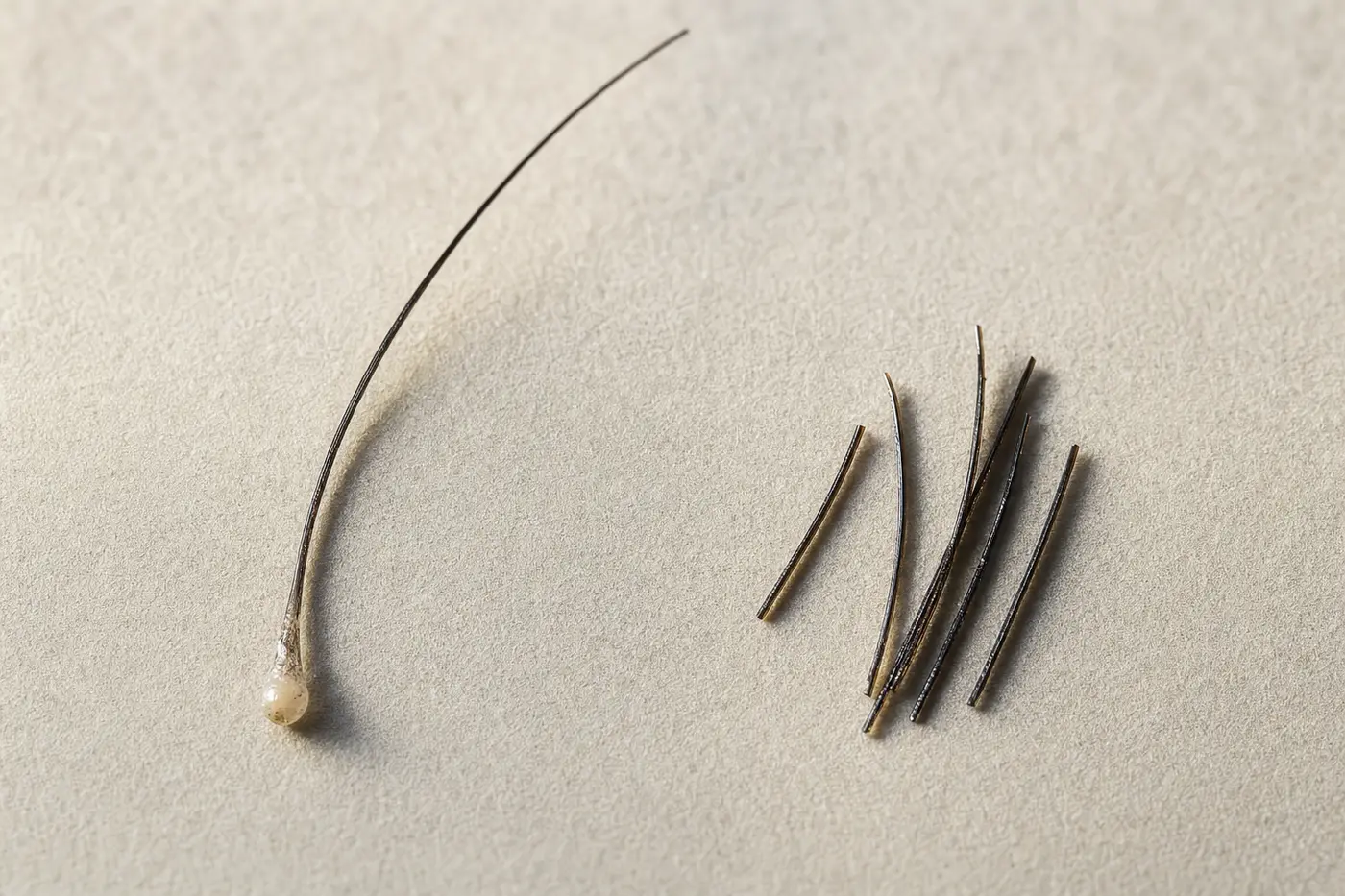
Treating breakage as shedding leads to the wrong fix. You may spend money on scalp serums when the real problem is repeated straightening, bleaching, tight braids, or rough detangling on mineral-heavy water. A 2020 cross-sectional study of 94 women linked hairstyling procedures with structural hair-shaft changes, which supports this distinction.
| Item | Normal shedding | Breakage |
|---|---|---|
| Root appearance | Small white or translucent bulb at one end | No bulb visible |
| Strand length | Usually full length, similar to the rest of your hair | Shorter fragment, often uneven |
| End appearance | One bulb end and one tapered or cut end | Both ends look similar in diameter |
| Main cause | Scalp cycle or systemic trigger such as telogen effluvium | Haircare damage such as heat, bleach, friction, tight styling |
| Where noticed | Pillow, comb, drain, fingers while washing | Mid-lengths, sink, clothes, brush, broken flyaways |
| What it signals | Postpartum shedding, illness, stress, nutritional issues, female pattern loss | Heat damage, chemical processing, traction, rough handling, tangling |
| Next step | Track trend, review triggers, see a dermatologist if persistent | Reduce heat and chemical damage, loosen styles, improve handling |
Common breakage causes in Indian routines are easy to miss. Tight braids, sleek buns, repeated blow-drying, bleaching, and rough towel rubbing all raise the risk. The American Academy of Dermatology says traction alopecia from tight hairstyles can become permanent if the pulling continues long enough.
And yes, hard water can still matter here, even though evidence for true shedding is weak. Mineral-heavy water can leave hair feeling rough and harder to detangle. That can increase snapping during combing, which looks like hair fall but is not the same biological process.
Normal Reasons Shedding Increases, and How Long Each Lasts
How much hair fall is normal in a day can rise for a while after common triggers, especially when more hairs shift into telogen, the resting phase. Timing matters here. Onset, peak shedding, and visible density recovery do not happen on the same day, and recovery is not identical for every woman.
Research suggests a mild seasonal pattern in shedding. A 2015 review of telogen effluvium cited a six-year study of 823 otherwise healthy women that found annual periodicity, with the maximal proportion of telogen hairs in July and a possible second peak in April. In India, that seasonal signal can overlap with monsoon-to-winter changes, making shedding more noticeable for a few weeks.
- Telogen effluvium
Telogen effluvium is diffuse shedding that starts after a trigger pushes more hairs than usual into the resting phase. A 2020 review of the literature says telogen effluvium typically manifests 6 to 12 weeks after the triggering event. Review authors in a 2015 review describe acute telogen effluvium as usually self-limiting, though visible regrowth may take many months after the trigger is removed. - Post-pregnancy shedding
Postpartum shedding often becomes noticeable a few months after delivery because falling oestrogen shifts many hairs back into the normal cycle together. A 2015 review of telogen effluvium supports that postpartum shedding often starts after delivery and can be marked for several months. Visible density recovery often takes longer than the shedding phase, and persistent shedding beyond 12 months warrants assessment for another cause. - After high fever, surgery, or severe illness
Illness-related shedding usually follows the same telogen effluvium timeline, with a lag of 6 to 12 weeks after the event. That is why hair may start falling long after you think you have recovered. The delay is built into the cycle. - After COVID-19
COVID-19 infection has been associated with telogen effluvium in a 2022 systematic review and meta-analysis. A 2021 prospective study of 204 post-COVID patients reported COVID-associated telogen effluvium in 27.9% of patients, with onset at a mean of 53.76 days after RT-PCR positivity. That is a little earlier than classic telogen effluvium in some cases. - Crash dieting and protein restriction
Severe protein deficiency, fatty acid and zinc deficiency, chronic starvation, and caloric restriction are recognized triggers of telogen effluvium. The evidence does not support assigning one exact calorie threshold. If the trigger is corrected, shedding usually improves over months, not days. - Emotional stress
Physical and psychological stress are recognized triggers of telogen effluvium, but the specific role of cortisol in human scalp shedding is still mechanistically plausible rather than firmly established as the sole causal pathway. So the useful message is practical: major stress can trigger shedding, and the lag is usually weeks to months. - Menopause and midlife thinning
Women can experience increased shedding around postpartum hormonal change and may notice hair thinning after menopause, but that does not mean women shed more than men overall. A 2018 review of female pattern hair loss states that more than 50% of women have some element of female pattern hair loss by age 79. If your complaint is reduced ponytail volume and a widening part, think beyond shedding alone.
Composite illustrative case
A 32-year-old woman develops diffuse thinning that starts four months after delivery. Her ferritin is 18 ng/mL. She notices more full-length hairs with bulbs during washing and while sweeping the floor, but no bald patches, no scalp pain, and no widening part at first. Reviews of telogen effluvium support postpartum shedding as a common trigger for diffuse loss a few months after childbirth, and low iron stores can be a contributor that needs medical review. The evidence-supported next step is assessment by a clinician rather than self-starting supplements blindly. If the pattern stays diffuse and the trigger is postpartum telogen effluvium, shedding often settles over months, while visible density recovery can take longer. If parting width increases, ponytail volume keeps dropping, or shedding persists well past a year postpartum, the evidence supports looking for overlap with female pattern hair loss or another cause rather than assuming all of it is normal postpartum shedding.
Myths to refute
- Myth: Hard water directly causes hair fall by weakening the roots.
The evidence does not support that claim. A small 2013 laboratory study of 15 volunteers found no significant effect of hard water on hair tensile strength or elasticity, and it did not study follicle-level shedding. Say instead: hard water may make hair feel rough or harder to manage, but current evidence does not clearly show that it directly causes follicle-level hair shedding. - Myth: Brushing or styling is responsible for excessive shedding in about 40% of all women.
That 40% figure appears in the abstract of a manufacturer-affiliated 2018 controlled clinical trial, not in an independent population survey. Say instead: some women notice more hairs during brushing or styling, but robust population estimates are lacking and visible shedding during grooming does not always mean abnormal hair loss. - Myth: Stress hair fall is proven to be caused by high cortisol.
The literature supports stress as a trigger of telogen effluvium, but it does not prove cortisol alone is the reason everyday shedding rises. Say instead: physical or emotional stress can trigger telogen effluvium, but the biology is more complex than cortisol alone. - Myth: The normal 50 to 100 hairs a day rule was established specifically in Indian women.
The reviewed literature did not identify a primary Indian cohort that established this threshold. Say instead: the 50 to 100 hairs a day figure is a general dermatology rule of thumb, not a threshold validated specifically in Indian women.
When to See a Dermatologist: Specific Signs That Need Medical Assessment
How much hair fall is normal in a day stops being the main question when visible thinning, scalp symptoms, or systemic symptoms appear. See a dermatologist if your parting is visibly wider than it was six months ago, you can see scalp through your hair in normal light, you notice a bald patch, shedding has continued beyond three months without an obvious trigger, or hair fall is accompanied by fatigue, irregular periods, or unexplained weight change.
- Your parting is widening in photos over three months.
That can point to androgenetic alopecia rather than simple shedding. Female pattern loss often overlaps with shedding, which is why photos matter. - You can see scalp through your hair indoors.
Not just under harsh flash or direct sunlight. Normal room light is the test. - You have patchy loss.
Circular or irregular bald areas are not typical telogen effluvium. Causes can include alopecia areata, fungal infection, trichotillomania, or inflammatory disease. - You have scalp pain, redness, scale, or scarring.
The American Academy of Dermatology advises prompt review because inflammatory, scarring, fungal, or autoimmune causes need diagnosis and may risk permanent loss if delayed. - Shedding goes on beyond three months with no clear trigger.
A 2015 review of telogen effluvium describes acute telogen effluvium as usually self-limiting. Persistent shedding needs evaluation for ferritin, thyroid-stimulating hormone or TSH, and other contributors depending on your history. - Hair fall comes with fatigue, irregular periods, or unexplained weight change.
Those symptoms can point to iron deficiency, thyroid disease, or hormonal issues. Do not self-prescribe iron, biotin, or vitamin D. Dosing is a clinical decision. - You are pregnant, trying to conceive, or breastfeeding.
Avoid minoxidil unless specifically advised by a clinician. The American Academy of Dermatology says women who are pregnant, planning pregnancy, or breastfeeding should avoid it. - You are considering finasteride products.
Do not self-start. Finasteride is approved for male pattern hair loss in men only and is contraindicated in pregnancy. The FDA-approved finasteride label and recent FDA safety communication coverage on compounded topical finasteride support caution, especially in women of childbearing potential.
What not to do
Do not self-start iron, biotin, or vitamin D because hair fall feels scary. Deficiency needs confirmation, and the wrong supplement can distract from the real diagnosis.
Do not use minoxidil in pregnancy, while trying to conceive, or while breastfeeding unless a clinician specifically advises it. Do not self-start finasteride products either, especially compounded topical products.
Do not keep tight hairstyles if there is pain, scalp tenderness, bumps, or headaches after styling. The American Academy of Dermatology warns that traction alopecia can become permanent if tension continues.
Do not assume hard water filters, onion oil, rosemary oil, or routine champi will treat true telogen effluvium or female pattern hair loss. Those may change feel or breakage, but they do not replace diagnosis when thinning is visible.
Bring your Three-Point Check log, your monthly parting photos, and a list of recent life events. Include childbirth, fever, COVID-19, surgery, severe dieting, new medicines, and tight hairstyles.
Frequently Asked Questions
Is 100 hair fall a day normal?
Yes. The American Academy of Dermatology says 50 to 100 hairs a day is a normal range. If how much hair fall is normal in a day for you has usually been lower, a sustained rise plus visible thinning matters more than one number alone.
Why do I lose more hair on wash days?
Wash day releases hairs that detached earlier but stayed trapped among other strands. Water, shampoo, and combing bring several days out at once. That is why how much hair fall is normal in a day can look much higher in one shower than it really is across the week.
Does long hair fall more than short hair?
Long hair does not usually shed more strands than short hair. Each strand is simply longer, so the pile looks larger on the floor, pillow, or drain. The number of hairs entering exogen depends on the follicle cycle, not hair length.
How do I count my hair fall properly at home?
Use a simple trend log. Count pillow hairs before combing, count wash-day hairs and divide by days since the last wash, and compare monthly parting photos in the same light. Home counting helps answer how much hair fall is normal in a day for your routine, but it is still only a rough tool.
Is losing 200 hairs a day serious?
It can be, if 200 is a true daily average rather than one high wash-day count after a gap. Persistent counts well above your own baseline, especially with visible thinning or symptoms, warrant review. That is a more useful rule than treating one number as a strict medical cutoff.
Does hair fall more in certain seasons in India?
Seasonal variation has been reported, including a six-year study of 823 healthy women cited in a 2015 review that found a July peak and a possible April peak in telogen hairs. In India, humidity, dandruff, and tangling can make that temporary rise look worse.
Can I tell the difference between hair fall and hair breakage?
Yes. A shed hair usually has a small white or translucent bulb at one end. A broken hair has no bulb and is often shorter than your full hair length. That difference matters because shedding and breakage have different causes.
At what point should I see a doctor about hair fall?
See a dermatologist if your parting is wider than before, scalp shows in normal indoor light, you notice a bald patch, shedding continues beyond three months without a clear cause, or hair fall comes with fatigue, irregular periods, itching, pain, or weight change.
Is losing 150 hair a day normal?
How much hair fall is normal in a day cannot be judged from one count alone. A count of 150 after a few days without washing can still fit normal accumulation. A true daily average around that level for several weeks, especially with visible thinning, deserves assessment.
What is the big 3 of hair loss?
Online, the “big 3” usually means minoxidil, finasteride, and ketoconazole shampoo. That phrase mostly comes from male hair-loss forums. It is not a universal treatment plan for women, and women need diagnosis first, especially to separate telogen effluvium from female pattern hair loss.
How do I know I am losing too much hair?
Look for a rising pattern over time. If how much hair fall is normal in a day for you has clearly changed, and you also see a widening part, reduced ponytail volume, visible scalp, or shedding beyond three months, the change is more meaningful than one dramatic shower.
Is losing 500 hairs a day normal?
A repeated true daily average near 500 is not typical and needs prompt dermatology review. A one-off count after a long wash gap, heavy champi, or aggressive detangling can still mislead, so context matters before deciding how much hair fall is normal in a day.
Where the evidence is missing
How much hair fall is normal in a day is widely answered with 50 to 100 hairs, but the reviewed sources did not identify a robust Indian cohort validating this threshold specifically for Indian women. That is the biggest gap.
Direct Indian-versus-European comparative data on healthy female scalp density and shaft diameter were also not confirmed in the reviewed sources. Ethnic variation exists, but the exact Indian comparison many websites claim is not well supported.
Hard water and real-world shedding data are sparse. The available primary study was a small laboratory experiment on hair strands and did not show significant changes in tensile strength or elasticity.
Stress is a recognized trigger of telogen effluvium, but the reviewed literature does not establish cortisol alone as the definitive cause of routine human shedding.
And the often-cited 40% prevalence of styling-related excessive shedding came from a product-focused trial abstract, not an independent epidemiologic survey. That number should not be generalized to all women.