


Yes, hair fall in monsoon commonly feels worse during the Indian rainy season, and the increase is often temporary. Hair fall in monsoon may overlap with telogen effluvium, dandruff flares, breakage, or all three at once. According to DermNet NZ, acute telogen effluvium usually becomes noticeable about 2 to 4 months after a trigger and then gradually tapers over 6 to 9 months in most cases, rather than resolving within 12 weeks.
Key takeaways
- Hair fall in monsoon is often temporary, but the cause is not always one thing. Hair fall in monsoon may reflect seasonal telogen effluvium, dandruff-related shedding, shaft breakage, or a mix of these rather than permanent follicle damage.
- Losing 50 to 100 strands per day is the accepted normal range for adult women, according to the American Academy of Dermatology. During hair fall in monsoon, shedding can rise above your usual baseline and still settle, but shedding that stays clearly excessive for more than 3 months should be assessed, and diffuse shedding lasting beyond about 6 to 9 months raises concern for chronic telogen effluvium.
- A warm, humid scalp can support dandruff flares. A 2020 review of the microbiology and immunology of seborrheic dermatitis identifies Malassezia globosa and Malassezia restricta as the main species linked to dandruff and seborrheic dermatitis, and a 2002 randomized multicenter trial of ketoconazole 2% and zinc pyrithione 1% supports anti-dandruff shampoo use when scalp inflammation is part of the problem.
- Heavy scalp oiling during hair fall in monsoon can backfire. The same 2020 review explains that Malassezia metabolises sebum triglycerides to produce oleic acid, which can irritate the scalp barrier. If you oil during hair fall in monsoon, keep it on the lengths and treat a short pre-wash application as editorial guidance rather than a proven medical rule.
- See a dermatologist promptly for patchy bald spots, scalp sores, crusting, pustules, sudden severe shedding without a seasonal pattern, visible widening of the part, or hair fall in monsoon that has not improved after 3 months of consistent scalp care.
What Is Actually Happening to Your Hair During Monsoon?
Hair fall in monsoon may reflect several overlapping problems rather than one proven humidity effect. Humid weather can plausibly worsen scalp oiliness, sweat retention, dandruff flares, and breakage, while telogen effluvium follows its own delayed timeline. That is why hair fall in monsoon often feels sudden even when the biology started earlier.
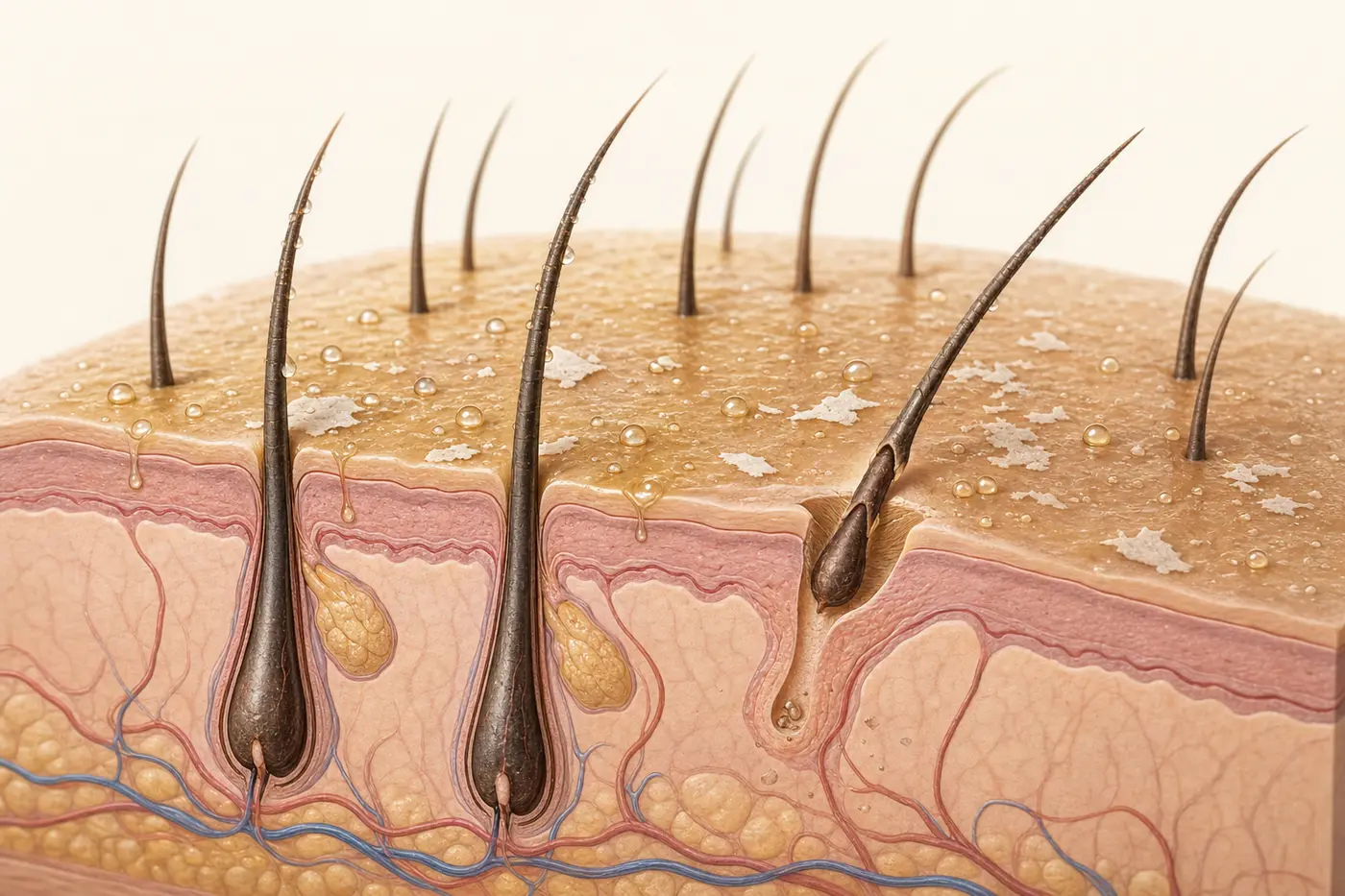
What many women call hair fall in monsoon is often two problems mixed together. One is true shedding from the root, usually telogen effluvium. The other is breakage from the shaft, where the strand snaps because the cuticle has been stressed by humidity, friction, rough towel drying, and tight hairstyles.
The Seasonal Telogen Shift: Why Your Follicles Are on a Timer
Your scalp hairs do not all grow together. Conventional teaching says most scalp follicles are in anagen, the active growth phase, while a smaller share are in telogen, the resting phase before shedding, although a small 2024 histologic review notes that these figures are not fixed biology. That matters because hair fall in monsoon is often blamed on the wrong week.
Telogen effluvium means more hairs than usual enter the telogen phase and then shed later. DermNet NZ states that acute telogen effluvium usually becomes noticeable 2 to 4 months after a trigger because new anagen hairs push out resting club hairs. That delay matters. It is why women often blame the shampoo they started last week for hair fall in monsoon that was set in motion months earlier.
Competitor articles often cite Courtois et al. for a fixed seasonal hair-cycle pattern. That claim should be handled carefully. Hair growth and shedding appear to show seasonal variation in some studies, but a fixed summer-versus-autumn pattern should not be stated here without the original seasonal hair-cycle paper or a modern review confirming it.
Humidity, the Cuticle, and the Difference Between Shedding and Breakage
Humidity changes how the hair shaft behaves. A 2023 review on the hair growth cycle and hair loss supports the general biology of hair-fiber stress, but the term hygral fatigue comes more from cosmetic science than from patient-centered dermatology trials. So the mechanism is plausible, and hair fall in monsoon may include more breakage, but the diagnosis should not be oversold.
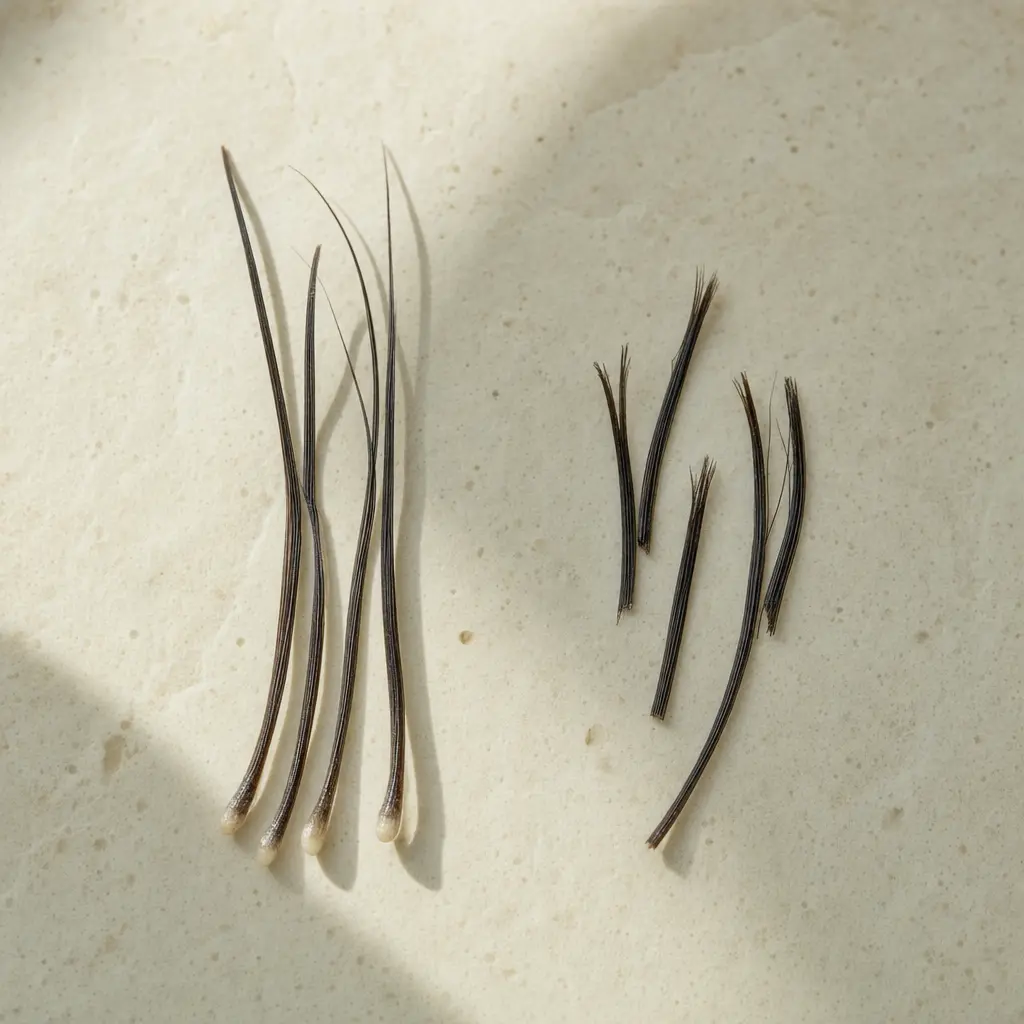
Still, the practical effect is easy to see. Hair swells when it takes up water. The cuticle, which is the outer protective layer, lifts and roughens more easily. Add combing, friction from a towel, a wet bun, or a helmet on damp hair, and strands can snap mid-length. That is breakage, not follicular loss. On wash day, breakage often looks like shorter strands on the shoulder or sink, while root shedding leaves longer hairs with a pale bulb at one end.
This difference matters because the fix is different. True shedding from the root means you focus on scalp triggers, dandruff control, and time. Breakage means you reduce mechanical stress, improve slip with conditioner, detangle better, and stop treating the scalp as the problem when the shaft is the one failing.
Lotus Femcare calls this the Root-or-Break? check. Club hairs with a pale keratinized bulb are typical of telogen shedding, whereas broken hairs lack an intact club root, according to DermNet NZ. But readers should not rely on a single visual sign alone to self-diagnose the cause of hair fall in monsoon. Use it as a guide, not a verdict.
Malassezia and the Damp Scalp: The Fungal Connection
Malassezia is a yeast that normally lives on human skin. A 2020 review of the microbiology, immunology and genetics of seborrheic dermatitis identifies Malassezia globosa and Malassezia restricta as the primary species implicated in seborrheic dermatitis and dandruff. That link matters because dandruff-related hair fall in monsoon often shows up as more shedding on itchy, greasy wash days.
Malassezia thrives in an oily environment. The same 2020 review explains that it metabolises sebum triglycerides to produce oleic acid, which penetrates the scalp barrier and triggers inflammation. If your scalp is already sweaty and greasy in humid weather, that is a plausible setup for dandruff flares that can make hair fall in monsoon look worse.
In many Indian monsoon cities, especially coastal metros, monsoon weather commonly combines warm temperatures in the high 20s to low 30s Celsius with high relative humidity, but the exact range varies by city and month, according to the India Meteorological Department Mumbai weather bulletin. Mumbai monsoon weather can combine temperatures around 32 to 33°C with relative humidity in the mid-80s, creating a plausible environment for sweat, scalp occlusion, and dandruff flares.
Sweat itself is not dirt, but it does change the scalp environment. A 2013 skin study shows that sweat contains lactate, urea, sodium, and potassium, but the claim that retained sweat shifts scalp pH toward neutral was not directly verified in a scalp study. What is fair to say is simpler: a sweaty, unwashed scalp is a better place for dandruff to flare than a clean one, and that can make hair fall in monsoon feel heavier.
How Much Shedding Is Normal, and When Should You Worry?
The accepted normal range is 50 to 100 hairs a day, according to the American Academy of Dermatology. During hair fall in monsoon, shedding can rise above your usual baseline and still be self-limiting, but patchy loss, scalp disease, or persistent clearly excessive shedding should not be dismissed as seasonal.
If you lose 20 extra hairs in the shower, that is not a crisis. If your comb, pillow, drain, and T-shirt are all collecting hair for weeks and your part looks wider, you need to stop guessing. That pattern of hair fall in monsoon deserves a closer look.
The internet loves exact seasonal numbers like 150 to 200 strands a day during monsoon. That sounds neat, but the opened evidence supplied for this article does not directly verify a monsoon-specific daily range in women. So the honest version is this: the accepted normal range is 50 to 100 a day, and a temporary increase can happen with telogen effluvium, but persistent clearly excessive hair fall in monsoon needs assessment.
DermNet NZ also gives the timeline that matters most. Acute telogen effluvium usually becomes noticeable about 2 to 4 months after a trigger, then gradually tapers over 6 to 9 months in most cases. That means hair fall in monsoon may start after the first humid spell and continue into autumn. In Delhi, that can mean you notice the worst of it in October or November and wrongly assume the monsoon had nothing to do with it.
Use 3 months as a practical point to get assessed if hair fall in monsoon is not improving. Use 6 to 9 months as the stronger chronicity window that raises concern for chronic telogen effluvium or another diagnosis, according to DermNet NZ.
The Pull Test: A 30-Second Home Assessment
A hair pull test can support telogen effluvium when gentle traction removes an increased number of club hairs, according to DermNet NZ. But this article should not state a fixed threshold of more than 6 hairs from 40 to 60 without the original Sinclair R source in hand. Many websites quote that cutoff. We are not going to pretend we verified it when we did not.
Here is the safe way to use the pull test at home:
- Start with dry hair that has not been washed immediately before the test.
- Hold a small section of hair close to the scalp.
- Use gentle traction, not a yank.
- Look at the hairs that come away.
- If several hairs release easily and many have pale club bulbs, active shedding is more likely.
Repeat the test on different parts of the scalp, not just one spot. Repeat it after a week, not five times in one anxious evening. A single positive-feeling pull test does not diagnose telogen effluvium by itself. It only tells you whether active shedding may be happening during hair fall in monsoon.
The 60-second comb test is better for tracking change over time. Use the same comb, same time of day, and same pre-wash interval. Comb for 60 seconds over a plain towel or sink and count what falls. The number is less useful than the trend, especially when hair fall in monsoon is fluctuating.
Red flags are clearer than any home test. Patchy circular bald spots suggest alopecia areata, according to DermNet NZ. Scalp sores, crusting, pustules, crown thinning, or a widening part suggest something other than simple seasonal hair fall in monsoon.
What Actually Helps: The Evidence-Based Monsoon Hair Care Routine
The best routine for hair fall in monsoon depends on whether the main problem is scalp inflammation, true root shedding, breakage, or a mix. More frequent washing can help some women manage sweat, sebum, and flakes in humid weather, but the exact schedule should be treated as practical guidance based on scalp oiliness and dandruff tendency, not as a fixed evidence-backed rule.
Start with the problem you actually have. If your brush shows club hairs with bulbs and your scalp is itchy or flaky, treat the scalp. If the strands are snapping mid-length and your scalp is calm, treat breakage. If you have both, which is common during hair fall in monsoon, split the routine accordingly.
1. Increase wash frequency before you buy another serum
Skipping washes in monsoon is one of the fastest ways to make dandruff worse. A sweaty scalp plus sebum plus dead skin is not a sign you need more oil. It is a sign you need cleansing, especially if hair fall in monsoon comes with itch or greasy flakes.
For many women in humid Indian cities, every alternate day is a practical starting point during hair fall in monsoon. Daily washing can make sense if you sweat heavily, work out, wear a helmet, or have an oily scalp. Frequent washing does not cause telogen effluvium. Rough washing and untreated scalp inflammation usually cause more trouble than water does.
The first two weeks after increasing wash frequency can feel odd. The scalp may feel cleaner by evening, but the shower drain can still look full because wash day reveals hairs that were already detached. By week three or four, many women notice less greasy root feel, less waxy flake buildup under the nails, and fewer short snapped hairs caught in tangles, even if hair fall in monsoon has not fully settled yet.
2. Use an anti-dandruff active if you have flakes, itch, or greasy scaling
Zinc pyrithione is an accepted anti-dandruff active with antifungal activity against Malassezia. A 2002 randomized multicenter trial of 331 volunteers with severe dandruff or scalp seborrheic dermatitis compared ketoconazole 2% with zinc pyrithione 1% and found that ketoconazole 2% was significantly superior after 4 weeks in severe dandruff or seborrheic dermatitis. That does not make zinc pyrithione useless. It makes zinc pyrithione a reasonable first step for milder dandruff and ketoconazole the stronger option when hair fall in monsoon comes with a clearly inflamed scalp.
Ketoconazole also has direct comparative evidence in shedding linked to dandruff. A 2002 randomized study of 150 men with androgenetic alopecia, dandruff, and telogen effluvium compared 1% ketoconazole, 1% piroctone olamine, and 1% zinc pyrithione shampoos used 2 to 3 times weekly for 6 months and found reduced shedding during shampooing across the active comparator groups. The opened source does not support a 17% reduction versus placebo or a 2% ketoconazole placebo comparison, so that common claim should not be repeated here.
There is also an older 1997 comparative study suggesting ketoconazole shampoo gave a longer-lasting reduction in Malassezia recurrence than zinc pyrithione or selenium sulfide shampoos after 6 weeks, but confidence is weak because the opened abstract did not provide the sample size.
Selenium sulphide is an established anti-dandruff and anti-seborrheic active. The OTC Monograph M032 regulatory source specifically supports 1% selenium sulfide in OTC dandruff and seborrheic dermatitis monographs. Many Indian products use 2.5%, but this article should not claim a separate 2.5% efficacy advantage for severe disease without a verified clinical or labeling source.
3. Match the active to the scalp
Use zinc pyrithione if you have mild to moderate dandruff, a slightly oily scalp, and want a regular-use anti-dandruff shampoo. Use ketoconazole if dandruff is stubborn, visible, itchy, or closer to seborrheic dermatitis. Use selenium sulphide if flakes are heavy and greasy and you tolerate stronger medicated shampoos well. Matching the active matters more than buying a product with anti-hair-fall branding when hair fall in monsoon is really dandruff-led.
Read the Indian ingredient list carefully. The front label may say anti-hair fall, scalp cleanse, or anti-dandruff, but the back label tells you the active. Look for zinc pyrithione, ketoconazole, or selenium sulphide by name and concentration.
4. Dry the scalp fully before sleep
Sleeping with a damp scalp is not a disease diagnosis, but it is a bad monsoon habit. It keeps the scalp occluded for hours. In high-humidity cities, that means more sweat, more stickiness, and more chance of waking to itch, greasy flakes, and worse-feeling hair fall in monsoon.
Air-dry if you have time. Use a dryer on a gentle setting if you do not. The goal is a dry scalp, not scorched lengths. A medicated shampoo often leaves the scalp feeling squeakier and less coated than an oil-heavy routine, and the smell can be medicinal rather than perfumed. That is normal. What matters is whether the scalp feels less itchy by the next day.
5. Detangle wet hair like it is fragile, because it is
Use a wide-tooth comb. Start from the ends and work upward. Do not drag a fine comb from scalp to tip through wet knots just because you are in a hurry. That habit can turn hair fall in monsoon into visible mid-length breakage.
This matters more if your monsoon hair fall is really breakage. Wet hair plus friction plus force equals snapped strands. That is not something ketoconazole can fix. If your towel comes away with shorter broken pieces rather than full-length hairs, the shaft needs gentler handling.
6. Stop tying tight buns or braids on damp hair
DermNet NZ states that traction alopecia results from repeated tension on the hair. Tying hair tightly can contribute to it. The specific claim that wet hair is more vulnerable because it is swollen and weakened was not directly verified in a clinical traction-alopecia source, but in practical terms, tight wet hairstyles are still a bad idea if hair fall in monsoon already includes tangling and breakage.
Choose a loose braid on dry hair, or a low loose ponytail. If you need a work hairstyle, reduce tension first.
Choosing the Right Shampoo Ingredient for Your Scalp
If your scalp is flaky but not very inflamed, start with zinc pyrithione. If flakes are thick, greasy, itchy, or recurring quickly, ketoconazole is the stronger evidence-backed option from the 2002 Piérard-Franchimont head-to-head trial. If you have persistent heavy scaling and can tolerate a stronger medicated wash, selenium sulphide is a reasonable alternative, though the best opened regulatory support is for 1% OTC use.
Use medicated shampoos the way labels direct. In real life, that usually means a few times a week, not ten days in a row because panic set in. And if the scalp is red, painful, crusted, or not improving, stop trying to out-shampoo the problem and see a dermatologist.
OTC Anti-Dandruff Shampoos Available in India: A Comparison (Table)
Prices below are based on current Amazon.in or Nykaa listings available at the time of writing and converted to price per 100 ml for easy comparison. Online prices move. Check the live listing before you buy.
Methodology: products were shortlisted from widely available India retail listings because they represent the main OTC anti-dandruff actives readers are most likely to find during hair fall in monsoon. Prices and ratings were taken from public listings available on 10 August 2026. Formulas were assessed from public ingredient listings only. No hands-on testing was performed. Inclusion is not a treatment endorsement, and active ingredients can change, so verify the current label before buying.
| Product | Active | Strength | Price | Per 100 ml | Best for |
|---|---|---|---|---|---|
| Head & Shoulders variants | Zinc pyrithione | 1% | about ₹190 | about ₹106 | Mild dandruff, oily scalp |
| Nizoral shampoo | Ketoconazole | 2% | about ₹340 | about ₹340 | Stubborn dandruff, itch |
| Selsun suspension | Selenium sulphide | 2.5% | about ₹265 | about ₹221 | Heavy greasy scaling |
| Dove Dandruff Care | Zinc pyrithione | 1% | about ₹230 | about ₹128 | Mild dandruff, drier lengths |
| Minimalist Anti-Dandruff | Piroctone olamine | Check label | about ₹349 | about ₹194 | Cosmetic anti-dandruff use |
A note on the table. Product labels and concentrations can change. Minimalist and similar new-age brands often use piroctone olamine rather than ketoconazole or zinc pyrithione, so they belong in the cosmetic anti-dandruff category, not the same evidence bucket as the medicated actives above.
We may earn a commission from purchases made through these links, at no extra cost to you. Products are chosen on evidence and value, never on commission.

TRESemme Hairfall Defense+ Shampoo 580ml
This is the most straightforward fit in the list for breakage-led shedding because the title clearly frames its benefit as preventing hair fall due to breakage. In a humid season with more frequent washes, a simple shampoo like TRESemme Hairfall Defense+ Shampoo 580ml can suit readers who need slip and manageable lengths rather than scalp treatment claims.
- Title specifically positions it for hair fall due to breakage
- Large 580ml size keeps cost reasonable for frequent monsoon washing
- Useful when the main problem is rough, tangled lengths rather than scalp disease
- Not an anti-dandruff treatment and should not be expected to address Malassezia-related scalp issues
- May be too much product volume if you want to test a shampoo first
- Keratin-filler positioning is cosmetic, not a treatment for telogen effluvium

Dove Hair Fall Rescue Shampoo 1 L
This works as a practical pick for households or women who wash hair several times a week in sticky weather. The value is the 1 L size at Rs 658, which lowers the cost burden of frequent cleansing. It is best framed as a routine shampoo, not a medical answer to true shedding.
- 1 L size is practical for frequent monsoon washing
- Lower effective cost per ml than many smaller bottles in the list
- Simple option when the goal is keeping hair clean without relying on oil-heavy routines
- Very large bottle is inconvenient for travel or trial use
- No evidence-backed anti-dandruff active in the listing
- Hair fall rescue naming can mislead if your problem is telogen effluvium rather than breakage

L’Oréal Paris Fall Resist Anti Hair Fall Serum 102ml
This is the only candidate that states a quantified active, 1.5% Aminexil, and is clearly a scalp serum rather than an oil or mist. That makes it easier to place in a low-grease monsoon routine. Still, it should be treated as an optional cosmetic add-on, not proof-backed treatment for monsoon telogen effluvium.
- Clear leave-in serum format suits humid weather better than heavy oils
- Listing gives a stated active concentration of 1.5% Aminexil
- Can fit a simple routine without overnight oiling
- Rs 649 for 102ml is costly for a non-essential step
- Evidence provided for this article does not establish it as a treatment for monsoon telogen effluvium
- Does not address dandruff or seborrheic dermatitis if those are driving shedding
What Does Not Help: Monsoon Hair Fall Myths Debunked
Many common fixes for hair fall in monsoon target the wrong problem. If the issue is dandruff, buildup, or breakage, heavier oiling and less washing often make the scalp feel worse rather than better.
Heavy scalp oiling during monsoon is counterproductive. A 2020 review explains that Malassezia metabolises sebum triglycerides to produce oleic acid that can irritate the scalp barrier and worsen dandruff-related inflammation. If you oil during hair fall in monsoon, apply only to hair lengths, not the scalp, and treat washing it out within about two hours as practical editorial guidance rather than a proven medical cutoff.
- Myth 1: Oil your scalp heavily to nourish roots.
This is common bad advice in monsoon hair care tips for women. If your scalp is already humid, sweaty, and producing sebum, adding more oil gives Malassezia more of the lipid-rich environment it thrives in. Oil can reduce friction on dry lengths. It is not food for the follicle. - Say instead: If you like oiling, use a small amount on the mid-lengths and ends before washing. Do not leave heavy oil on the scalp overnight during hair fall in monsoon.
- Myth 2: Wash less to prevent hair fall.
This sounds logical because shed hairs are more visible on wash day. But wash day only reveals hair that was already detached. Less washing means more buildup, more itch, and more opportunity for seborrheic dermatitis to flare. - Say instead: Wash often enough to keep the scalp clean. Every alternate day is a practical baseline for many women in humid weather, and daily washing can be reasonable for oily or sweaty scalps.
- Myth 3: Onion juice stops monsoon hair fall.
A small unblinded 2002 trial of onion juice studied alopecia areata in 38 patients. Alopecia areata is patchy autoimmune hair loss. That evidence does not apply to telogen effluvium or hair fall in monsoon. - Say instead: Onion juice has weak, condition-specific evidence from a small alopecia areata trial and should not be presented as an evidence-based treatment for monsoon shedding.
- Myth 4: Rainwater is good for hair.
The evidence does not support that blanket claim. Rainwater chemistry in Indian cities varies by location and season. Some studies report acidic rain influenced by sulfate and nitrate, while others report near-neutral rain because alkaline dust and ammonium partly neutralize acidity. No direct clinical study linked rain exposure to seasonal telogen effluvium. - Say instead: Hair fall in monsoon is more plausibly explained by telogen effluvium, dandruff or seborrheic dermatitis flares, sweat, and breakage than by one rainwater explanation. If rain gets on your hair during hair fall in monsoon, rinsing it off with clean water is sensible editorial guidance, especially in polluted urban settings.
- Myth 5: Tight oiled braids protect hair during rain.
DermNet NZ states that tight hairstyles can contribute to traction alopecia. Add oil, dampness, and friction, and you have a recipe for a scalp that feels protected while the hairline quietly takes the hit. - Say instead: Use loose styles on dry hair. Protection should reduce friction and tension, not increase both.
- Myth 6: Any anti-dandruff shampoo will stop hair fall in monsoon.
Anti-dandruff shampoos help when dandruff or seborrheic dermatitis is contributing to shedding. They do not treat every cause of hair loss. - Say instead: Anti-dandruff shampoos may help if scalp flaking, itch, or seborrheic dermatitis is part of the picture, but telogen effluvium, alopecia areata, traction alopecia, and androgenetic alopecia need different approaches.
India-Specific: How Monsoon Hair Fall Differs by City
Hair fall in monsoon can feel different in Mumbai versus Delhi because the scalp environment is different. Mumbai commonly records relative humidity in the mid-80s during monsoon, according to the 2026 India Meteorological Department Mumbai bulletin, so sweat, dandruff, and scalp occlusion become the main practical targets. Delhi NCR has a shorter monsoon and a widely discussed hard-water problem, but hard water should be framed cautiously as a possible contributor to buildup or breakage rather than a proven main cause of seasonal shedding.

India is not one climate. Your routine for hair fall in monsoon should change with your city, not just with the calendar.
Mumbai and Kerala: Managing the High-Humidity Scalp
Mumbai monsoon weather can combine temperatures around 32 to 33°C with relative humidity in the mid-80s, according to the IMD bulletin for Mumbai. That is enough to make a scalp feel greasy by evening even after a morning wash. In this setting, antifungal shampoo matters more than fancy leave-ins when hair fall in monsoon comes with flakes and itch.
Mumbai readers should usually wash every alternate day at minimum if hair fall in monsoon comes with scalp oiliness. If you sweat heavily, commute in crowded transport, or wear a helmet, daily washing may be more realistic. Do not sleep with a damp scalp. And do not do mid-week scalp oiling if dandruff is active.
For Kerala and coastal Karnataka, the practical advice is similar, but one claim needs caution. Mumbai commonly records very high monsoon humidity, but a precise June-to-September range for all Kerala coastal regions should not be stated without station-level IMD data. The safe takeaway is still useful: year-round humidity means scalp maintenance matters for longer, and heavy coconut oil on the scalp during hair fall in monsoon is often a bad trade.
Delhi NCR and North India: Hard Water Plus a Shorter Monsoon
Delhi’s monsoon is shorter than Mumbai’s, and the post-monsoon period can be deceptive. Acute telogen effluvium usually becomes noticeable 2 to 4 months after a trigger and tapers over 6 to 9 months, according to DermNet NZ. So a woman in Delhi may notice increased hair fall in monsoon in October or November and assume it is winter hair fall when the trigger may have started earlier.
Hard water is a common consumer concern in parts of Delhi NCR, but this article should not assign a citywide TDS range without a current municipal or laboratory source because the BIS drinking-water standard gives limits, not Delhi-specific measurements. If you suspect hard water from rough hair, mineral film, or poor lather, using a clarifying or chelating shampoo once weekly is reasonable editorial guidance for breakage-prone hair fall in monsoon. Look for EDTA or citric acid on the ingredient list.
The key is not to overstate the hard-water story. It may worsen buildup, roughness, and breakage. It is not a verified primary-source explanation for monsoon telogen effluvium in Delhi.
Chennai: The Monsoon Arrives on a Different Clock
Chennai often gets its more prominent rainy period with the northeast monsoon, usually around October to December rather than the June to September pattern seen in much of western India. That changes the timing of your flare, not the basic logic of management for hair fall in monsoon.
If you live in Chennai, do not copy a Mumbai calendar blindly. Increase wash frequency when the weather turns sticky and damp. Keep the scalp clean. Avoid heavy scalp oils during the wet months. If hair fall in monsoon persists well past the season, stop calling it weather and get it checked.
City-specific humidity and temperature claims for India are easier to verify than city-specific hair-loss outcomes. The weather pattern is real. Direct epidemiologic links between those weather patterns and shedding severity are still largely absent. That gap matters, and readers deserve to know it.
The ‘Root-or-Break?’ Check: How to Know What You Are Actually Losing
The Lotus Femcare Root-or-Break? check helps you tell likely root shedding from likely shaft breakage at home. Club hairs with a pale keratinized bulb are typical of telogen shedding, whereas broken hairs lack an intact club root, according to DermNet NZ, but a single visual sign should not be used as a final diagnosis. Use this check to choose the right first response for hair fall in monsoon, not to replace a dermatologist.
Step 1: Collect 5 to 10 shed strands
Take strands from your brush, pillow, or shower drain. Do not use hairs you deliberately pulled out for this step. Naturally shed hairs are more informative when you are trying to understand hair fall in monsoon.
Step 2: Hold each strand under bright light
Use daylight or your phone torch. Look at one end of the strand carefully. You are checking whether the strand has an intact club root or whether it snapped.
Step 3: Look for the bulb
If you see a white or pale club-like bulb, true telogen shedding is more likely. DermNet NZ notes that telogen effluvium shows club hair on light microscopy and that pulled hairs are typically telogen hairs with an epithelial sac. If there is no bulb and the strand ends look tapered, snapped, or frayed, breakage is more likely.
Step 4: Match the result to the response
If most strands show breakage, reduce mechanical stress. Use a conditioner with enough slip, detangle gently, avoid rough towel drying, and stop tight styles on damp hair. A basic shampoo for damage-prone lengths may help more than a medicated scalp product when hair fall in monsoon is really shaft damage.
If most strands show club bulbs, focus on the scalp. Increase wash frequency, use an anti-dandruff shampoo if flakes or itch are present, and watch the trend over weeks rather than days.
Step 5: If the result is mixed, treat both sides
Mixed results are common. You can have dandruff-related shedding and breakage from rough monsoon handling at the same time. Use a scalp treatment shampoo on schedule, then follow with a conditioner on the lengths and better detangling habits.

Bare Anatomy Damage Repair Hair Shampoo 250ml
This is the clearest damage-repair pick for readers dealing with frizzy, dry lengths in humid weather. It makes sense only when the root problem is hair-fiber damage. The smaller 250ml size is easier for testing than the 580ml and 1 L bottles.
- Better fit for damage and breakage than for vague growth claims
- Smaller bottle is easier to trial than jumbo packs
- Useful when monsoon grooming habits are worsening shaft roughness
- Rs 459 for 250ml is expensive compared with larger shampoos here
- Not positioned for dandruff control or scalp inflammation
- May not suit readers who need a stronger cleanser after heavy oiling
Reader Case Study: 12 Weeks of Monsoon Hair Fall in Mumbai (Anonymised)
This section is a composite illustrative scenario built from common monsoon shedding patterns, not a real patient record. The point is to show what hair fall in monsoon can look and feel like over time, including what changes first, what does not improve immediately, and why wash-day panic often peaks before the scalp settles.
A 29-year-old Mumbai reader with normal pre-monsoon hair density tracked her shedding through one monsoon season using a daily 60-second comb count. The pattern was not dramatic on day one. It built over weeks, which is exactly why seasonal hair fall in monsoon is easy to dismiss at first and easy to panic about later.
In the first two weeks, the count rose clearly above her usual baseline on heavier shed days, but the exact daily number should be treated as an estimate rather than a verified measurement. The scalp felt greasy by evening, the roots had that waxy, coated feel after one day out, and wash day left more long bulb-ended hairs on the bathroom floor than usual. She was still washing only once a week and doing a mid-week scalp oiling routine because she thought more washing would worsen hair fall in monsoon.
By week 3 and week 4, she switched to every-alternate-day washing with a zinc pyrithione 1% shampoo and stopped mid-week scalp oiling. The comb counts did not drop immediately. That is normal. Wash changes remove buildup faster than they reverse a shedding cycle. What changed first was the scalp feel. The evening itch eased, the flakes were less stuck to the scalp, and the roots felt lighter after drying.
By week 6, visible dandruff had appeared and the home pull test felt more clearly positive. Because the scalp picture had become more obvious, she switched to ketoconazole 2% shampoo twice weekly and kept non-medicated washes in between as needed. The medicated wash smelled more clinical than cosmetic, and the lengths felt slightly drier, but the scalp was less sore and less greasy the next morning.
The middle weeks were the hardest. Many readers quit here because hair fall in monsoon still looks dramatic in the shower even when the scalp is improving. What often changes first is itch, greasy scale, and the amount of residue under the nails when you scratch. What often changes later is the visible shed count.
By the last few weeks, the pattern looked different. The daily counts had moved closer to her usual range on most days, the pull test no longer felt clearly positive, and the scalp was calmer. The key lesson from this case is not that one shampoo cured hair fall in monsoon. The change came from fixing the scalp routine, washing often enough, and stopping the oil-plus-buildup cycle.
When to See a Doctor About Hair Fall
- Patchy circular bald spots or sharply defined bare areas
DermNet NZ states that alopecia areata typically presents with well-demarcated round or oval bald patches. Stop self-treating this as hair fall in monsoon and see a dermatologist to rule out alopecia areata or other focal alopecias. - Scalp sores, crusting, pustules, or painful redness
These can point to scalp infection or significant inflammatory scalp disease. OTC shampoos are not enough here. A 2002 randomized trial in severe dandruff and seborrheic dermatitis supports medical review when inflammatory scalp disease is not improving with OTC care. - Sudden severe diffuse shedding with no clear seasonal trigger
DermNet NZ says telogen effluvium is usually self-correcting, but clinicians should look for triggers such as illness, nutritional deficiency, thyroid disease, medications, and scalp disorders. Iron deficiency with low ferritin and thyroid dysfunction with abnormal TSH are systemic causes that need blood panel diagnosis. - Hair loss that has not improved after 3 months of consistent scalp hygiene
Use 3 months as the practical point to get assessed if hair fall in monsoon is not improving. If diffuse shedding lasts beyond about 6 to 9 months, or keeps recurring without settling, seek evaluation for chronic telogen effluvium or another cause, according to DermNet NZ. - Visible widening of the part, crown thinning, or reduced volume rather than just extra shed hairs
DermNet NZ says female pattern hair loss should be distinguished from chronic telogen effluvium because the management differs. This pattern is more consistent with female pattern hair loss than seasonal hair fall in monsoon. - Worked example: seasonal shedding versus female pattern hair loss
Seasonal hair fall in monsoon usually means more hairs on the pillow, comb, and shower floor, but the overall parting often looks similar once shedding settles. Female pattern hair loss looks different. The part slowly widens, the crown shows more scalp in bright light, and the ponytail feels smaller over months rather than just on wash day. If you are seeing fewer full-length shed hairs but steadily less volume at the part and crown, think diagnosis, not weather. - What a dermatologist may do
Expect a scalp exam, a pull test, and often trichoscopy, which is magnified scalp and hair examination. DermNet NZ notes that a trichogram showing more than 25% telogen hairs strongly suggests telogen effluvium. Blood tests may include ferritin, TSH, and a CBC. - What not to self-start casually
Do not start minoxidil, finasteride, or random supplement stacks because a reel told you to. These belong in a diagnosis-led plan. - Pregnancy and breastfeeding
If you are pregnant or breastfeeding and plan to use medicated anti-dandruff products for a prolonged period, use clinician or pharmacist guidance first, in line with the OTC dandruff monograph.
A useful reality check comes from a 2021 retrospective cohort of 3028 telogen effluvium patients. Ferritin was the most frequently ordered laboratory test, while thyroid dysfunction was identified in a minority rather than a majority of patients. That means blood work can matter, but it is not proof that every woman with hair fall in monsoon has a hidden deficiency.
Frequently Asked Questions
Is hair fall in monsoon normal?
Hair fall in monsoon is common, but the honest answer is that it is a pattern, not a diagnosis. Humidity, sweat, dandruff flares, breakage, and delayed telogen effluvium can all make shedding more visible. According to the American Academy of Dermatology, normal shedding is about 50 to 100 hairs a day, and when shedding is significantly higher the condition may be telogen effluvium, which often begins a few months after a stressor.
How much hair fall is too much during monsoon?
Losing 50 to 100 strands per day is the accepted normal range, according to the American Academy of Dermatology. There is no strong opened primary study that verifies a monsoon-specific safe higher number in Indian women. If hair fall in monsoon is clearly far above your usual baseline, looks relentless, or continues beyond 3 months without improvement, get assessed.
Does rainwater cause hair fall?
Rainwater chemistry in Indian cities varies by location and season. A 2025 observational study supports that variability, but no direct clinical study linked rain exposure to seasonal telogen effluvium. Rainwater alone is not a verified cause of hair fall in monsoon, but leaving polluted rainwater on the scalp is still a bad idea. Rinse and dry your hair after rain exposure.
Should I wash my hair after getting wet in the rain?
Yes. Rinse with clean water as soon as you can. If the scalp feels greasy or itchy, shampoo it. Then dry the scalp properly. The aim is to remove pollutants, sweat, and residue before they sit there for hours, which is a sensible practical step during hair fall in monsoon even though no direct trial verifies this exact advice.
How long does monsoon hair fall last?
Beauty sites often say 8 to 12 weeks. That is too neat. According to DermNet NZ, acute telogen effluvium usually becomes noticeable 2 to 4 months after a trigger and gradually tapers over 6 to 9 months in most cases. If hair fall in monsoon seems to continue after the rains, that may still fit the biology.
Does oiling help with monsoon hair fall?
Heavy scalp oiling does not help dandruff-prone hair fall in monsoon. A 2020 review explains that Malassezia metabolises sebum triglycerides to produce oleic acid, which can worsen scalp inflammation. If you enjoy oiling, keep it to the lengths and treat washing it out within about two hours as practical guidance rather than a proven medical rule.
Can humidity cause dandruff and hair fall together?
That pairing is common. Humid weather can support the oily, sweaty scalp environment in which Malassezia thrives, according to a 2020 seborrheic dermatitis review. That can trigger dandruff or seborrheic dermatitis and make hair fall in monsoon more visible at the same time. Treat the scalp first.
Is losing 700 hairs a day normal?
No. That is not normal seasonal shedding. Acute telogen effluvium can be dramatic and can affect up to 50% of scalp hair without causing complete baldness, according to DermNet NZ, but losing hair in handfuls every day needs a dermatologist review, even if it started during hair fall in monsoon.
How to stop hair fall in monsoon home remedies?
Most monsoon hair fall home remedies are weak on evidence. The useful home measures are simple: wash more often if your scalp is oily, treat dandruff if present, stop heavy scalp oiling, detangle gently, and dry the scalp before sleep. A 2002 onion juice trial does not support onion juice as an evidence-based treatment for hair fall in monsoon.
How to stop seasonal hair fall?
Start by identifying whether you have true shedding, breakage, or both. Then remove the trigger you can control. Keep the scalp clean, use an anti-dandruff shampoo if needed, reduce mechanical damage, and see a dermatologist if hair fall in monsoon lasts beyond 3 months without improvement or shows crown thinning, bald patches, or scalp lesions.
Where the evidence is missing, and why that matters
No primary clinical studies were verified that specifically test monsoon hair fall as a distinct diagnosis in Indian women. Most usable evidence comes from telogen effluvium, dandruff and seborrheic dermatitis, and general hair-loss literature rather than monsoon-specific cohorts. That is why this article keeps separating what is known from what is plausible about hair fall in monsoon.
City-specific humidity and temperature claims for India are easier to verify than city-specific hair-loss outcomes. The India Meteorological Department can tell you what Mumbai humidity looked like. It cannot tell you how many extra club hairs you will shed because of it.
The hard-water story is also weaker than consumer content suggests. Hard water is a common concern and may contribute to buildup, roughness, or breakage, but Delhi NCR citywide TDS claims and direct links to seasonal shedding were not verified from opened primary sources here.
Scalp pH claims are another area where beauty content gets too confident. Human skin surface, including the scalp, is generally mildly acidic, but a single universal healthy scalp pH range is too precise to state without scalp-specific primary data.
And finally, evidence on wet-hair breakage and hygral fatigue is stronger in cosmetic science than in patient-centered dermatology trials. You should still handle wet hair gently. But it is honest to tell you where the science is thinner, especially on hair fall in monsoon.