

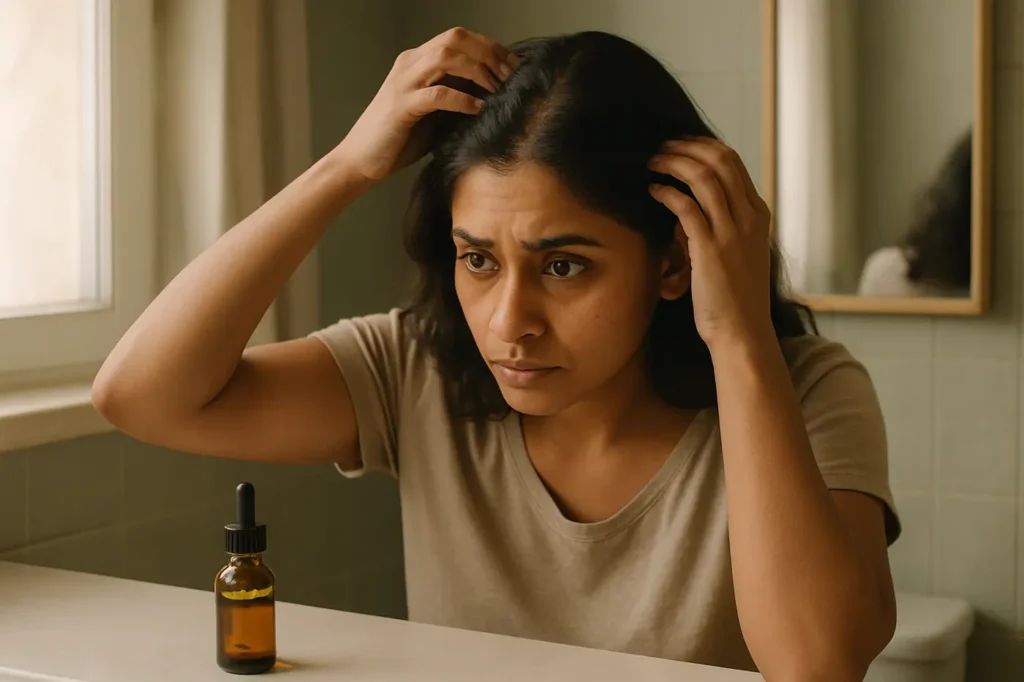
Among cosmetic options, the Best Hair Growth Serum for Women is not one universal bottle. The Best Hair Growth Serum for Women depends on whether the goal is mild shedding support, a lightweight hair growth serum for oily scalp, or a drug-based hair fall treatment for diagnosed female pattern hair loss. For cosmetic use, rosemary-led formulas have the clearest direct human evidence in this list. For diagnosed pattern thinning, minoxidil still has the strongest support.
Dermatologist reviewer: Dr. Neha Sharma, MD Dermatology.
How we selected products: Lotus Femcare shortlisted products sold in India that are positioned as a hair growth serum or scalp serum for women and that name at least one evidence-linked active discussed in this article, such as rosemary oil, caffeine, peptides, Redensyl, AnaGain, or minoxidil. Prices and Amazon ratings were checked on 1 August 2026 using the supplied product pages. Formulas were reviewed from public ingredient positioning and product-page disclosures. No hands-on laboratory testing was performed for this article, and no brand funded this article. Products were not supplied by manufacturers for review. “Best value” refers to lower cost over a realistic multi-month trial plus stronger ingredient logic. “Best budget” refers to the lowest entry price with at least one evidence-linked active. “Best evidence base” refers to the strongest support for the ingredient category discussed, not a direct head-to-head trial between all products listed.
Key takeaways
- Redensyl, Anagain, and multi-peptide complexes are heavily marketed for hair regrowth, but the evidence is uneven. A 2015 randomised trial of 100 patients found rosemary oil improved hair count comparably to 2% minoxidil after six months.
- Minoxidil is the only drug active in this article with the best evidence base for female pattern hair loss. A 2016 Cochrane review of interventions for female pattern hair loss found topical minoxidil had the strongest support among treatments studied.
- At a 1 ml daily dose, The Ordinary Multi-Peptide Serum for Hair Density at ₹1,350 for 60 ml costs ₹22.50 per day and ₹2,025 for a 90-day course. Soulflower Rosemary Redensyl at ₹599 for 50 ml costs ₹11.98 per day and ₹1,078.20 for a 90-day course.
- Postpartum hair fall is usually telogen effluvium. A 2019 review of telogen effluvium found postpartum telogen effluvium usually begins 2 to 4 months after childbirth, is self-limited, and commonly resolves within about 6 months. A serum may support scalp comfort, but it will not override that biology.
- A 2016 laboratory study of hair treated in hard water found calcium and magnesium deposition on the hair shaft and rougher cuticle changes, but I did not find evidence here proving that hard water raises scalp pH above 5.5 or directly reduces serum efficacy.
Do Hair Growth Serums Actually Work? What the Clinical Evidence Says
Hair growth serums can help only when follicles are still alive and capable of cycling back into growth. A 2015 randomised controlled trial of 100 patients found rosemary oil matched 2% minoxidil for hair count after 6 months. Serums cannot regrow hair on scarred scalp tissue or reverse advanced androgenetic alopecia without medical treatment.
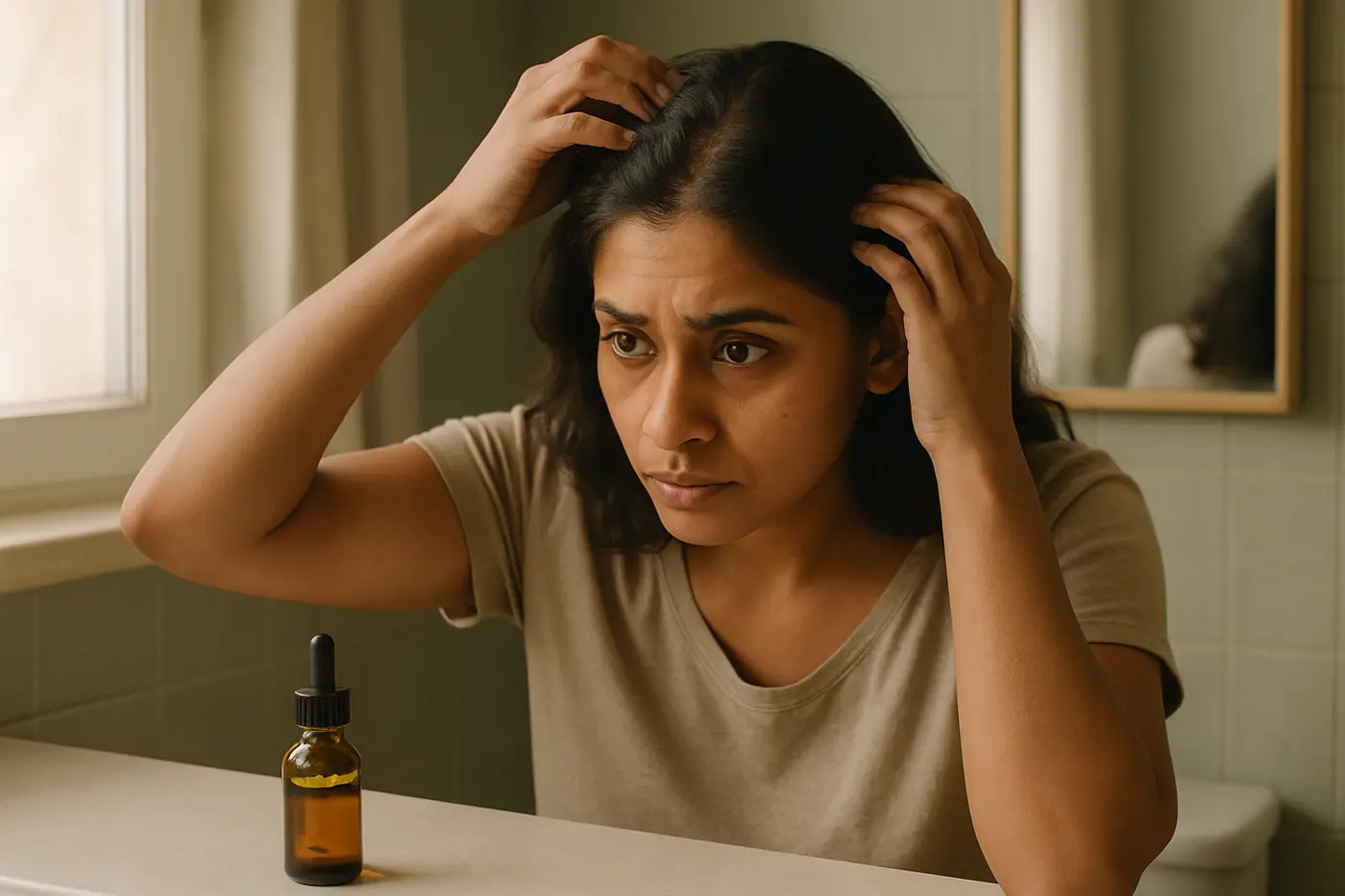
A scalp serum and a hair serum are not the same product. A scalp serum is designed to sit on the skin around the follicle opening and deliver actives such as rosemary oil, caffeine, peptides, or minoxidil to the scalp. A hair serum usually coats the hair shaft for shine, frizz control, or heat protection. If the bottle tells you to apply from mid-length to ends, it is not a hair fall treatment.
The strongest cosmetic-ingredient evidence in this category is for rosemary oil, not for the peptide-heavy blends that dominate Amazon and Nykaa. Panahi and colleagues’ 2015 randomised trial of 100 patients compared rosemary oil with minoxidil 2%, and both groups improved significantly from baseline with no significant difference between them at month six. Even so, that evidence comes from one trial, and clear independent replication did not surface in this search.
Minoxidil sits in a different evidence tier. A 2016 Cochrane review of female pattern hair loss interventions concluded that topical minoxidil is the only intervention with moderate-to-low quality evidence of efficacy, and that 2% twice daily is effective while 5% once daily may be similarly effective with easier adherence. Many cosmetic serums are marketed as if they belong in the same evidence category. They do not.
Redensyl is where most marketing gets ahead of the evidence. Givaudan’s Redensyl page markets the ingredient as a cosmetic active that targets hair follicle stem cells and dermal papilla fibroblasts, but in this search I did not find an independent peer-reviewed human study verifying the specific claim that DHQG reactivates outer root sheath stem cells in vivo. Redensyl also has manufacturer-reported clinical claims, but I did not find a peer-reviewed primary human trial in this search that verifies a specific percentage reduction in hair fall at 3% concentration.
What “clinically proven” actually means on a serum label
“In vitro” means the ingredient was tested in cells or isolated follicles in a lab. Fischer and colleagues’ 2007 caffeine study is an example. In that in vitro study of follicles from 14 men with androgenetic alopecia, caffeine penetrated the hair follicle and stimulated hair shaft elongation under laboratory conditions. That supports biologic plausibility. It is not proof that a caffeine serum will regrow your hair.
“In vivo” can mean testing on humans, but it does not automatically mean a rigorous clinical trial. Supplier dossiers for AnaGain and Redensyl often use this language for small, manufacturer-run studies without peer-reviewed publication. An RCT, or randomised controlled trial, is a higher bar because it compares groups under a defined protocol. Brand-funded studies are not useless, but they need independent replication before you treat their effect sizes as settled fact.
The follicle lifecycle: why timing matters
Hair follicles cycle through anagen, catagen, and telogen. Anagen is the growth phase. Catagen is the short transition phase. Telogen is the resting and shedding phase. A serum can only help if the follicle is still alive and capable of returning to anagen.
That is why timing matters so much. Serums can support follicles that are dormant, miniaturised, or cycling poorly. Serums cannot revive follicles destroyed by scarring alopecia such as lichen planopilaris or frontal fibrosing alopecia. And they cannot replace medical treatment when the main driver is androgenetic alopecia, iron deficiency, thyroid disease, or PCOS.
Key Ingredients in Hair Growth Serums: What the Science Actually Says
Look for Redensyl, Anagain, multi-peptides, rosemary oil, and caffeine if you want a cosmetic hair growth serum with at least some evidence-linked logic. But read the evidence in the right order. Rosemary oil has one randomised trial against 2% minoxidil. Minoxidil has the strongest overall evidence base. Redensyl, Procapil, Baicapil, Capilia Longa, and peptide blends are mostly supported by supplier material or ingredient-marketing language rather than independent peer-reviewed human trials.
Redensyl
Redensyl appears on dozens of Indian product pages because the mechanism sounds precise. You will see DHQG, which stands for dihydroquercetin-glucoside, and EGCG, which stands for epigallocatechin gallate, described as if their pathway is proven in living human scalps. But the honest wording is narrower: Redensyl is marketed by its manufacturer as a cosmetic active that targets hair follicle stem cells and dermal papilla fibroblasts, but in this search I did not find an independent peer-reviewed human study verifying the specific claim that DHQG reactivates outer root sheath stem cells in vivo.
You will also see a lot of concentration claims. Many Indian serums advertise 3% Redensyl. That may reflect common brand positioning, but Redensyl has manufacturer-reported clinical claims, and I did not find a peer-reviewed primary human trial in this search that verifies a specific percentage reduction in hair fall at 3% concentration. So if a brand says “clinically proven 3% Redensyl,” ask one question first: where is the independent human trial?
Anagain
Anagain is a pea sprout extract from Mibelle Biochemistry. It is sold as an ingredient that pushes follicles from resting phase into growth phase. In manufacturer testing cited by Mibelle Biochemistry, a gel containing 4% AnaGain applied for 3 months in 20 mainly female subjects increased the anagen-to-telogen ratio from 4.0 to 7.2, but this evidence comes from a supplier dossier rather than an independent peer-reviewed clinical trial.
Confidence should be lower than for minoxidil or even rosemary oil. If a serum contains 4% Anagain and nothing else with stronger support, treat it as a cosmetic experiment, not a proven hair regrowth treatment.
Rosemary Oil
Rosemary oil is the ingredient I would take most seriously among non-drug scalp-serum actives. Panahi and colleagues’ 2015 randomised controlled trial of 100 patients found rosemary oil matched 2% minoxidil for hair count after 6 months. The study randomised 50 patients to rosemary oil and 50 to minoxidil 2%, and both groups showed significant hair-count increases from baseline with no significant difference between groups at month six.
The other useful detail from that trial is tolerability. Scalp itching occurred more often in the minoxidil group than in the rosemary oil group. That does not mean rosemary oil is irritation-free. Essential oils can still trigger contact dermatitis, especially on sensitive scalps. But it does make rosemary oil more than a folklore ingredient. It has one proper comparative trial behind it.
Multi-Peptides
Multi-peptide serums usually rely on ingredients such as Biotinoyl Tripeptide-1 and Acetyl Tetrapeptide-3. These are often paired with niacinamide, caffeine, or botanical extracts. The marketing language usually says the peptides stimulate growth factors, strengthen anchoring proteins, or improve follicle health. I did not find an independent peer-reviewed human trial in this search proving that Biotinoyl tripeptide-1 and acetyl tetrapeptide-3 stimulate growth factors in a way that improves female hair loss outcomes.
The best way to think about peptide serums is supportive, not drug-like. A water-based best hair serum can still be pleasant to use every day, but pleasant use is not the same as proven hair regrowth.
Caffeine
Caffeine is plausible, but the evidence is early-stage. Fischer and colleagues’ 2007 in vitro study of scalp follicles from 14 men with androgenetic alopecia found that caffeine penetrated the hair follicle and stimulated hair shaft elongation under laboratory conditions. That was a mechanistic study, not a clinical efficacy trial in women.
So caffeine belongs in the “reasonable add-on” category. It has a biologic rationale. It does not have the kind of human outcome data that would justify choosing a hair growth serum based on caffeine alone.
Biotin
Biotin, or Vitamin B7, is one of the most overhyped hair ingredients in India. A 2017 review of the use of biotin for hair loss found that biotin deficiency causes hair loss, and that supplementation benefits people with confirmed deficiency or another underlying pathology, not healthy users by default. The review identified 18 reported cases of biotin use for hair and nail changes, and all patients had an underlying pathology for poor hair or nail growth.
This is why “biotin serum” is mostly a marketing term. Topical biotin has even less convincing evidence than oral correction of deficiency. If a product leads with biotin but does not name stronger actives, skip it unless you have a documented deficiency and your doctor has advised correction.
Minoxidil vs. cosmetic actives
Minoxidil is not in the same bucket as Redensyl, Anagain, Procapil, Baicapil, or Capilia Longa. A 2024 review of minoxidil describes the mechanism as proposed rather than fully settled, with effects thought to involve potassium-channel opening and prolongation of anagen. More importantly, a 2016 Cochrane review of female pattern hair loss interventions found topical minoxidil had the best evidence of efficacy in female pattern hair loss.
CDSCO drug data show approval of topical minoxidil products, but I did not find a clear primary CDSCO rule in this search proving that 2% is specifically OTC for women while higher strengths require prescription. So the safe, honest line is this: minoxidil is a drug active with CDSCO-documented approvals for topical products, and it is the evidence leader. Verify the exact current Indian labeling before purchase.
Minoxidil also comes with practical caveats. An initial increase in shedding can occur in the first weeks of topical minoxidil use and does not necessarily mean the treatment is failing. A 2023 therapeutic update on female-pattern hair loss noted that about 18% of patients using topical minoxidil experience transient increased shedding in the first weeks. The American Academy of Dermatology says women generally need 6 to 12 months of continuous use before judging response.
Procapil, Capilia Longa, and Baicapil
Procapil, Capilia Longa, and Baicapil appear on many Indian labels because proprietary blend names sell well. The problem is evidence access. Independent peer-reviewed human trials for supplier actives such as Redensyl, Procapil, Capilia Longa, and Baicapil are sparse compared with the volume of marketing claims. Most accessible evidence surfaced here was supplier or manufacturer material rather than independent replication, which limits confidence in effect sizes and mechanisms.
Saw palmetto often appears in the same conversation because some brands imply DHT blocking. A 2020 systematic review of saw palmetto in alopecia found small, heterogeneous evidence that is much weaker than the evidence for minoxidil. If a label says “DHT blocker” without naming finasteride or at least saw palmetto, treat it as empty copy.
Top 5 Hair Growth Serums for Women in India: Ranked and Compared
For Indian women comparing a cosmetic hair growth serum, the most defensible picks in this list are the formulas that pair reasonable ingredient logic with a price you can sustain for at least 3 months. Among cosmetic options, Soulflower offers the strongest value logic, The Ordinary has a polished lightweight format with mixed-evidence actives, and minoxidil remains the evidence leader when the diagnosis is female pattern hair loss rather than routine shedding.
Comparison table
| Product | Price | Volume | Price/ml | Cost per day at 1 ml | Cost for 90 days | Key actives + concentration | Evidence rating | Best scalp type | Hard-water compatibility |
|---|---|---|---|---|---|---|---|---|---|
| Mamaearth Rosemary Hair Growth Scalp Serum | ₹299 | 30 ml | ₹9.97 | ₹9.97 | ₹897.30 | Rosemary oil, glycerin base, niacinamide listed in formula context, no verified Redensyl claim disclosed here | One RCT supports rosemary oil, formula-specific evidence not identified | Oily to normal scalp | Yes, lightweight water-based |
| WishCare Hair Growth Serum | ₹679 | 30 ml | ₹22.63 | ₹22.63 | ₹2,036.70 | Rosemary-led positioning, Redensyl, some variants mention saw palmetto | Supplier studies plus rosemary-linked ingredient logic | Oily scalp, humid weather | Yes, lightweight leave-in |
| Soulflower Hair Growth Serum | ₹599 | 50 ml | ₹11.98 | ₹11.98 | ₹1,078.20 | Rosemary oil, Redensyl, caffeine, AnaGain | One RCT for rosemary, in vitro support for caffeine, supplier data for Redensyl and AnaGain | Dry to normal scalp, diffuse shedding | Yes, but clarify scalp regularly if hard water leaves residue |
| Dr. Reddy’s Mintop Pro Plus | ₹1,237 | 60 ml | ₹20.62 | depends on label dose | depends on label dose | Minoxidil-based drug formulation | Strongest evidence category because minoxidil leads the evidence base | Pattern thinning, androgenetic alopecia | Usually yes, but scalp irritation risk matters more |
| The Ordinary Multi-Peptide Serum for Hair Density | ₹1,350 | 60 ml | ₹22.50 | ₹22.50 | ₹2,025 | Biotinoyl Tripeptide-1, Acetyl Tetrapeptide-3, Redensyl, caffeine, peptide complex | Mixed formula with evidence-linked ingredients, but peptide claims lack independent human trials | Oily, combination, sensitive to heavy oils | Yes, very lightweight water-based |
The cost table matters because small bottles distort value. A ₹299 bottle can look cheap at checkout, but a 30 ml bottle used at about 1 ml daily may last only around 30 days. A ₹599 bottle in 50 ml format can work out cheaper over a full 90-day trial than some 30 ml bottles priced only a little lower.
I also need to say what this table cannot prove. Prices can change across retailers, and few brands disclose enough concentration data for every active to let you compare formulas cleanly. That makes category-level comparison messy, especially for any best hair serum list built from cosmetic labels rather than direct clinical trials.
1. Mamaearth Rosemary Hair Growth Scalp Serum, Best Budget Pick
Mamaearth is the low-risk entry point if your budget is tight and you want a lightweight hair growth serum rather than an oil. The case for it rests mostly on rosemary oil, because the 2015 Panahi randomised trial of 100 patients gives rosemary oil one piece of direct comparative human data. The limitation is simple: formula-specific clinical evidence was not identified in the supplied research.
Who it suits: oily scalp, early shedding, first-time users, and women who want a cheap leave-in before committing to a 3-month course.
Who should skip it: women with clear androgenetic alopecia, rapid widening part line, or anyone who wants the strongest evidence base.
Pros
- ₹299 is the lowest entry price in this list
- Lightweight texture suits oily scalp and summer use
- Rosemary oil gives it at least one evidence-linked reason to exist
Cons
- No minoxidil
- No verified formula-specific clinical trial
- Smaller bottle means you may spend more than expected over 90 days
2. WishCare Hair Growth Serum Concentrate, Best for Daily Shedding
WishCare is a sensible pick for women dealing with ongoing daily shedding who want a non-oily serum in Mumbai humidity or an office-friendly daytime routine. The strongest reason to consider it is rosemary oil, because the 2015 Panahi trial gives rosemary the clearest direct human support among cosmetic ingredients in this list. The Redensyl and AnaGain side of the pitch should be treated more cautiously because the most specific claims come from supplier material, not independent peer-reviewed human trials.
The texture matters in India. A fast-drying water-based hair growth serum is usually easier to keep using in monsoon weather than a thicker oil, and adherence often decides whether any best hair serum routine lasts past week four.
Pros
- Lightweight texture works well in humid climates
- Contains rosemary oil, the clearest evidence-linked cosmetic active in the list
- Broad review volume suggests substantial real-world use
Cons
- ₹679 for 30 ml is not cheap over a realistic 3-month trial
- Redensyl and AnaGain evidence is mostly supplier-led
- Marketing claims can sound stronger than the actual data
3. Soulflower Rosemary Redensyl Hair Growth Serum, Best Value Overall
Soulflower is the best value pick because it combines the most defensible cosmetic active here, rosemary oil, with caffeine and commonly used growth-serum actives, while keeping the 50 ml bottle at ₹599. That gives it a lower rupee-per-ml cost than most rivals. The formula logic is better than many “biotin serum” products because caffeine has mechanistic support from a 2007 in vitro study and rosemary has an RCT.
This is also one of the easier formulas to recommend to women dealing with diffuse shedding rather than obvious pattern baldness. In cities where hard water often leaves the scalp and hair feeling coated, a lightweight leave-in can be easier to tolerate than a thicker oil.
Pros
- Good price-to-volume ratio
- Rosemary oil plus caffeine is a stronger evidence mix than most cosmetic serums
- 50 ml bottle lowers cost per 90-day course
Cons
- Review count is lower than category giants
- Redensyl and AnaGain claims remain less certain than the label suggests
- Multi-active formulas can irritate sensitive scalps
4. Dr. Reddy’s Mintop Pro Plus, Best for Androgenetic Alopecia
Dr. Reddy’s Mintop Pro Plus belongs in a different lane from the cosmetic serums above. This is the option to consider when the pattern looks like androgenetic alopecia, meaning a widening part, reduced density over the crown, or a family history of female pattern hair loss. The 2016 Cochrane review and American Academy of Dermatology guidance place minoxidil above cosmetic actives for evidence strength.
But do not buy Mintop because an influencer called it the best hair serum. Buy it only if the diagnosis makes sense. AAD patient guidance says women with suspected pattern hair loss should see a dermatologist because several causes of hair loss can look similar and require different treatment.
Pros
- Best-supported active in the entire category
- Appropriate for true pattern thinning
- Drug-level treatment logic, not cosmetic-only logic
Cons
- Not a casual beauty purchase
- Can irritate the scalp and may cause transient early shedding
- Wrong diagnosis means wasted money and delayed treatment
5. The Ordinary Multi-Peptide Serum for Hair Density, Best Premium Cosmetic Pick
The Ordinary gets the premium cosmetic label here not because every peptide in it is proven, but because the formula combines several evidence-linked ideas in one clean, water-based serum. It includes Biotinoyl Tripeptide-1, Acetyl Tetrapeptide-3, Redensyl, and caffeine. The peptide claims themselves are weakly supported, but caffeine has mechanistic support, and the overall formula is easy to use daily.
The biggest downside is cost. At ₹1,350 for 60 ml, you pay ₹22.50 per ml and ₹2,025 for a 90-day course at 1 ml daily. That is nearly double the 90-day cost of Soulflower. So this is the best hair serum for women who want elegant texture and are willing to pay for it, not for women trying to stretch every rupee.
Pros
- Lightweight and easy to use on oily scalp
- Strong formula composition by category standards
- Large review footprint gives more real-world signal than niche brands
Cons
- Expensive over a 3-month trial
- Peptide claims are not independently proven in women
- Premium pricing can make long-term adherence harder
We may earn a commission from purchases made through these links, at no extra cost to you. Products are chosen on evidence and value, never on commission.

WishCare Hair Growth Serum
This formula stands out mainly because it includes rosemary oil, the best-supported cosmetic ingredient in the provided evidence, plus Redensyl. That does not make the Redensyl claims proven, but rosemary gives it a more evidence-linked reason to consider it than many peptide-heavy rivals.
- Contains rosemary oil, which has the clearest human trial support among cosmetic ingredients listed
- 4.2 rating with 11900 reviews suggests broad real-world usage
- ₹679 is mid-range rather than premium for a 30ml growth serum
- Relies partly on Redensyl, whose specific growth claims are not independently well verified in the supplied evidence
- 30ml bottle can get expensive if used consistently for several months
- Headline claims like dramatic new growth and hairfall reduction overstate what the evidence can support

Soulflower Hair Growth Serum
Among the cosmetic serums here, this one combines rosemary oil with caffeine, which has laboratory evidence for follicle effects though not strong clinical trial proof for women. It also includes Redensyl and AnaGain, but those claims should be treated more cautiously than the marketing suggests.
- Includes rosemary oil, the best-supported cosmetic active in the evidence provided
- Includes caffeine, which has plausible follicle-level biologic activity
- ₹599 is reasonable for a 30ml leave-in serum
- Much of the rest of the formula leans on actives with manufacturer-led rather than strong independent human evidence
- Multi-ingredient formulas make it hard to know what is actually helping or irritating
- 30ml size still means repeat purchases for a realistic 3 to 6 month trial
How Long Does a Hair Growth Serum Take to Work? Realistic Timelines
Most cosmetic hair growth serum routines need at least 12 to 16 weeks before they are worth judging, and rosemary data extend to 6 months. The 2015 rosemary trial used a 6-month endpoint, while the American Academy of Dermatology says minoxidil often needs 6 to 12 months in women.
What daily use actually feels like
Water-based serums usually dry cleaner than oil-led formulas, but some leave a slight tacky film for 5 to 15 minutes, especially if you overapply. Rosemary formulas can smell strongly herbal at first, and the scent may linger on the pillow if you use more than the label amount. Minoxidil solutions can leave stiffness, dryness, or scalp sting, and some users notice transfer to pillowcases before the product fully dries. In weeks 1 to 4, the most common failure is not lack of efficacy. It is using too much, applying to hair instead of scalp, skipping wash days because of residue, then quitting before the timeline is long enough to judge.
- Weeks 0 to 4
You may notice less itch, less heaviness, or a cleaner-feeling scalp if the formula suits you. But you should not expect visible density change in this window. If a brand promises hair regrowth in 7 days, ignore it. Hair biology does not move that fast. - Around week 8
This is the earliest point where a useful change may show up as fewer hairs on your pillow, comb, or shower drain. Redensyl claims are mostly manufacturer-reported, so take exact percentages lightly, but this is the timeframe many brands cite for reduced shedding. - Weeks 12 to 16
This is the first fair judging point for a cosmetic hair serum. Look for baby hairs along the hairline, a slightly tighter parting, or less scalp show-through in photos. If nothing has changed after 16 weeks of proper daily use, stop guessing and see a dermatologist. - Around week 24
The 2015 Panahi randomised trial of 100 patients found rosemary oil matched 2% minoxidil for hair count after 6 months. That is also a reminder that the strongest cosmetic ingredient in this category still needed half a year in a proper study. - Track progress properly
Take one photo a week, same parting, same room, same lighting, same distance. Keep a simple shed-count log for wash days and non-wash days. Without that, you will rely on memory, and memory is terrible at tracking gradual change.
How to Apply a Hair Growth Serum Correctly: A Step-by-Step Protocol
Daily application is standard for cosmetic hair growth serum formulas containing Redensyl, peptides, or rosemary oil. Clinical-style routines apply these actives once daily to a clean scalp and leave them on. Skipping days weakens the cumulative effect, which is why a basic scalp care routine that keeps buildup under control and supports healthy follicles makes any hair growth serum easier to use consistently.
- Clean the scalp first
Use a gentle shampoo if your scalp is normal to dry. Use a clarifying or chelating shampoo weekly if hard water leaves your hair rough or coated. A 2016 laboratory study of hair treated in hard water showed calcium and magnesium deposition on the hair shaft and rougher cuticle changes, which is why choosing a shampoo that suits hair fall concerns and helps keep the scalp clean without overstripping can make a serum routine easier to tolerate. - Towel-dry to damp
Do not apply to soaking wet hair. Water dilutes the serum and makes it run down the hair shaft instead of sitting on the scalp. Do not wait until the scalp is sweaty or dirty again either. - Section the hair
Make 4 to 6 partings through thinning zones. Apply about 1 ml total, usually 6 to 8 drops depending on the dropper. Put the product on scalp skin, not on hair lengths. - Massage for 2 minutes
Use fingertips, not nails. The goal is to spread the serum and improve contact, not to scrub the scalp raw. - Leave it in
Leave-in use is required for the cosmetic serums in this list. Do not rinse them out after 20 minutes and then say they did nothing. Follow the label for Mintop and other minoxidil products exactly. - Use at night if possible
Night application is practical because the serum gets uninterrupted contact time and your scalp is less exposed to sweat, sun, and styling products. - Avoid the common mistakes
Do not apply to hair lengths. Do not use it on a dirty scalp loaded with dry shampoo, sweat, and sebum. And do not quit after two weeks because the part line looks the same.

Be Bodywise Rosemary Hair Growth Serum
This serum includes rosemary plus Redensyl and AnaGain in a roll-on format that may help targeted application along the part line. The evidence fit comes mainly from rosemary; the Redensyl and AnaGain claims remain less certain based on the supplied research summary.
- Rosemary gives it a clearer evidence link than many cosmetic growth serums
- Roll-on format can make targeted scalp application easier
- 4.4 rating with 2700 reviews is solid for a newer-style serum
- 25ml is small for a product that needs consistent long-term use
- Roll-on packaging can be slower for full-scalp coverage
- Depends partly on Redensyl and AnaGain, where independent clinical support is limited
Using Hair Growth Serums in India: Hard Water, Monsoon Humidity and City-Specific Guidance
Hard water and humidity do not change follicle biology in a simple way, but they do change whether a hair growth serum feels tolerable enough to use every day. A 2016 laboratory study supports mineral deposition on the hair shaft in hard water, while humid weather mainly affects residue, greasiness, and adherence.
The Lotus City-Scalp Matrix
| City | Typical scalp challenge | Best serum texture | Application frequency | Ingredients to prefer | Ingredients to avoid |
|---|---|---|---|---|---|
| Delhi / NCR | Hard water residue, dry winters, dust, frequent rough hair feel | Lightweight water-based serum | Daily, with weekly clarifying wash | Rosemary oil, caffeine, niacinamide, peptide serums | Heavy oils if scalp gets coated fast |
| Mumbai | Monsoon humidity, excess sebum, sweat, buildup | Gel or water-based serum | Daily in mild weather, alternate days if scalp feels greasy in peak monsoon | The Ordinary type textures, WishCare-style lightweight serums | Thick oil serums, sticky leave-ins |
| Chennai | Heat, sweat, hard water in many areas, scalp stickiness | Fast-drying non-comedogenic serum | Night use only | Water-light serums, rosemary-led formulas | Occlusive oils, strongly fragranced blends |
| Bengaluru | Moderate climate, fewer extreme seasonal shifts | Standard serum textures | Daily | Most lightweight leave-ins | Very heavy oil-based leave-ins if scalp is oily |
For Delhi and Chennai, the key issue is usually not that hard water is causing baldness. The 2016 hard-water hair study supports shaft deposition and roughness, not a proven scalp-driven hair-loss mechanism. So the practical move is to keep the scalp cleaner and the leave-in lighter.
For Mumbai, adherence is the whole game. In June to September, a thick oil-based serum can feel so greasy that you stop using it. That makes a lighter water-based hair growth serum the better hair fall treatment even if the ingredient list looks less romantic.
For Bengaluru, standard protocol usually works. You still need daily use. But you are less likely to need city-specific hacks unless your apartment water is very hard.
How to test water hardness at home
A TDS meter from Amazon.in usually costs around ₹300 to ₹500. It measures total dissolved solids in water. That is useful for household awareness, but it is not a validated scalp-disease diagnostic tool.
About apple cider vinegar rinses
I need to be blunt here because this advice is everywhere. I did not find a dermatology or trichology study in this search showing that apple cider vinegar rinses safely remove hard-water mineral deposits from the scalp or improve hair-growth-serum performance. If hard water leaves hair feeling rough, clarify that evidence supports mineral deposition on the hair shaft, not proven improvement in hair growth from ACV rinses.
When a Hair Growth Serum Will Not Help: Postpartum, PCOS and Scarring Alopecia
Postpartum telogen effluvium, androgen-driven thinning in PCOS, and scarring alopecia need different thinking from routine cosmetic shedding. A 2019 review of telogen effluvium found postpartum shedding usually begins 2 to 4 months after childbirth and commonly resolves within about 6 months, which is why the normal timeline and recovery pattern of postpartum hair fall matters more than choosing the best hair serum alone.
A 2015 review of telogen effluvium notes that normal shedding is often described as roughly 50 to 100 hairs per day, but no single daily count diagnoses the cause by itself. AAD patient guidance says women with suspected pattern hair loss should see a dermatologist because several causes of hair loss can look similar and require different treatment.
Postpartum hair fall: what the timeline actually looks like
Postpartum telogen effluvium is common, but not universal. A 2019 review of telogen effluvium states that postpartum telogen effluvium usually begins 2 to 4 months after childbirth and is self-limited. That is the evidence-based wording. It is more accurate than the neat but overconfident line that it always peaks at 3 to 4 months and resolves by 12 months.
A serum may still have a place here, but only as support. If your scalp feels dry, itchy, or neglected, a lightweight serum can make the routine easier and may reduce cosmetic breakage or discomfort. But it will not accelerate the underlying reset of the hair cycle in a proven way.
Nutrition still matters in postpartum recovery and diffuse shedding. If ferritin, protein intake, or overall diet are part of the picture, nutrition and protein-rich foods that support hair growth alongside topical treatment can matter more than switching between one hair growth serum and another.
PCOS and androgenic hair loss: treat the cause first
PCOS, or polycystic ovary syndrome, can drive hair thinning through androgen excess and progressive follicle miniaturisation. That is closer to androgenetic alopecia than to simple seasonal shedding. If you have irregular periods, acne, hirsutism, rapid onset thinning, or a widening central part, do not spend six months cycling through cosmetic serums first.
Get evaluated. Ask about CBC, ferritin, thyroid-stimulating hormone or TSH, DHEAS, and free testosterone. A 2022 meta-analysis of 36 studies with 10,029 participants found that women with nonscarring alopecia had lower ferritin values than controls by a mean difference of 18.51 ng/dL. A 2024 systematic review and meta-analysis on vitamin D in alopecias found that low vitamin D levels are associated with several alopecia types, including female pattern hair loss and telogen effluvium, but the evidence is largely observational and does not prove that supplementation alone will reverse hair thinning.
Hormonal treatment may involve metformin, spironolactone, or oral contraceptive pills depending on your diagnosis and plans for pregnancy. A topical serum can be added later as adjunct care. It should not be your first move if the driver is endocrine.
Scarring alopecia and inflammatory scalp disease
Patchy hair loss, scalp pain, burning, pustules, thick scale, or shiny scar-like areas need medical evaluation fast. Lichen planopilaris and frontal fibrosing alopecia can cause permanent loss if treatment is delayed. No cosmetic hair regrowth serum can fix destroyed follicles.
Safety and When to See a Doctor
Pregnancy, persistent shedding, scalp symptoms, and signs of androgen excess are all reasons to stop treating a hair growth serum like a harmless beauty extra and treat hair loss as a medical problem. The American Academy of Dermatology and AAD patient guidance both make that distinction clear.
Pregnancy, trying to conceive, or breastfeeding changes the risk calculation. The American Academy of Dermatology states that women who are pregnant, planning pregnancy, or breastfeeding should avoid minoxidil unless specifically advised by a physician.
Persistent diffuse shedding beyond about 6 months, or shedding with visible thinning, needs workup. A 2015 review of telogen effluvium notes that chronic telogen effluvium, female pattern hair loss, iron deficiency, thyroid disease, and other causes can look similar in the mirror but need different treatment.
Patchy hair loss, scalp pain, burning, pustules, heavy scale, or signs of scarring are not wait-and-watch problems. Stop self-treating and see a dermatologist promptly because inflammatory scalp disease and scarring alopecias can cause permanent loss if treatment is delayed. If what to do when scalp flaking, itch, or dandruff is part of the hair fall picture is the main question, start there rather than layering a serum onto an inflamed scalp.
New facial hair growth, severe scalp irritation, or worsening shedding after starting minoxidil can happen. A 2023 review on female-pattern hair loss noted transient early shedding in about 18% of topical minoxidil users, but if the reaction is troublesome or persistent, stop and get reviewed.
Hair loss with irregular periods, acne, hirsutism, rapid onset, or other signs of androgen excess needs medical evaluation for PCOS or endocrine disease. A serum alone will not address the underlying driver.
Myths That Need to Die
Hair growth serum marketing is full of claims that sound scientific but outrun the evidence. The easiest way to judge them is to ask whether the claim comes from an independent human trial, a supplier brochure, or a vague before-and-after ad.
Myth: Redensyl gives hair-transplant-equivalent results in 3 months
This appears in manufacturer-style marketing, but no independent peer-reviewed human trial was identified here to support a transplant-equivalent claim. Say instead: Redensyl is a cosmetic active with manufacturer-reported hair-growth data, but independent clinical replication is limited and it should not be described as equivalent to hair transplantation.
Myth: Apple cider vinegar rinse removes hard-water buildup from the scalp and boosts serum absorption
No dermatology or trichology study was found here testing apple cider vinegar rinses for mineral removal from scalp or improved serum efficacy. Say instead: evidence supports mineral deposition on the hair shaft, not proven improvement in hair growth from ACV rinses.
Myth: Peptide serums with Biotinoyl Tripeptide-1 and Acetyl Tetrapeptide-3 are clinically proven to regrow hair in women
No independent peer-reviewed human trial was identified in this search proving clinically meaningful regrowth from these peptides alone in women. Say instead: these peptides are used in cosmetic formulations, but independent clinical evidence for meaningful hair regrowth is limited.
Myth: Hard water causes hair fall by raising scalp pH above 5.5
The studies found support mineral deposition on hair shafts, not a validated scalp-pH mechanism causing shedding. Say instead: hard water may worsen hair feel and breakage through mineral deposition on the hair shaft, but evidence that it directly causes scalp-driven hair loss is limited.
Myth: Biotin supplements help most women with hair fall
A 2017 review of biotin for hair loss found limited evidence for benefit outside confirmed deficiency or specific underlying pathology. Say instead: biotin supplementation is most defensible when deficiency or a relevant underlying condition is documented. Routine use for otherwise healthy women is not well supported.
Buying Guide: How to Choose the Right Hair Growth Serum for Your Scalp Type and Budget
The right hair growth serum depends on three things: scalp type, likely cause of hair loss, and whether you can actually afford a 3-month course. Oily scalp usually does better with lightweight water-based serums such as WishCare or The Ordinary. Dry scalp can tolerate Soulflower or Mamaearth more easily. If the pattern looks medical rather than cosmetic, skip the serum hunt and get diagnosed first.
- If your scalp is oily
Pick a lightweight water-based serum. WishCare and The Ordinary make more sense than thick oil-led formulas. In Mumbai humidity, these are easier to stick with. - If your scalp is dry or mildly flaky
Look for glycerin, humectant bases, or a formula that does not evaporate too fast. Soulflower and Mamaearth are usually more comfortable here than a very stripped-down liquid. - If your scalp is sensitive
Patch test first. Apply a small amount on the inner arm or behind the ear for 48 hours before scalp use. Avoid strong fragrance, menthol-heavy formulas, and complex multi-active blends if you react easily. - If your budget is under ₹400
Mamaearth at ₹299 is the obvious starting point. Keep expectations modest and commit to at least 12 weeks. - If your budget is ₹400 to ₹700
WishCare and Soulflower are the strongest value zone. Soulflower usually wins on price per ml. WishCare wins on lightweight texture. - If your budget is ₹700 to ₹1,500
The Ordinary is the premium cosmetic pick. Dr. Reddy’s Mintop Pro Plus belongs here too, but only if you likely have androgenetic alopecia and are using it with dermatologist guidance. - If the label says “DHT blocker”
Check whether it actually contains a named antiandrogenic ingredient such as saw palmetto. A 2020 systematic review of saw palmetto in alopecia found limited and heterogeneous evidence that is much weaker than the evidence for minoxidil. - If the label says “activates roots”
Ask which active ingredient does that, and whether the claim comes from a peer-reviewed human trial or a supplier brochure. - If the label says “results in 7 days”
Ignore it. That claim is physiologically impossible for visible hair density change.
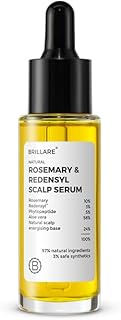
Brillare 10% Rosemary & 3% Redensyl Hair Growth Serum
This product is notable because the title puts rosemary at the center rather than relying only on cosmetic peptide complexes. That makes it easier to justify in an evidence-led article, although the 3% Redensyl portion still carries the same evidence limitations as similar serums.
- Rosemary is the strongest evidence-linked cosmetic ingredient in the candidate set
- Simple positioning makes the formula logic easier to understand than some crowded blends
- 4.9 rating is unusually high
- ₹845 for 30ml is expensive versus several similar options
- Only 605 reviews, so the rating is based on a smaller sample than category leaders
- Still includes Redensyl, whose specific efficacy claims are not independently well established here
90-Day Reader Case Study: Postpartum Hair Fall in Delhi (Hard Water)
Reader-reported anecdote: A 31-year-old Lotus Femcare reader in Delhi, four months postpartum, started with daily shedding estimated at 180 to 200 hairs and tap water measured at 480 mg/L TDS on a home meter. She used Soulflower Hair Growth Serum at ₹599 with a nightly 1 ml application. Over 12 weeks, shedding dropped and the hairline looked fuller in photos. Major confounders matter here: postpartum telogen effluvium often improves on its own, and iron treatment was added later, so the serum’s exact contribution cannot be separated cleanly from natural recovery and ferritin correction.
At week 0, the scalp photo showed a widened central part and visible scalp flash under overhead bathroom lighting. The reader described itch after wash days and rough-feeling hair from local water. Baseline ferritin was 14 ng/mL. A 2022 meta-analysis of 36 studies with 10,029 participants found lower ferritin values in women with nonscarring alopecia than in controls, but it did not establish one universal ferritin cutoff for every patient.
The protocol was simple. Chelating shampoo twice weekly. No oiling. Nightly application of about 1 ml of Soulflower to the central part, temples, and crown. Shed count was tracked by collecting loose hairs from the shower drain and pillow each day, then averaging the count over one week at a time. The serum felt light and slightly damp for a few minutes, with a noticeable herbal rosemary smell but no strong sting. The reader also tried an apple cider vinegar rinse early in the routine, but I need to say clearly that I did not find direct clinical evidence showing ACV improves serum performance.
At week 4, the average daily shed count in the reader log was lower than baseline, and the scalp felt less itchy. Combing felt less alarming, though the part line still looked similar in photos. That kind of change can feel emotionally huge while still looking modest on camera.
At week 6, iron supplementation was added after the ferritin result. That complicates attribution, but it also reflects real life. Hair loss often has more than one driver, and a serum alone is rarely the whole answer.
At week 8, the reader noted short new hairs along the frontal hairline and fewer long strands on the pillow. Because postpartum telogen effluvium is commonly self-limited according to a 2019 review, this timing could reflect normal recovery, serum support, improved scalp care, iron correction, or all three.
At week 12, the central part looked tighter in the same bathroom-lighting photos. The improvement was visible, but not dramatic enough to call a transformation. The pattern looked like ordinary life rather than a polished ad.
Frequently Asked Questions
Does hair growth serum really work?
A hair growth serum can help only if follicles are still alive and capable of cycling back into growth. A 2015 randomised trial of 100 patients found rosemary oil matched 2% minoxidil for hair count after 6 months, but that is one small comparative trial. For diagnosed female pattern hair loss, the 2016 Cochrane review and the American Academy of Dermatology place minoxidil in the strongest evidence tier. Redensyl, peptides, and similar cosmetic actives are lower-confidence options.
Which hair growth serum is best for hair fall in India?
There is no single best hair growth serum for women in every situation. For cosmetic use, Soulflower and WishCare make sense because they include rosemary oil, which has the clearest direct human trial support in this list. For diagnosed female pattern hair loss, minoxidil-based treatment has the strongest evidence. The right choice depends on the cause, scalp tolerance, and whether you can keep using the product for months.
Can I use a hair growth serum every day?
Yes. Daily use is standard for most cosmetic scalp serums containing rosemary oil, Redensyl, AnaGain, peptides, or caffeine. Apply to a clean scalp and leave it on. Skipping days usually means weaker results because the routine loses consistency.
How long does it take to see results from a hair growth serum?
Expect at least 12 to 16 weeks before judging a cosmetic hair growth serum. The 2015 rosemary trial used a 6-month endpoint, and American Academy of Dermatology guidance says minoxidil often needs 6 to 12 months before response can be judged properly.
Which is India’s No. 1 serum for hair growth?
There is no single honest answer. Cosmetic serums do not have direct comparative trials proving one national winner. A best hair serum list can rank products by price, texture, ingredient logic, and evidence tier, but that is not the same as proving one bottle is No. 1 for every woman.
Is minoxidil serum safe for women in India?
Minoxidil is the best-supported topical option for female pattern hair loss, but safety depends on diagnosis, formulation, and life stage. The American Academy of Dermatology says women who are pregnant, planning pregnancy, or breastfeeding should avoid minoxidil unless specifically advised by a physician.
Can I use a hair growth serum if I have an oily scalp?
Yes, but choose a water-based or gel-textured hair growth serum. WishCare and The Ordinary are easier to tolerate than thick oil-led formulas. Apply only to the scalp, not the lengths.
Should I use a hair growth serum for postpartum hair fall?
Postpartum hair fall is usually telogen effluvium and often improves on its own. A 2019 review of telogen effluvium found that postpartum shedding commonly begins 2 to 4 months after childbirth and is usually self-limited. A serum may support scalp comfort and routine consistency, but it will not override the normal recovery timeline.
Which hair growth serum is the best?
The best hair growth serum for women depends on the cause. Soulflower is a strong value cosmetic pick. The Ordinary is a premium cosmetic pick with a light texture. Minoxidil is the best-supported active if the problem is female pattern hair loss rather than general shedding.
Can hair serum regrow hair?
A scalp-targeted hair growth serum can help regrow hair only if follicles are still alive and capable of returning to growth phase. It cannot regrow hair on scarred scalp tissue or revive follicles destroyed by scarring alopecia.
What is the best product to regrow women’s hair?
For proven female pattern hair loss, the 2016 Cochrane review and American Academy of Dermatology guidance support topical minoxidil as the best-studied option. For cosmetic non-drug options, rosemary-based serums have the clearest direct human trial support, but the evidence is much thinner than for minoxidil.
Is hair growth serum safe for women?
Most cosmetic serums are safe for many women if patch-tested first, but safety depends on the ingredient, your scalp, and your life stage. Essential oils can irritate. Minoxidil needs more caution. Any sudden, patchy, painful, or scarring hair loss needs a doctor, not another bottle.